
360 Feedback Examples: 122 Comments for Peers, Managers and Employees
Good 360 feedback examples describe one thing the person did, when they did it, and what it led to. That’s the SBI model: Situation, Behavior, Impact. For instance: “In last week’s client call, you summarized the three open issues before we hung up, so everyone left knowing who owned what.” Below are 122 copy-ready comments for peers, managers, direct reports and self-reviews, sorted by skill and by tone, plus before-and-after rewrites.
Key takeaways
- The best 360 comments are specific: one situation, one behavior, one impact. “Great communicator” tells the person nothing they can repeat.
- Give one or two strengths and one area to improve per person. That’s usually enough for them to act on, and it keeps the feedback fair.
- Write about behavior, not personality. “Interrupts in meetings” can change. “Is arrogant” can’t, and it tends to make people defensive.
- Match the tone to the person and the culture. A gentle and a direct version of the same comment can both work. Pick the one they’ll actually hear.
- Keep it anonymous-safe: leave out details only you would know, like a private meeting or a one-off project, if your 360 is anonymous.
Here’s the problem with most “360 feedback examples” pages: they actually give you questions to ask, not feedback to write. And when you’re sitting in front of a rater survey with a blank comment box, a list of questions doesn’t really help. You need words.
So this guide is a phrase library. Every comment below is written to be copied and then edited, so that it fits the real person and the real situation. You can browse by who you’re giving feedback to, by skill, or by tone. And if you’re the one setting up the 360, our guide to 360 feedback questions covers the questions side.
What good 360 feedback looks like
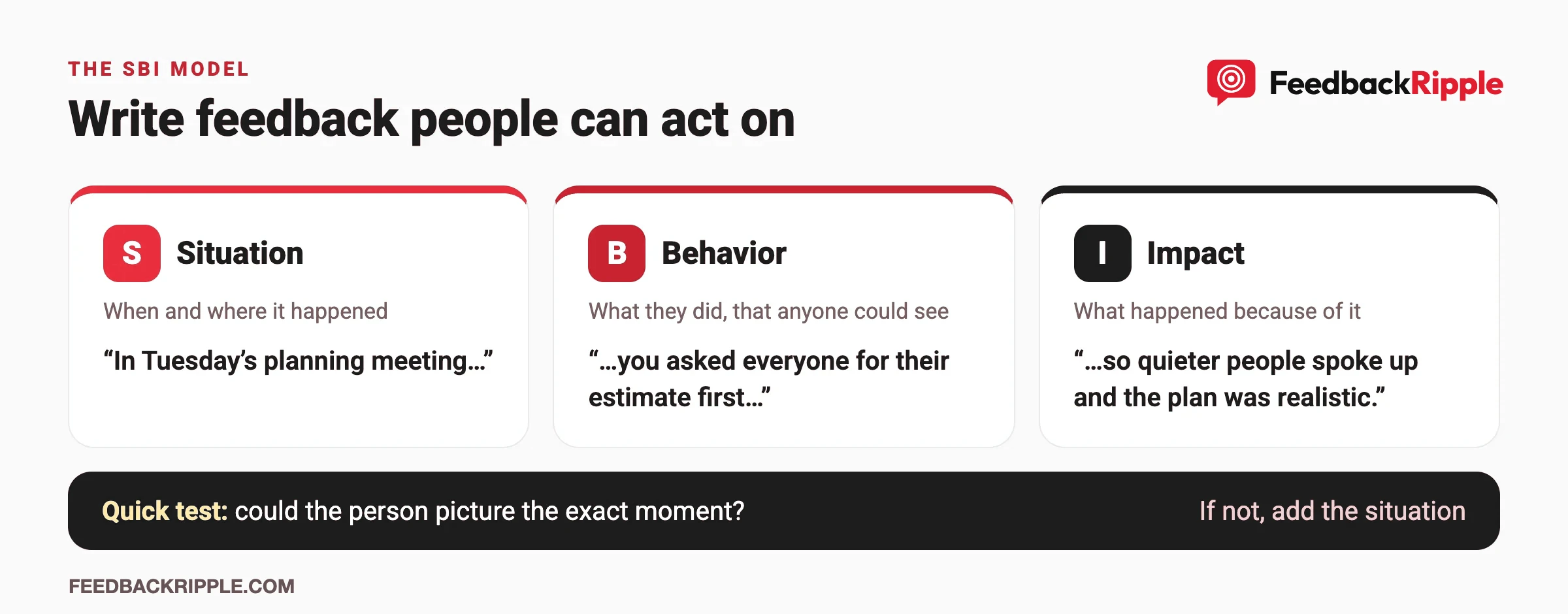
A good feedback message is one the person can actually use. In practice, the easiest way to get there is the SBI model, which a lot of coaches and HR teams use:
- Situation: when and where it happened. “In Tuesday’s planning meeting…”
- Behavior: what the person did or said, the part anyone could have seen. “…you asked each person for their estimate before giving yours…”
- Impact: what happened because of it. “…so the quieter people on the team actually spoke up, and the plan was more realistic.”
You don’t have to use all three parts every time, given that a 360 comment box is usually short. But if a comment has no behavior in it, it’s probably not useful yet. Here are three examples of the same idea written well:
- “In the Q3 handover, you wrote up every open ticket with next steps, so the new team started without a single ‘where is this?’ message.”
- “When the launch date moved, you told the client the same day and gave them two options, which kept their trust even though the news was bad.”
- “In our 1:1s, you usually ask what’s getting in my way before you ask for updates. That makes it genuinely easier to raise problems early.”
FeedbackRipple · First 3 people free
Help raters write comments like these
FeedbackRipple gives raters gentle prompts while they write, so that comments come out specific and kind instead of vague. Your first 3 people are free, no credit card.
360 feedback examples for peers
Peers usually see how someone collaborates day to day: how they share work, handle disagreement and support the team. So peer comments tend to be most useful when they focus on working together.
Positive peer feedback examples
- “You always share credit in team updates. When the migration went well, you named the three people who did the heavy lifting.”
- “When I was stuck on the reporting bug, you dropped what you were doing for 20 minutes to pair with me. That saved me a day.”
- “You give honest input in design reviews, even when it’s uncomfortable, and you always explain why.”
- “You reply to cross-team requests quickly, which really helps given that our work depends on yours.”
- “In retros, you’re usually the first to admit what didn’t go well, and that makes it safer for the rest of us to do the same.”
- “Your documentation is clear enough that I can pick up your work without asking you questions.”
- “You stay calm when deadlines get tight, and it genuinely lowers the stress for everyone around you.”
- “You make new team members feel welcome. You set up a coffee chat with each new hire in their first week.”
Constructive peer feedback examples
- “In planning meetings, you sometimes commit our team to dates before checking with us. Could you check in first so that the dates are realistic?”
- “Your updates in the project channel are often very long. A two-line summary at the top would help me find what I need faster.”
- “When we disagree, you tend to move the discussion to private messages. I’d find it easier to resolve things in the meeting itself.”
- “A few handoffs this quarter arrived without context, like the vendor contract. A short note on what’s done and what’s left would really help.”
- “You’re great at spotting problems. It would help even more if you suggested a possible fix when you raise one.”
- “In design reviews, you sometimes interrupt before people finish their point. Letting them finish would make the discussion more productive.”
- “I’d love to hear more of your ideas in team meetings. You often share great points with me afterwards that the whole team would benefit from.”
- “Some requests from your side come in late on Friday for Monday. More notice would help us plan our week.”
360 feedback examples for your manager
Giving feedback upward can feel risky, and that’s exactly why 360s keep it anonymous. So here are examples of good feedback to give your manager, written to be honest without being harsh. If you’re setting up this kind of survey, our page on upward feedback explains how to keep it safe.
Positive feedback for your manager
- “You make priorities clear. When everything feels urgent, you tell us what matters most this week, and that really helps me focus.”
- “You explain the reason behind decisions, even the ones we don’t like, so I can explain them to my own stakeholders.”
- “You back the team in front of senior leaders. When the release slipped, you took responsibility instead of naming people.”
- “Your feedback is specific and timely. You usually tell me within a day what worked and what to change.”
- “You protect our focus time. Since you moved status updates to a written check-in, I get two more hours of deep work a week.”
- “You actually follow up on what we raise in 1:1s, which shows me you take it seriously.”
- “You’ve been really supportive of my development. You found me a stretch project that matched what I said I wanted to learn.”
- “You admit when you don’t know something and ask the team, which makes it easier for all of us to do the same.”
Constructive feedback for your manager
- “Priorities sometimes change mid-week without a reason. A quick note on why would help me re-plan without losing momentum.”
- “Our 1:1s get canceled fairly often. Even a 15-minute version would help me get decisions I’m waiting on.”
- “Feedback on my work usually comes at review time. I’d find it more useful closer to the moment, while I can still act on it.”
- “In team meetings, decisions sometimes feel made before the discussion starts. If there’s room for input, saying so would help.”
- “You take on a lot of the hard tasks yourself. I think the team could handle more of them, and we’d learn a lot from it.”
- “Recognition tends to go to the most visible work. The people doing quieter, behind-the-scenes work would really value a mention too.”
- “When you’re under pressure, your messages get very short, and it’s hard to tell if something is urgent. Adding a priority would help.”
- “I’d like more context on how my work connects to the department’s goals, so that I can make better trade-offs on my own.”
360 feedback examples for direct reports
If you’re a manager rating someone on your team as part of their 360, you typically see the bigger picture: results, judgment and growth over time. These comments work for individual contributors at most levels. Have a look at our page on 360 reviews for managers if you’re running this for a whole team.
Positive feedback for a direct report
- “You’ve really grown in how you handle clients. Six months ago you escalated most questions to me, and now you resolve almost all of them yourself.”
- “You raise risks early. Flagging the data issue two weeks before launch gave us time to fix it properly.”
- “Your analysis on the pricing project was clear and well-structured, and the leadership team used it as is.”
- “You take ownership. When the integration broke, you didn’t wait to be asked; you pulled in the right people and fixed it.”
- “You ask for feedback and genuinely act on it. Your last two reports already reflect what we discussed.”
- “You’re a natural mentor. The two new hires both mentioned how much your walkthroughs helped them get started.”
Constructive feedback for a direct report
- “Your work is high quality, but it often arrives right at the deadline. Sharing a rough draft halfway through would let us catch issues earlier.”
- “In leadership meetings, you tend to go into detail before giving the headline. Starting with the conclusion would help your ideas land.”
- “You sometimes say yes to every request. It’s okay to push back or ask me to help prioritize when your plate is full.”
- “I’d like to see you speak up more in cross-team meetings. Your ideas are strong, and other teams would really benefit from hearing them.”
- “Your written updates are thorough, but they could be shorter. Three bullet points usually do the job.”
- “When a project changes direction, you can get frustrated in front of the team. Bringing those concerns to me first would help keep morale up.”
360 self-review examples
The self-review is where you rate yourself on the same questions as everyone else, so that blind spots show up when the answers are compared. It can feel awkward, but honest, specific comments can help make the debrief much more useful. Here are examples you can adapt:
Self-review strengths
- “I’m good at breaking big projects into clear steps. The onboarding redesign shipped on time because the plan was clear from week one.”
- “I build strong relationships with other teams. Most of my cross-team requests get answered within a day.”
- “I stay calm under pressure, and I think that helps the team when deadlines are tight.”
- “I’ve gotten better at giving feedback. I now give it in the moment instead of saving it for reviews.”
- “I’m reliable on follow-through. If I commit to something in a meeting, I usually close it out that week.”
- “I learn new tools quickly and often help others get started with them.”
Self-review areas to improve
- “I tend to take on too much myself instead of delegating. I want to hand off at least one recurring task this quarter.”
- “I can be too detailed in presentations. I’d like to practice leading with the key message.”
- “I avoid difficult conversations longer than I should. I want to raise problems within a week instead of waiting.”
- “I don’t always share my work early. I want to show drafts sooner, so that I get input before it’s finished.”
- “I could be more visible in team meetings. I usually share ideas one-on-one instead of with the group.”
- “I sometimes say yes before checking my capacity. I want to pause and check before committing to new work.”
360 feedback examples by skill
If your 360 is built around competencies, it’s easier to write comments skill by skill. Each table has three strengths and three areas to improve. For instance, you can pick one from each column for the skills that matter most in the person’s role.
Communication feedback examples
| Strength | Area to improve |
|---|---|
| “Explains complex topics simply, so non-experts can follow.” | “Updates are long; a short summary at the top would help.” |
| “Keeps stakeholders updated before they have to ask.” | “Could check that the message landed, not just that it was sent.” |
| “Listens fully before responding, even in heated discussions.” | “Sometimes goes quiet when projects are off track; earlier updates would help.” |
Leadership feedback examples
| Strength | Area to improve |
|---|---|
| “Gives the team a clear direction and explains why it matters.” | “Could delegate more of the high-visibility work to grow the team.” |
| “Makes decisions in a reasonable time, even with incomplete information.” | “Decisions sometimes change without explanation; sharing the reason would help.” |
| “Develops people by giving them stretch work and real support.” | “Could ask for input earlier, before a direction is set.” |
Teamwork feedback examples
| Strength | Area to improve |
|---|---|
| “Shares credit generously and names who did the work.” | “Could involve other teams earlier on shared projects.” |
| “Steps in to help when a colleague is overloaded.” | “Sometimes works alone on problems the team could solve faster together.” |
| “Handles disagreement openly and respectfully.” | “Could be more open to approaches that differ from their own.” |
Accountability feedback examples
| Strength | Area to improve |
|---|---|
| “Owns mistakes quickly and focuses on the fix.” | “Could set clearer owners and dates when agreeing next steps.” |
| “Follows through on commitments made in meetings.” | “Sometimes explains delays instead of proposing a recovery plan.” |
| “Flags risks to deadlines early instead of at the last minute.” | “Could close the loop when a task is done, so others know.” |
Time management feedback examples
| Strength | Area to improve |
|---|---|
| “Plans work in clear steps and usually delivers on time.” | “Often starts big tasks late; earlier drafts would reduce last-minute pressure.” |
| “Protects time for focused work and helps the team do the same.” | “Could say no or renegotiate when the workload is too high.” |
| “Knows when ‘good enough’ is right and doesn’t over-polish.” | “Meetings often run over; a clear agenda would help.” |
Problem-solving feedback examples
| Strength | Area to improve |
|---|---|
| “Gets to the root cause instead of fixing symptoms.” | “Could test ideas with others earlier before committing to a solution.” |
| “Uses data to back up recommendations.” | “Sometimes goes deep on analysis when a quick decision would do.” |
| “Brings options, not just problems, when something goes wrong.” | “Could document the reasoning, so others can learn from it.” |
Start, stop, continue feedback examples
Start, stop, continue is a simple format that a lot of 360s use for open questions, given that each answer points to a clear action. Here are examples of each:
Start
- “Start sharing rough drafts earlier, so that we can give input before the work is finished.”
- “Start ending meetings with a quick recap of who owns what.”
- “Start asking the team for ideas before proposing your own solution.”
Stop
- “Stop replying to non-urgent messages late at night. It makes the team feel they should too.”
- “Stop saying yes to every request before checking your capacity.”
- “Stop rewriting other people’s work without telling them. A quick comment would help them learn.”
Continue
- “Continue giving feedback in the moment. It’s one of the most useful things you do.”
- “Continue the weekly written updates. They really keep everyone aligned.”
- “Continue mentoring the new hires. They’re ramping up much faster because of you.”
Weak vs strong 360 feedback: how to say it better
Most weak comments aren’t unkind, they’re just vague. Here’s how to turn common ones into something the person can actually act on:
| Weak | Strong |
|---|---|
| “Great team player.” | “When Priya was out, you covered her client calls without being asked, so nothing slipped.” |
| “Needs to communicate better.” | “Project updates often come after deadlines pass. A quick heads-up when something slips would help us plan.” |
| “Is too aggressive.” | “In the budget review, you interrupted Sam twice before he finished. Letting people finish would make your points land better.” |
| “Doesn’t take ownership.” | “When the report had errors, the fix waited for me to follow up. Owning the fix end to end would build a lot of trust.” |
| “Good leader.” | “You explained why we changed the roadmap, which helped me explain it to my team.” |
| “Should be more strategic.” | “In planning, you focus mostly on this quarter. Linking your proposals to next year’s goals would strengthen them.” |
| “Works hard.” | “You rebuilt the onboarding flow in two weeks, and support tickets dropped by about a third.” |
| “Not a people person.” | “During the last two onboardings, new team members often waited a day for answers from you. A weekly open slot would really help.” |
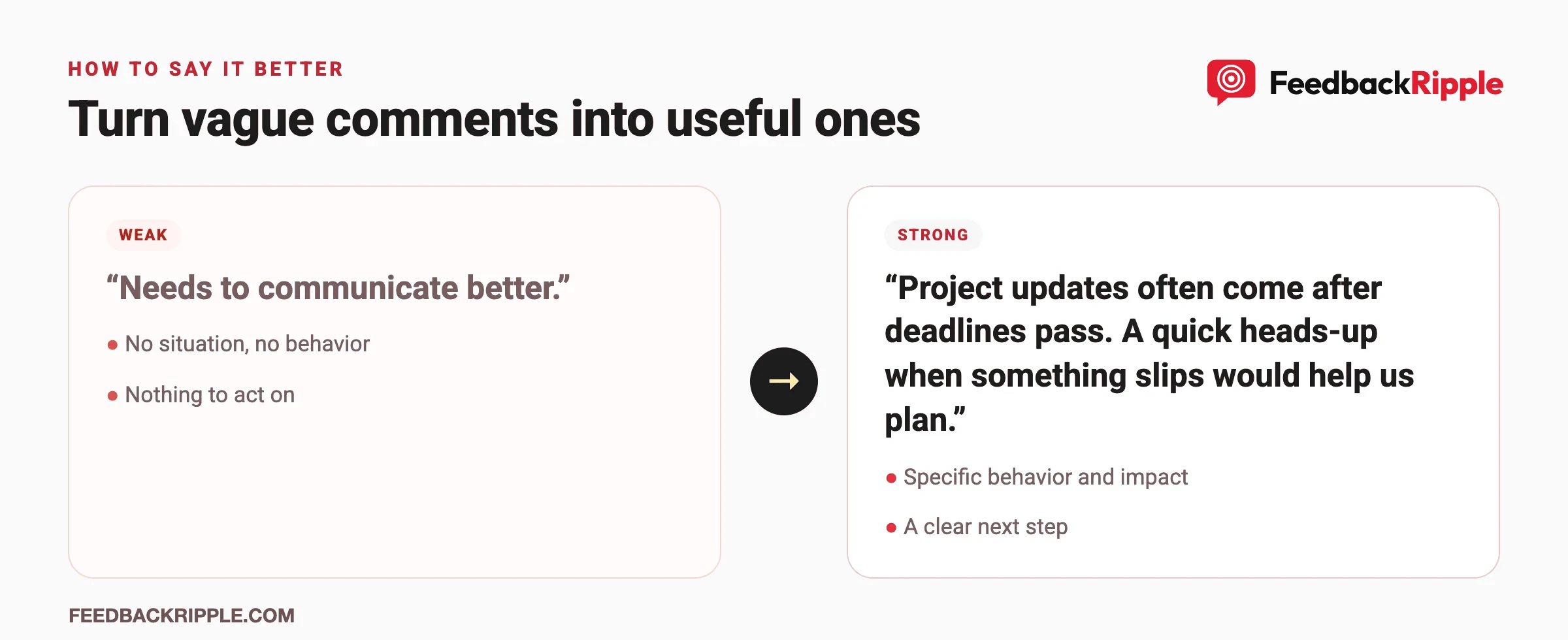
Tip: If you’re not sure a comment is specific enough, ask yourself: “Could the person picture the exact moment I mean?” If not, add the situation.
Gentle vs direct: the same feedback, two ways
There’s no single right tone. Some people truly prefer it straight, and others hear direct feedback as an attack. So here are the same messages written both ways. You have to pick the one the person will actually hear, and a short example can help either version land:
| Situation | Gentle | Direct |
|---|---|---|
| Missed deadlines | “I know the last few weeks have been busy. When a deadline is at risk, an early heads-up would really help us plan.” | “Three deadlines slipped this quarter without warning. Please flag risks as soon as you see them.” |
| Interrupting | “Your ideas are valuable. It might help to let others finish first, so that they feel heard too.” | “You often interrupt in meetings. Let people finish before you respond.” |
| Long updates | “Your updates are thorough. A short summary at the top could help busy readers.” | “Your updates are too long. Lead with three bullet points.” |
| Avoiding conflict | “It can be hard to raise tough topics. Bringing concerns up earlier would help the team solve them sooner.” | “You avoid difficult conversations. Raise problems within the week.” |
| Not delegating | “You’re great at hard problems. Sharing some of them could help the team grow too.” | “You keep the hardest work for yourself. Delegate more of it.” |

360 feedback for global and multicultural teams
If your team spans countries, the same comment can land very differently. And given that a 360 is usually read without you in the room, there’s no chance to soften it in person. So you have to think a little about how it reads. A few things that typically help:
- Lead with the behavior, not a label. “Too blunt” or “too quiet” mean different things in different cultures. Describing what happened travels much better.
- Watch out for softeners. In the UK, “It might be worth considering…” often means “please change this.” Readers elsewhere can take it as optional. If it matters, say so.
- Avoid idioms and sports metaphors. “Drop the ball” or “step up to the plate” can confuse people reading in a second language, or in a translated survey.
- Be careful with praise inflation. In the US, “good” can sound lukewarm; in many other places, it’s genuine praise. Specific examples avoid the problem.
- Keep spelling consistent with your audience. US: behavior, prioritize, organization. UK: behaviour, prioritise, organisation. Neither is wrong, but mixing them in one report looks careless.
FeedbackRipple runs surveys in 15 languages, so raters can usually write in the language they’re most comfortable with. You can read more on the HR and L&D teams page.
Mistakes to avoid in 360 feedback comments
- Writing about personality. “Is lazy” or “is arrogant” can’t be acted on, and it usually makes people defensive.
- Only praise or only criticism. All-positive comments feel empty, and all-negative ones feel like an attack. One strength and one improvement is a good balance.
- Comments that give you away. “As your only designer…” or a detail from a private meeting can reveal who wrote it. You can read how we protect raters on our anonymity page.
- Old news. Feedback about something from a year ago is hard to act on. Focus on the last six months.
- Hearsay. Write about what you saw yourself, not what others told you.
- Copying without editing. The examples here are a starting point. A comment that doesn’t sound like you, or doesn’t fit the person, simply won’t land.
From comments to change
Good comments only matter if the person does something with them. So it really helps when the report brings the comments together instead of showing a long, unsorted list.
To give you a concrete example, at FeedbackRipple, we don’t simply paste every comment into a PDF. The feedback report groups comments by theme, shows the top strengths and blind spots next to the ratings, and suggests a few things to try in the next 30 days. And because raters get writing prompts as they type, the comments tend to be specific to begin with. In practice, that’s what turns 120 good sentences into one or two real changes.
If you need a ready-made survey to collect comments like these, our free 360 feedback survey template has 15 rating questions and 3 open questions. And if you’re choosing a tool to run it, see our roundup of the best 360 feedback software.
FeedbackRipple · First 3 people free
Run your first 360 free
Collect specific, anonymous comments and get a report that says what to do next. In 15 languages. Your first 3 people are free, no credit card.
The author

Venchito Tampon
Venchito Tampon is the Founder of FeedbackRipple, 360 feedback software that tells people what to do next. It helps executive coaches and HR and L&D teams run anonymous 360s, turn the results into clear guidance and follow through on development plans.
He is a Certified Executive Coach, certified by Symbiosis Coaching, an ICF-accredited coaching organization. He brings that coaching lens to FeedbackRipple: every report ends with clear next steps, not just charts.
He is also the CEO and Founder of eLearning Solutions Lab, a Philippines-based eLearning production company specializing in custom eLearning development and rapid eLearning solutions for global clients.
He founded Rainmakers Training & Consultancy, a corporate training and leadership development firm where he has trained and spoken at 250+ conventions, seminars, and workshops across the Philippines and internationally, including Singapore, Slovakia, and Australia. He has worked with top corporations including SM Hypermarket, Shell, and National Bookstore.
His other ventures include ExpirePilot, document expiration tracking software for small businesses, SharpRocket, a digital marketing and SEO company, and Hills & Valleys Cafe, a local café with available franchising.
He is a certified member of The Philippine Society for Talent Development (PSTD), the premier organization for Talent Development practitioners in the country, and an active Go Negosyo Mentor under the Mentor Me program.