
10 Best Spidergap Alternatives in 2026 (With Real Prices)
10 Best Spidergap Alternatives in 2026 (With Real Prices)
FeedbackRipple is the best Spidergap alternative for most coaches and HR teams. It keeps Spidergap’s simple per-person pricing and readable report, then adds AI setup, guidance on what to try next, anonymity built into how answers are stored and Lucy, an AI coach that follows up for 90 days. Your first 3 people are free, and 10 people a year cost $490, compared with $1,099 on Spidergap Starter.
Spidergap is one of the best-known 360 tools, and for good reason: clear reports, 100+ languages and helpful experts. But it starts at $1,099 a year even if you review one person, it doesn’t use AI, and the report stops at a development plan.
We compared 10 alternatives, from dedicated 360 tools to performance suites, with real prices checked in November 2026.
Key takeaways
- FeedbackRipple is our top pick: a Spidergap-style report plus next steps, AI setup and 90-day follow-up, from $49 per person.
- EchoSpan is the closest match if you need 100+ languages and deep configuration.
- Culture Amp, Lattice, Leapsome and 15Five make sense only if you also want engagement surveys or performance reviews, and they charge for every employee.
- Teamflect is free for up to 10 users if you live in Microsoft Teams.
In this guide
- In summary
- How we compared these Spidergap alternatives
- Why teams look for Spidergap alternatives
- The 10 best Spidergap alternatives at a glance
- 1. FeedbackRipple
- 2. EchoSpan
- 3. Culture Amp
- 4. Lattice
- 5. Leapsome
- 6. 15Five
- 7. Qualtrics EmployeeXM
- 8. PerformYard
- 9. Teamflect
- 10. CheckPoint 360°
- Feature comparison
- What to look for
- Other alternatives worth a look
- How to switch from Spidergap
- Choose by what you need
In summary
The best Spidergap alternative depends on what you need it to do better. Our picks by use case:
- FeedbackRipple: Best overall. The same per-person approach as Spidergap, with AI setup, next steps in every report and 90-day follow-up. First 3 people free, then from $49 per person.
- EchoSpan: Best for configurable global programs. A veteran 360 specialist with 100+ languages and deep options, many as paid add-ons.
- Culture Amp: Best if you also want engagement surveys. 360s inside an engagement and performance platform, priced by quote per employee.
- Lattice: Best for 360s inside performance reviews. Peer feedback as part of review cycles, from $10 per seat a month with a $4,000 minimum.
- Leapsome: Best all-in-one for European teams. Reviews, 360s, learning and goals in one Berlin-based platform.
- 15Five: Best for manager check-ins. 360s as part of weekly check-ins and reviews, $11 per user a month on Perform.
- Qualtrics EmployeeXM: Best for large enterprises. 360 development inside an enterprise listening platform, by quote.
- PerformYard: Best for flexible review processes. Review cycles shaped around how you work, including client feedback.
- Teamflect: Best for Microsoft Teams users. Reviews and 360s inside Teams, free for up to 10 users.
- CheckPoint 360°: Best ready-made leadership model. A fixed, research-based leadership survey from Wiley, sold through partners.
Disclosure: FeedbackRipple publishes this guide and is one of the tools in it. We put it first because it’s the option we know best for coaches and HR teams, and we list its limits as plainly as everyone else’s. Prices and ratings were checked in November 2026 from vendor pages, Capterra and public price trackers; check the vendor’s own page before you buy.
How we compared these Spidergap alternatives
We looked at each tool the way a Spidergap customer would, on five things:
- Price as you grow: what 1, 10, 30 and 100 people reviewed cost in a year
- Free start: a free plan or a real trial
- The report: whether people know what to do after reading it
- Anonymity and languages: how raters are protected, and in how many languages
- Admin effort: setup time, reminders and integrations
Sources are vendor pricing pages, help centers, Capterra and public price trackers, checked in November 2026. Where a vendor only sells by quote, we say so rather than guess. Ratings are Capterra scores.
Why teams look for Spidergap alternatives
Spidergap customers are generally happy with it. These are the reasons they look around anyway:
The minimum price is high for small teams
Starter is $1,099 a year for 10 people. If you review 3 managers or one coaching client, you still pay for 10.
No AI help
We found no AI features on Spidergap’s public pages, so writing questions, chasing raters and turning results into advice stays manual.
The report stops at a plan
Spidergap’s report is clear and ends with a development plan, but there’s no built-in follow-up to check whether behavior changed.
No HR system integrations listed
Participants and raters are imported rather than synced from BambooHR, HiBob or Workday.
Tip: Before you switch, list the two or three things you’d miss most about Spidergap, such as languages or EU hosting, and check each alternative against those first.
The 10 best Spidergap alternatives at a glance
| Tool | Best for | Price (Nov 2026) | Capterra rating | Free option |
|---|---|---|---|---|
| FeedbackRipple | Best overall | Free for 3 people, then $49 per person; Team $1,069/yr for 30 | New, not yet rated | Yes, first 3 people |
| EchoSpan | Best for configurable global programs | Calculator; directories from $6/user/mo | 4.9 (76 reviews) | 14-day trial |
| Culture Amp | Best if you also want engagement surveys | Quote; about $4,500/yr minimum (estimate) | 4.6 (157 reviews) | Demo only |
| Lattice | Best for 360s inside performance reviews | $10/seat/mo, $4,000/yr minimum | 4.5 (205 reviews) | Demo only |
| Leapsome | Best all-in-one for European teams | Quote; HRIS base about $7/employee/mo | 4.6 (136 reviews) | 14-day trial |
| 15Five | Best for manager check-ins | $11/user/mo (Perform) | 4.7 (895 reviews) | No |
| Qualtrics EmployeeXM | Best for large enterprises | Quote | Not checked | No |
| PerformYard | Best for flexible review processes | About $5–$10/person/mo (estimates) | 4.7 (187 reviews) | No |
| Teamflect | Best for Microsoft Teams users | Free up to 10 users, then about $7–$14/user/mo | 4.7 (143 reviews) | Yes, up to 10 users |
| CheckPoint 360° | Best ready-made leadership model | Quote per participant | Not checked | No |
Ratings from Capterra, November 2026. “Not checked” means we didn’t find a comparable Capterra listing.
1. FeedbackRipple: Best overall
- Starting price: Free for 3 people, then $49 per person; Team $1,069/yr for 30
- Capterra rating: New, not yet rated
- Free option: Yes, first 3 people
FeedbackRipple is 360 feedback software that tells people what to do next. It was built by a certified executive coach, and its report follows the familiar Spidergap-style structure, then adds guidance after each part.
It covers the whole journey: AI that drafts the 360, a survey raters finish, a report with clear next steps, and Lucy, an AI coach that follows up for 90 days. You pay per person reviewed, and raters and questions are unlimited.
Why FeedbackRipple is a Spidergap alternative
FeedbackRipple is the closest like-for-like switch. Both are 360-only tools priced per person reviewed, with unlimited raters, free re-runs within 12 months and a report that leads with top strengths and areas to improve. FeedbackRipple adds what happens before and after: AI that drafts the 360, a comment helper for raters, guidance on what to try in the next 30 days, Lucy’s 90-day check-ins and an impact survey on each goal. It also costs less at every size: 30 people a year are $1,069 on the Team plan vs $2,879 on Spidergap Starter.
Key features
- AI 360 setup: describe a 360 in one sentence and get the questions, raters and deadline drafted for you to check
- A report that says what to do next: top 5 strengths and areas to improve, blind spots, and what to try in the next 30 days
- Anonymity built into the data: answers stored with no link to the rater, groups under 3 merged, confidential mode on by default
- Comment helper for raters: flags comments that could give someone away, with a safer version the rater can choose
- Lucy, a 90-day AI coach: turns the report into a plan and checks in at 30, 60 and 90 days
- Impact survey: colleagues re-rate each goal weeks later, so you can see change
- 15 survey languages, with comments translated into English in the report
- Works with your tools: BambooHR, HiBob, Workday, Slack and Fireflies
Pros
- The only tool here whose report ends in clear next steps and a ready-made plan
- Anonymity rules built into how answers are stored
- Follows up for 90 days with Lucy and an impact survey
- Published prices from $49, first 3 people free, no card
- Usually a third to a half of the price of other dedicated 360 tools
Cons
- 15 survey languages, fewer than Spidergap or EchoSpan
- Hosted in Sydney; no US or EU data location yet
- SAML SSO is on the roadmap
- A newer product with no review-site ratings yet
- Not a full performance suite
Pricing
Free trial: first 3 people, every feature. Pay as you go: $49 per person. Coach: $469 a year for 12 people, then $39 each. Team: $1,069 a year for 30 people, then $29 each. Enterprise: from $5,029 a year for 250 people, then $19 each. Yearly plans can be paid monthly. See pricing. Compared with Spidergap: 10 people cost $490 vs $1,099, 30 people $1,069 vs $2,879, and 100 people $3,099 vs $7,509.
FeedbackRipple · First 3 people free
Switch from Spidergap in an afternoon
Bring your questions, upload your raters and run a real 360 with 3 people free. Compare the report with your last Spidergap one.
2. EchoSpan: Best for configurable global programs
- Starting price: Calculator; directories from $6/user/mo
- Capterra rating: 4.9 (76 reviews)
- Free option: 14-day trial
EchoSpan has focused on 360s since 2005 and sells three editions (360 Essentials, Professional and Professional Plus) plus a pay-per-review option. It’s one of the most configurable 360 tools, with many extras sold as add-ons.
Why EchoSpan is a Spidergap alternative
EchoSpan is the other long-running dedicated 360 tool. Like Spidergap it offers 100+ languages, and it goes further on configuration, with conditional logic, benchmarks and an API on its top edition. It also has AI insights, as a paid add-on. See FeedbackRipple vs EchoSpan.
Key features
- AI survey generation and a competency library
- 500+ report template options (Professional)
- Conditional logic, benchmarks and an API (Professional Plus)
- AI Insights Toolkit add-on: summaries, action plans, debrief guides
- 100+ languages as an add-on
- SSO and enterprise support as add-ons
Pros
- Highly configurable
- 100+ languages available
- Long 360 track record; 4.9 on Capterra
- Pay-per-review option for consultants
Cons
- Base prices behind a calculator
- AI insights ($44/review), languages ($17/review) and SSO ($1,200/yr) cost extra
- Raters per person capped by edition
Pricing
Base price from its calculator; directories list from about $6 per user a month. Add-ons: Insights Toolkit $44 per review, languages $17 per review, SSO $1,200 a year.
3. Culture Amp: Best if you also want engagement surveys
- Starting price: Quote; about $4,500/yr minimum (estimate)
- Capterra rating: 4.6 (157 reviews)
- Free option: Demo only
Culture Amp, founded in Melbourne in 2011, is best known for engagement surveys and benchmarks. Its Perform module adds performance reviews, 360s, goals and development, with AI Coach and AI comment summaries across the platform.
Why Culture Amp is a Spidergap alternative
Culture Amp makes sense if you want to replace Spidergap and your engagement survey tool with one platform. Its 360 templates are designed for development, but you pay per employee for the whole company. See FeedbackRipple vs Culture Amp.
Key features
- Individual, Leadership and Manager 360 templates
- Engagement surveys with benchmarks
- Performance reviews, goals and 1-on-1s
- AI Coach and AI comment summaries
- People analytics
Pros
- Engagement, performance and 360s in one place
- Strong benchmarks and analytics
- Established enterprise vendor
Cons
- No published prices
- Priced per employee for the whole company
- More to roll out than a 360-only tool
Pricing
Quote only, per employee and module, billed yearly. A third-party guide estimates a minimum of about $4,500 a year.
4. Lattice: Best for 360s inside performance reviews
- Starting price: $10/seat/mo, $4,000/yr minimum
- Capterra rating: 4.5 (205 reviews)
- Free option: Demo only
Lattice is a San Francisco-based performance platform, founded in 2015, with reviews, goals, 1-on-1s and engagement surveys. Its 360 feedback happens inside performance review cycles, and an AI Agent and analytics come with each product.
Why Lattice is a Spidergap alternative
Choose Lattice if you want 360 input to feed formal performance reviews, alongside goals and 1-on-1s. It’s a different model from Spidergap: 360s happen inside review cycles, and you pay for every employee. See FeedbackRipple vs Lattice.
Key features
- Peer and upward feedback inside review cycles
- Goals and OKRs, 1-on-1s and engagement surveys
- AI Agent and analytics included
- Compensation and Grow add-ons
- Many HRIS integrations
Pros
- One platform for reviews, goals and engagement
- Published per-seat prices
- Large user base and many integrations
Cons
- $4,000 yearly minimum
- Pay for every employee, not people reviewed
- 360s tied to review cycles
Pricing
Performance $10 and Foundations $13 per seat per month, billed yearly, with a $4,000 minimum. Engagement $4, Goals $8; Compensation +$6 and Grow +$4.
5. Leapsome: Best all-in-one for European teams
- Starting price: Quote; HRIS base about $7/employee/mo
- Capterra rating: 4.6 (136 reviews)
- Free option: 14-day trial
Leapsome is a Berlin-based people platform that combines reviews and 360s with goals, engagement surveys, learning and 1-on-1s. Its 360s can lead to suggested learning paths, and European buyers like its GDPR-minded approach.
Why Leapsome is a Spidergap alternative
European Spidergap customers who want more than 360s often shortlist Leapsome for its GDPR-minded approach and the link between feedback and learning paths.
Key features
- Reviews and 360s with leadership templates
- Learning paths recommended from feedback
- Goals, surveys and 1-on-1s
- AI copilot and summaries
Pros
- Broad, connected feature set
- Strong fit for European data expectations
- Links feedback to learning
Cons
- Modular per-employee pricing adds up
- One-year minimum contracts
- Heavy if you only want 360s
Pricing
No full price list. Its HRIS foundation was about $7 per employee per month in October 2026, with modules on top.
6. 15Five: Best for manager check-ins
- Starting price: $11/user/mo (Perform)
- Capterra rating: 4.7 (895 reviews)
- Free option: No
15Five is built around weekly check-ins and manager effectiveness. Its Perform plan adds reviews, 360 feedback, goals and career paths, as part of a continuous performance rhythm.
Why 15Five is a Spidergap alternative
15Five suits companies that want ongoing feedback habits rather than standalone 360 projects. 360 feedback sits inside its Perform plan.
Key features
- 360 feedback within performance reviews
- Weekly check-ins, 1-on-1s and recognition
- Manager training on Total Platform
- AI help for reviews
Pros
- Published prices, no seat minimum
- Strong focus on manager habits
- Highly rated: 4.7 from nearly 900 reviews
Cons
- Pay per user for everyone
- 360s aren’t the main focus
- No free plan
Pricing
Engage $4, Perform (with 360s) $11 and Total Platform $16 per user per month, billed yearly.
7. Qualtrics EmployeeXM: Best for large enterprises
- Starting price: Quote
- Capterra rating: Not checked
- Free option: No
Qualtrics is a survey research powerhouse. Its 360 Development offering runs on the same platform as engagement, pulse and lifecycle surveys, built for programs across thousands of people.
Why Qualtrics EmployeeXM is a Spidergap alternative
Large organizations that outgrow Spidergap’s simplicity, and already run Qualtrics for employee surveys, can run 360s on the same platform with deeper analytics.
Key features
- 360 development on the same data as engagement surveys
- Advanced analytics and text analysis
- Deep enterprise HR integrations
- Expert frameworks and services
Pros
- Enterprise-grade analytics and security
- Handles very large, global programs
- One platform for all employee listening
Cons
- Quote-only, priced by employee count
- Setup often needs a project team or partner
- Far more than most teams need
Pricing
Quote only, priced by number of employees as part of EmployeeXM.
8. PerformYard: Best for flexible review processes
- Starting price: About $5–$10/person/mo (estimates)
- Capterra rating: 4.7 (187 reviews)
- Free option: No
PerformYard lets HR shape reviews around how the company already works. 360s can include peers, direct reports and even clients, with sign-off routing and reminders.
Why PerformYard is a Spidergap alternative
PerformYard suits HR teams that want 360s, upward and even client feedback inside a review process they design themselves.
Key features
- 360, upward, peer and client reviews
- Flexible review cycles with sign-offs
- Goals, check-ins and 9-box reporting
- Optional AI writing help
Pros
- Very flexible review design
- Easy for employees
- Responsive support
Cons
- No public prices or free trial
- Annual minimum
- Light on development guidance
Pricing
Quote. Third-party sources put it at about $5 to $10 per person per month, billed yearly.
9. Teamflect: Best for Microsoft Teams users
- Starting price: Free up to 10 users, then about $7–$14/user/mo
- Capterra rating: 4.7 (143 reviews)
- Free option: Yes, up to 10 users
Teamflect runs reviews, goals, 1-on-1s and 360 feedback inside Microsoft Teams and Outlook, with external and anonymous feedback and AI summaries.
Why Teamflect is a Spidergap alternative
If your company lives in Microsoft Teams and Spidergap’s minimum price is too high for a small team, Teamflect’s free plan is worth a look.
Key features
- 360 and instant feedback in Teams chat
- External and anonymous feedback
- Tasks synced with Planner and To Do
- AI feedback summaries
Pros
- Easy adoption for Teams users
- Free for up to 10 users
- Affordable paid plans
Cons
- Much less useful outside Microsoft 365
- Lighter 360 reports
- Prices vary across its pricing page
Pricing
Free for up to 10 users. Paid plans about $7 to $14 per user per month.
10. CheckPoint 360°: Best ready-made leadership model
- Starting price: Quote per participant
- Capterra rating: Not checked
- Free option: No
CheckPoint 360° is a fixed leadership survey from Wiley, with about 70 questions across core leadership competencies. You use a tested model rather than writing questions, usually through a certified partner or coach.
Why CheckPoint 360° is a Spidergap alternative
Coaches who use Spidergap mainly for leadership 360s may prefer CheckPoint 360°’s tested competency model, debriefed through a certified partner.
Key features
- Research-based leadership competency model
- Consistent results across leaders
- Partner-led debriefs
Pros
- Tested leadership model
- Good fit for coach-led programs
Cons
- Can’t fit questions to your own values
- Pricing and access through partners
- Long survey for raters
Pricing
Priced per participant through Wiley’s partners.
Feature comparison: Spidergap alternatives side by side
| Tool | Type | Starting price | Free option |
|---|---|---|---|
| FeedbackRipple | Dedicated 360 | Free for 3 people, then $49 per person; Team $1,069/yr for 30 | Yes, first 3 people |
| EchoSpan | Dedicated 360 | Calculator; directories from $6/user/mo | 14-day trial |
| Culture Amp | Engagement + performance suite | Quote; about $4,500/yr minimum (estimate) | Demo only |
| Lattice | Performance suite | $10/seat/mo, $4,000/yr minimum | Demo only |
| Leapsome | All-in-one people platform | Quote; HRIS base about $7/employee/mo | 14-day trial |
| 15Five | Performance + engagement suite | $11/user/mo (Perform) | No |
| Qualtrics EmployeeXM | Enterprise experience platform | Quote | No |
| PerformYard | Performance management | About $5–$10/person/mo (estimates) | No |
| Teamflect | Performance suite in Microsoft Teams | Free up to 10 users, then about $7–$14/user/mo | Yes, up to 10 users |
| CheckPoint 360° | Fixed leadership assessment | Quote per participant | No |
What to look for in a Spidergap alternative
- Per-person pricing if you review a subset of people, so you don’t pay for every employee
- A report with next steps, not just scores
- Anonymity rules that merge small groups automatically
- The languages your raters speak
- Data location and certifications your security team needs
- Follow-up after the report, so you can show change
Other Spidergap alternatives worth a look
- Google Forms or SurveyMonkey: free or cheap for one informal 360, if you can handle anonymity and reports by hand. See our comparison.
- G360 Surveys: a dedicated 360 tool listed on Capterra from about $100.
- Primalogik 360: a 360 and performance review tool often compared with Spidergap.
How to switch from Spidergap
- Export your Spidergap reports as PDFs and keep them for your records.
- List your questions and rating scale, or pick the closest template in the new tool.
- Export your participant and rater lists, or connect your HR system.
- Run a pilot 360 with 3 to 5 people.
- Compare the new report with your last Spidergap one, side by side.
- Check unused Spidergap licenses before you cancel, since they carry over while your plan is active.
Tip: Spidergap licenses last 12 months from when an assessment starts, so time your switch for when current 360s have closed.
Choose a Spidergap alternative by what you need
- Best overall and best value: FeedbackRipple
- Many languages and deep configuration: EchoSpan
- Engagement surveys too: Culture Amp
- 360s inside performance reviews: Lattice or 15Five
- European all-in-one: Leapsome
- Large enterprise: Qualtrics EmployeeXM
- Microsoft Teams: Teamflect
- A fixed leadership model: CheckPoint 360°
First 3 people free · No credit card
Run a 360 people actually act on
Anonymous by design, a report that says what to do next, and Lucy to follow up for 90 days. Try every feature with your first 3 people, then pay only for the people you review.
FeedbackRipple is our product, and we’ve ranked it first. Every other tool is described as fairly as we can from public information, checked in November 2026. Product names belong to their owners. Spot something out of date? Email hello@feedbackripple.com.
Keep reading
- FeedbackRipple vs Spidergap: an 11-category head-to-head
- 12 best 360 feedback software tools for 2026
- Best EchoSpan alternatives

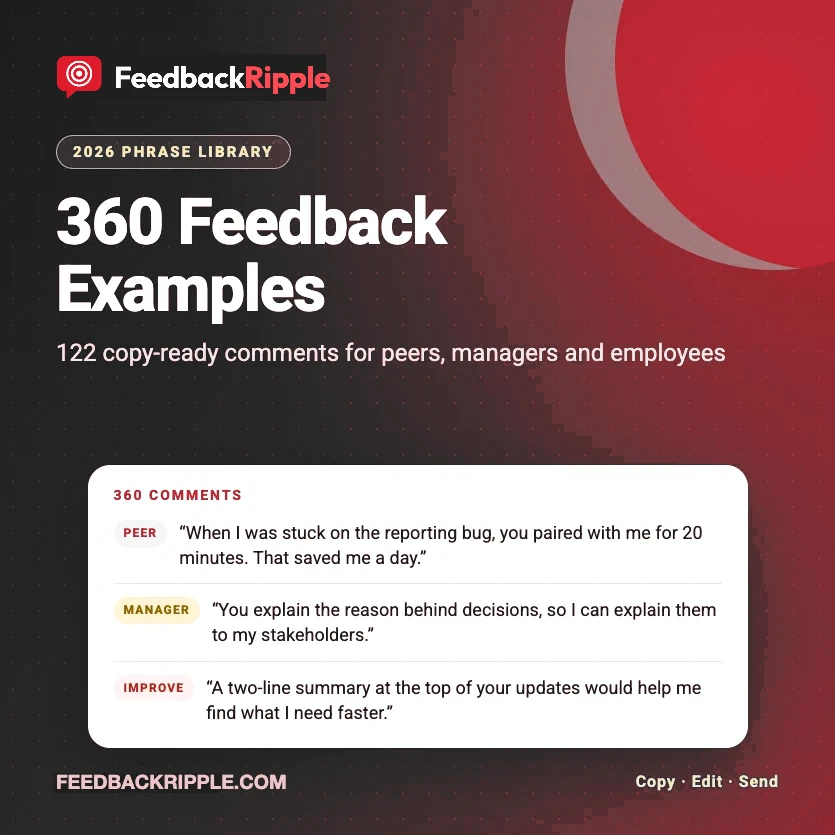
360 Feedback Examples: 122 Comments for Peers, Managers and Employees
360 Feedback Examples: 122 Comments for Peers, Managers and Employees
Good 360 feedback examples describe one thing the person did, when they did it, and what it led to. That’s the SBI model: Situation, Behavior, Impact. For instance: “In last week’s client call, you summarized the three open issues before we hung up, so everyone left knowing who owned what.” Below are 122 copy-ready comments for peers, managers, direct reports and self-reviews, sorted by skill and by tone, plus before-and-after rewrites.
Key takeaways
- The best 360 comments are specific: one situation, one behavior, one impact. “Great communicator” tells the person nothing they can repeat.
- Give one or two strengths and one area to improve per person. That’s usually enough for them to act on, and it keeps the feedback fair.
- Write about behavior, not personality. “Interrupts in meetings” can change. “Is arrogant” can’t, and it tends to make people defensive.
- Match the tone to the person and the culture. A gentle and a direct version of the same comment can both work. Pick the one they’ll actually hear.
- Keep it anonymous-safe: leave out details only you would know, like a private meeting or a one-off project, if your 360 is anonymous.
Here’s the problem with most “360 feedback examples” pages: they actually give you questions to ask, not feedback to write. And when you’re sitting in front of a rater survey with a blank comment box, a list of questions doesn’t really help. You need words.
So this guide is a phrase library. Every comment below is written to be copied and then edited, so that it fits the real person and the real situation. You can browse by who you’re giving feedback to, by skill, or by tone. And if you’re the one setting up the 360, our guide to 360 feedback questions covers the questions side.
In this guide
What good 360 feedback looks like
A good feedback message is one the person can actually use. In practice, the easiest way to get there is the SBI model, which a lot of coaches and HR teams use:
- Situation: when and where it happened. “In Tuesday’s planning meeting…”
- Behavior: what the person did or said, the part anyone could have seen. “…you asked each person for their estimate before giving yours…”
- Impact: what happened because of it. “…so the quieter people on the team actually spoke up, and the plan was more realistic.”
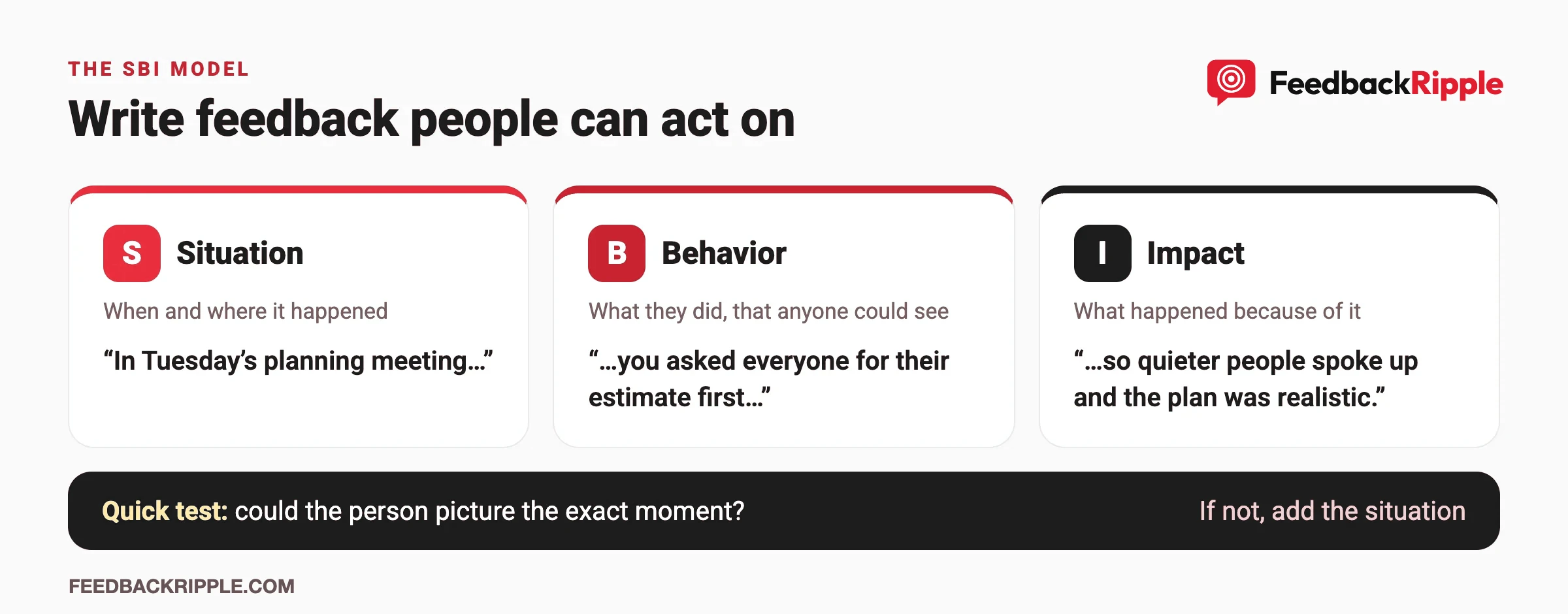
You don’t have to use all three parts every time, given that a 360 comment box is usually short. But if a comment has no behavior in it, it’s probably not useful yet. Here are three examples of the same idea written well:
- “In the Q3 handover, you wrote up every open ticket with next steps, so the new team started without a single ‘where is this?’ message.”
- “When the launch date moved, you told the client the same day and gave them two options, which kept their trust even though the news was bad.”
- “In our 1:1s, you usually ask what’s getting in my way before you ask for updates. That makes it genuinely easier to raise problems early.”
FeedbackRipple · First 3 people free
Help raters write comments like these
FeedbackRipple gives raters gentle prompts while they write, so that comments come out specific and kind instead of vague. Your first 3 people are free, no credit card.
360 feedback examples for peers
Peers usually see how someone collaborates day to day: how they share work, handle disagreement and support the team. So peer comments tend to be most useful when they focus on working together.
Positive peer feedback examples
- “You always share credit in team updates. When the migration went well, you named the three people who did the heavy lifting.”
- “When I was stuck on the reporting bug, you dropped what you were doing for 20 minutes to pair with me. That saved me a day.”
- “You give honest input in design reviews, even when it’s uncomfortable, and you always explain why.”
- “You reply to cross-team requests quickly, which really helps given that our work depends on yours.”
- “In retros, you’re usually the first to admit what didn’t go well, and that makes it safer for the rest of us to do the same.”
- “Your documentation is clear enough that I can pick up your work without asking you questions.”
- “You stay calm when deadlines get tight, and it genuinely lowers the stress for everyone around you.”
- “You make new team members feel welcome. You set up a coffee chat with each new hire in their first week.”
Constructive peer feedback examples
- “In planning meetings, you sometimes commit our team to dates before checking with us. Could you check in first so that the dates are realistic?”
- “Your updates in the project channel are often very long. A two-line summary at the top would help me find what I need faster.”
- “When we disagree, you tend to move the discussion to private messages. I’d find it easier to resolve things in the meeting itself.”
- “A few handoffs this quarter arrived without context, like the vendor contract. A short note on what’s done and what’s left would really help.”
- “You’re great at spotting problems. It would help even more if you suggested a possible fix when you raise one.”
- “In design reviews, you sometimes interrupt before people finish their point. Letting them finish would make the discussion more productive.”
- “I’d love to hear more of your ideas in team meetings. You often share great points with me afterwards that the whole team would benefit from.”
- “Some requests from your side come in late on Friday for Monday. More notice would help us plan our week.”
360 feedback examples for your manager
Giving feedback upward can feel risky, and that’s exactly why 360s keep it anonymous. So here are examples of good feedback to give your manager, written to be honest without being harsh. If you’re setting up this kind of survey, our page on upward feedback explains how to keep it safe.
Positive feedback for your manager
- “You make priorities clear. When everything feels urgent, you tell us what matters most this week, and that really helps me focus.”
- “You explain the reason behind decisions, even the ones we don’t like, so I can explain them to my own stakeholders.”
- “You back the team in front of senior leaders. When the release slipped, you took responsibility instead of naming people.”
- “Your feedback is specific and timely. You usually tell me within a day what worked and what to change.”
- “You protect our focus time. Since you moved status updates to a written check-in, I get two more hours of deep work a week.”
- “You actually follow up on what we raise in 1:1s, which shows me you take it seriously.”
- “You’ve been really supportive of my development. You found me a stretch project that matched what I said I wanted to learn.”
- “You admit when you don’t know something and ask the team, which makes it easier for all of us to do the same.”
Constructive feedback for your manager
- “Priorities sometimes change mid-week without a reason. A quick note on why would help me re-plan without losing momentum.”
- “Our 1:1s get canceled fairly often. Even a 15-minute version would help me get decisions I’m waiting on.”
- “Feedback on my work usually comes at review time. I’d find it more useful closer to the moment, while I can still act on it.”
- “In team meetings, decisions sometimes feel made before the discussion starts. If there’s room for input, saying so would help.”
- “You take on a lot of the hard tasks yourself. I think the team could handle more of them, and we’d learn a lot from it.”
- “Recognition tends to go to the most visible work. The people doing quieter, behind-the-scenes work would really value a mention too.”
- “When you’re under pressure, your messages get very short, and it’s hard to tell if something is urgent. Adding a priority would help.”
- “I’d like more context on how my work connects to the department’s goals, so that I can make better trade-offs on my own.”
360 feedback examples for direct reports
If you’re a manager rating someone on your team as part of their 360, you typically see the bigger picture: results, judgment and growth over time. These comments work for individual contributors at most levels. Have a look at our page on 360 reviews for managers if you’re running this for a whole team.
Positive feedback for a direct report
- “You’ve really grown in how you handle clients. Six months ago you escalated most questions to me, and now you resolve almost all of them yourself.”
- “You raise risks early. Flagging the data issue two weeks before launch gave us time to fix it properly.”
- “Your analysis on the pricing project was clear and well-structured, and the leadership team used it as is.”
- “You take ownership. When the integration broke, you didn’t wait to be asked; you pulled in the right people and fixed it.”
- “You ask for feedback and genuinely act on it. Your last two reports already reflect what we discussed.”
- “You’re a natural mentor. The two new hires both mentioned how much your walkthroughs helped them get started.”
Constructive feedback for a direct report
- “Your work is high quality, but it often arrives right at the deadline. Sharing a rough draft halfway through would let us catch issues earlier.”
- “In leadership meetings, you tend to go into detail before giving the headline. Starting with the conclusion would help your ideas land.”
- “You sometimes say yes to every request. It’s okay to push back or ask me to help prioritize when your plate is full.”
- “I’d like to see you speak up more in cross-team meetings. Your ideas are strong, and other teams would really benefit from hearing them.”
- “Your written updates are thorough, but they could be shorter. Three bullet points usually do the job.”
- “When a project changes direction, you can get frustrated in front of the team. Bringing those concerns to me first would help keep morale up.”
360 self-review examples
The self-review is where you rate yourself on the same questions as everyone else, so that blind spots show up when the answers are compared. It can feel awkward, but honest, specific comments can help make the debrief much more useful. Here are examples you can adapt:
Self-review strengths
- “I’m good at breaking big projects into clear steps. The onboarding redesign shipped on time because the plan was clear from week one.”
- “I build strong relationships with other teams. Most of my cross-team requests get answered within a day.”
- “I stay calm under pressure, and I think that helps the team when deadlines are tight.”
- “I’ve gotten better at giving feedback. I now give it in the moment instead of saving it for reviews.”
- “I’m reliable on follow-through. If I commit to something in a meeting, I usually close it out that week.”
- “I learn new tools quickly and often help others get started with them.”
Self-review areas to improve
- “I tend to take on too much myself instead of delegating. I want to hand off at least one recurring task this quarter.”
- “I can be too detailed in presentations. I’d like to practice leading with the key message.”
- “I avoid difficult conversations longer than I should. I want to raise problems within a week instead of waiting.”
- “I don’t always share my work early. I want to show drafts sooner, so that I get input before it’s finished.”
- “I could be more visible in team meetings. I usually share ideas one-on-one instead of with the group.”
- “I sometimes say yes before checking my capacity. I want to pause and check before committing to new work.”
360 feedback examples by skill
If your 360 is built around competencies, it’s easier to write comments skill by skill. Each table has three strengths and three areas to improve. For instance, you can pick one from each column for the skills that matter most in the person’s role.
Communication feedback examples
| Strength | Area to improve |
|---|---|
| “Explains complex topics simply, so non-experts can follow.” | “Updates are long; a short summary at the top would help.” |
| “Keeps stakeholders updated before they have to ask.” | “Could check that the message landed, not just that it was sent.” |
| “Listens fully before responding, even in heated discussions.” | “Sometimes goes quiet when projects are off track; earlier updates would help.” |
Leadership feedback examples
| Strength | Area to improve |
|---|---|
| “Gives the team a clear direction and explains why it matters.” | “Could delegate more of the high-visibility work to grow the team.” |
| “Makes decisions in a reasonable time, even with incomplete information.” | “Decisions sometimes change without explanation; sharing the reason would help.” |
| “Develops people by giving them stretch work and real support.” | “Could ask for input earlier, before a direction is set.” |
Teamwork feedback examples
| Strength | Area to improve |
|---|---|
| “Shares credit generously and names who did the work.” | “Could involve other teams earlier on shared projects.” |
| “Steps in to help when a colleague is overloaded.” | “Sometimes works alone on problems the team could solve faster together.” |
| “Handles disagreement openly and respectfully.” | “Could be more open to approaches that differ from their own.” |
Accountability feedback examples
| Strength | Area to improve |
|---|---|
| “Owns mistakes quickly and focuses on the fix.” | “Could set clearer owners and dates when agreeing next steps.” |
| “Follows through on commitments made in meetings.” | “Sometimes explains delays instead of proposing a recovery plan.” |
| “Flags risks to deadlines early instead of at the last minute.” | “Could close the loop when a task is done, so others know.” |
Time management feedback examples
| Strength | Area to improve |
|---|---|
| “Plans work in clear steps and usually delivers on time.” | “Often starts big tasks late; earlier drafts would reduce last-minute pressure.” |
| “Protects time for focused work and helps the team do the same.” | “Could say no or renegotiate when the workload is too high.” |
| “Knows when ‘good enough’ is right and doesn’t over-polish.” | “Meetings often run over; a clear agenda would help.” |
Problem-solving feedback examples
| Strength | Area to improve |
|---|---|
| “Gets to the root cause instead of fixing symptoms.” | “Could test ideas with others earlier before committing to a solution.” |
| “Uses data to back up recommendations.” | “Sometimes goes deep on analysis when a quick decision would do.” |
| “Brings options, not just problems, when something goes wrong.” | “Could document the reasoning, so others can learn from it.” |
Start, stop, continue feedback examples
Start, stop, continue is a simple format that a lot of 360s use for open questions, given that each answer points to a clear action. Here are examples of each:
Start
- “Start sharing rough drafts earlier, so that we can give input before the work is finished.”
- “Start ending meetings with a quick recap of who owns what.”
- “Start asking the team for ideas before proposing your own solution.”
Stop
- “Stop replying to non-urgent messages late at night. It makes the team feel they should too.”
- “Stop saying yes to every request before checking your capacity.”
- “Stop rewriting other people’s work without telling them. A quick comment would help them learn.”
Continue
- “Continue giving feedback in the moment. It’s one of the most useful things you do.”
- “Continue the weekly written updates. They really keep everyone aligned.”
- “Continue mentoring the new hires. They’re ramping up much faster because of you.”
Weak vs strong 360 feedback: how to say it better
Most weak comments aren’t unkind, they’re just vague. Here’s how to turn common ones into something the person can actually act on:
| Weak | Strong |
|---|---|
| “Great team player.” | “When Priya was out, you covered her client calls without being asked, so nothing slipped.” |
| “Needs to communicate better.” | “Project updates often come after deadlines pass. A quick heads-up when something slips would help us plan.” |
| “Is too aggressive.” | “In the budget review, you interrupted Sam twice before he finished. Letting people finish would make your points land better.” |
| “Doesn’t take ownership.” | “When the report had errors, the fix waited for me to follow up. Owning the fix end to end would build a lot of trust.” |
| “Good leader.” | “You explained why we changed the roadmap, which helped me explain it to my team.” |
| “Should be more strategic.” | “In planning, you focus mostly on this quarter. Linking your proposals to next year’s goals would strengthen them.” |
| “Works hard.” | “You rebuilt the onboarding flow in two weeks, and support tickets dropped by about a third.” |
| “Not a people person.” | “During the last two onboardings, new team members often waited a day for answers from you. A weekly open slot would really help.” |
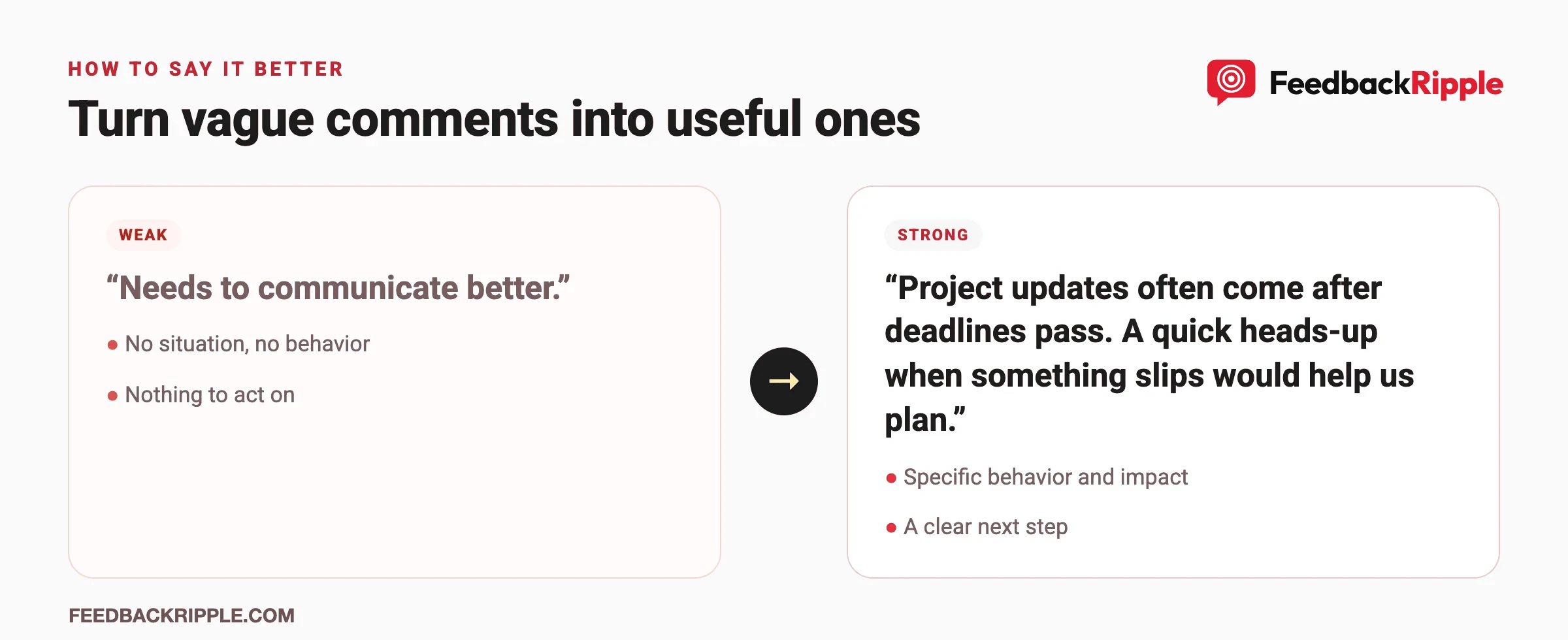
Tip: If you’re not sure a comment is specific enough, ask yourself: “Could the person picture the exact moment I mean?” If not, add the situation.
Gentle vs direct: the same feedback, two ways
There’s no single right tone. Some people truly prefer it straight, and others hear direct feedback as an attack. So here are the same messages written both ways. You have to pick the one the person will actually hear, and a short example can help either version land:
| Situation | Gentle | Direct |
|---|---|---|
| Missed deadlines | “I know the last few weeks have been busy. When a deadline is at risk, an early heads-up would really help us plan.” | “Three deadlines slipped this quarter without warning. Please flag risks as soon as you see them.” |
| Interrupting | “Your ideas are valuable. It might help to let others finish first, so that they feel heard too.” | “You often interrupt in meetings. Let people finish before you respond.” |
| Long updates | “Your updates are thorough. A short summary at the top could help busy readers.” | “Your updates are too long. Lead with three bullet points.” |
| Avoiding conflict | “It can be hard to raise tough topics. Bringing concerns up earlier would help the team solve them sooner.” | “You avoid difficult conversations. Raise problems within the week.” |
| Not delegating | “You’re great at hard problems. Sharing some of them could help the team grow too.” | “You keep the hardest work for yourself. Delegate more of it.” |

360 feedback for global and multicultural teams
If your team spans countries, the same comment can land very differently. And given that a 360 is usually read without you in the room, there’s no chance to soften it in person. So you have to think a little about how it reads. A few things that typically help:
- Lead with the behavior, not a label. “Too blunt” or “too quiet” mean different things in different cultures. Describing what happened travels much better.
- Watch out for softeners. In the UK, “It might be worth considering…” often means “please change this.” Readers elsewhere can take it as optional. If it matters, say so.
- Avoid idioms and sports metaphors. “Drop the ball” or “step up to the plate” can confuse people reading in a second language, or in a translated survey.
- Be careful with praise inflation. In the US, “good” can sound lukewarm; in many other places, it’s genuine praise. Specific examples avoid the problem.
- Keep spelling consistent with your audience. US: behavior, prioritize, organization. UK: behaviour, prioritise, organisation. Neither is wrong, but mixing them in one report looks careless.
FeedbackRipple runs surveys in 15 languages, so raters can usually write in the language they’re most comfortable with. You can read more on the HR and L&D teams page.
Mistakes to avoid in 360 feedback comments
- Writing about personality. “Is lazy” or “is arrogant” can’t be acted on, and it usually makes people defensive.
- Only praise or only criticism. All-positive comments feel empty, and all-negative ones feel like an attack. One strength and one improvement is a good balance.
- Comments that give you away. “As your only designer…” or a detail from a private meeting can reveal who wrote it. You can read how we protect raters on our anonymity page.
- Old news. Feedback about something from a year ago is hard to act on. Focus on the last six months.
- Hearsay. Write about what you saw yourself, not what others told you.
- Copying without editing. The examples here are a starting point. A comment that doesn’t sound like you, or doesn’t fit the person, simply won’t land.
From comments to change
Good comments only matter if the person does something with them. So it really helps when the report brings the comments together instead of showing a long, unsorted list.
To give you a concrete example, at FeedbackRipple, we don’t simply paste every comment into a PDF. The feedback report groups comments by theme, shows the top strengths and blind spots next to the ratings, and suggests a few things to try in the next 30 days. And because raters get writing prompts as they type, the comments tend to be specific to begin with. In practice, that’s what turns 120 good sentences into one or two real changes.
If you need a ready-made survey to collect comments like these, our free 360 feedback survey template has 15 rating questions and 3 open questions. And if you’re choosing a tool to run it, see our roundup of the best 360 feedback software.
FeedbackRipple · First 3 people free
Run your first 360 free
Collect specific, anonymous comments and get a report that says what to do next. In 15 languages. Your first 3 people are free, no credit card.

360 Feedback Questions: 92 Examples for Managers, Leaders and Employees
360 Feedback Questions: 92 Examples for Managers, Leaders and Employees
Good 360 feedback questions ask about one behavior that the rater can actually see, like “Gives me clear priorities when plans change” instead of “Is a good leader.” Most 360s work best with 15 to 30 rating questions on a 1–5 scale (plus a “not observed” option) and 2 to 4 open questions, so raters finish in about 10 to 15 minutes. Below are 92 example questions you can copy, grouped for managers, leaders, employees, peers and self-reviews.
Key takeaways
- Ask about behavior people can observe, not personality or intentions. “Explains the reason behind decisions” gets honest answers. “Is trustworthy” mostly gets guesses.
- Match the questions to the role: managers get questions about priorities, feedback and coaching, leaders about direction and decisions, and employees about delivery and teamwork.
- Keep it short. 15–30 rating questions and 2–4 open questions is usually enough, and longer surveys tend to get rushed, middle-of-the-scale answers.
- Always add a “not observed” option, and ask the person being reviewed the same questions as a self-assessment so blind spots show up.
- The open questions usually matter most. “What should this person keep doing?” and “What one thing would make them more effective?” are hard to beat.
Here’s the thing about 360 feedback questions: most of the lists online are really long, and a lot of the questions in them are vague. “Demonstrates leadership.” “Is a team player.” They sound fine, but raters can’t really answer them, so they click a 4 and move on. And the person who gets the report ends up with a page of averages and no idea what to change.
So this guide is built the other way around. Every question below asks about one thing a rater can actually see, and the sets are grouped by who’s being reviewed, so that you can pick the right ones in a few minutes. You can copy them as they are, mix them, or reword them to match your own competency model.
In this guide
- What makes a good 360 question
- How to structure your 360 questionnaire
- Questions for managers
- Questions for leadership
- Questions for employees
- Questions for peers
- Self-assessment questions
- Questions by competency
- The best open-ended questions
- Questions to avoid (and better versions)
- From questions to action
What makes a good 360 feedback question
A good 360 question is one that a rater can answer from what they’ve actually seen, and that the person can do something about afterwards. In practice, that comes down to four tests:
- It describes a behavior. “Listens without interrupting” is something you can see. “Is a good listener” is a judgment, and people tend to answer judgments based on how much they like someone.
- It asks about one thing. “Communicates clearly and on time” is two questions. If someone is clear but late, the rater simply has no right answer.
- The rater can observe it. Direct reports genuinely know whether their manager gives useful feedback. They usually don’t know how that manager handles the budget. So ask each group about what they see.
- It’s worded neutrally. “How often does Sam fail to share information?” pushes raters toward a negative answer. “Shares information the team needs” lets them decide.

And if you’re not sure whether a question passes, here’s a quick check: imagine the person reading a low score on it. If they’d know what to do differently, it’s a good question. If they’d just feel judged, rewrite it.
How to structure your 360 questionnaire
Most 360 surveys tend to follow the same simple shape, and it works. You group rating questions under a handful of themes (communication, collaboration, decision-making and so on), add a few open questions at the end, and use one rating scale throughout.
| Part | What we’d suggest | Why |
|---|---|---|
| Rating questions | 15–30, in 4–6 themes | Enough to see patterns without tiring raters out |
| Rating scale | 1–5 agreement scale + “not observed” | Easy to answer, and “not observed” keeps guesses out of the averages |
| Open questions | 2–4 | This is where the specific, usable examples come from |
| Self-assessment | Same questions, reworded to “I…” | Lets you compare self vs others and spot blind spots |
| Time to complete | 10–15 minutes | Longer surveys typically get rushed answers near the end |

For the scale itself, a 5-point agreement scale is usually the easiest for raters: 1 Strongly disagree, 2 Disagree, 3 Neither agree nor disagree, 4 Agree, 5 Strongly agree, plus “Not observed.” Some teams prefer a frequency scale (Rarely, Sometimes, Often, Almost always), and that can help when the questions describe habits. Either way, you have to pick one scale and keep it for the whole survey, given that mixing scales makes the results really hard to compare.
Tip: Write every rating question as a statement the rater agrees or disagrees with, starting with a verb: “Gives…”, “Explains…”, “Follows through on…”. The questions below all use this format, so that you can drop them straight into a 1–5 agreement scale.
FeedbackRipple · First 3 people free
Skip the copy-paste
Describe your 360 in one sentence, like “a 360 for new managers in our sales team,” and FeedbackRipple drafts the questions, rater groups and invites for you to edit. Your first 3 people are free, no credit card.
360 feedback questions for managers
These are written mainly for direct reports rating their manager, since they see the day-to-day management most clearly. Peers and the manager’s own boss can answer most of them too. If you only want feedback from the team, have a look at our guide to upward feedback surveys.
Rating questions for managers
- Sets clear priorities so I know what matters most.
- Explains the reason behind decisions that affect the team.
- Gives me feedback that helps me improve.
- Recognizes good work in a specific, timely way.
- Is available when I need help or a decision.
- Delegates work with enough context and authority to do it well.
- Treats everyone on the team fairly.
- Holds people accountable for commitments, including themselves.
- Supports my development and career goals.
- Handles disagreement on the team calmly and constructively.
- Keeps the team informed about changes that affect our work.
- Removes obstacles that slow the team down.
Open questions for managers
- What does this manager do that genuinely helps you do your best work?
- What is one thing they could do differently to support you better?
- When have you felt most supported by them? What did they do?
- Is there anything that makes it hard to raise problems or disagree with them?
If you’re running a 360 for first-time managers, it can help to lean on the first six questions, given that clear priorities, feedback and delegation tend to be where new managers struggle most. There’s more on that in our page on 360 reviews for managers.
360 feedback questions for leadership
Senior leaders and executives are usually judged less on day-to-day management and more on direction, decisions and the culture they create. So these questions work well for directors, VPs and the senior team, with ratings from their peers, their direct reports and their own manager or the board.
Rating questions for leaders
- Communicates a clear direction for where we are going and why.
- Connects the team’s work to the wider goals of the organization.
- Makes timely decisions, even with incomplete information.
- Asks for input from others before making important decisions.
- Admits mistakes and changes course when needed.
- Builds trust by doing what they say they will do.
- Develops strong leaders on their team.
- Works well with other leaders across departments.
- Speaks up about problems instead of avoiding them.
- Stays calm and focused under pressure.
- Models the values and behaviors they expect from others.
- Balances short-term results with long-term health of the team.
Open questions for leaders
- What is this leader’s biggest strength, and how could they use it more?
- What is one thing that would make them a more effective leader?
- What should they start doing, stop doing and continue doing?
- How does their leadership affect the way your team works?
For senior roles, you have to be especially careful with anonymity, given that a leader might only have four or five direct reports. We cover this in more detail in our page on executive 360 assessments, and you’ll find full leadership question sets on our leadership 360 assessment page.
360 feedback questions for employees
For individual contributors, a 360 typically focuses on how they get work done and how they work with others. Their manager, peers and (where it makes sense) internal customers can answer these.
Rating questions for employees
- Delivers work on time and to the agreed standard.
- Communicates clearly in writing and in meetings.
- Asks for help early when they get stuck.
- Shares knowledge and information with the team.
- Takes ownership of problems instead of passing them on.
- Responds well to feedback and acts on it.
- Looks for better ways to do the work.
- Keeps commitments to colleagues.
- Adapts well when priorities change.
- Treats colleagues with respect, even under pressure.
Open questions for employees
- What does this person do that makes working with them easier?
- What is one skill that, if they developed it, would make the biggest difference?
- Can you share a recent example of their work that stood out, for better or worse?
360 feedback questions for peers
Peers see things that managers often don’t: how someone collaborates, shares credit and handles friction between teams. And peer feedback really only works when people feel safe, so these questions stay focused on working together rather than on overall performance. You can read more about running peer reviews on our 360 peer review page.
Rating questions for peers
- Is easy to work with on shared projects.
- Shares credit for team successes.
- Responds to requests in a reasonable time.
- Gives honest input, even when it’s uncomfortable.
- Listens to other points of view before deciding.
- Helps out when a colleague is overloaded.
- Handles disagreements directly and respectfully.
- Keeps others informed about work that affects them.
- Follows through on what they agree to do.
- Makes meetings and discussions more productive.
Open questions for peers
- What do you value most about working with this person?
- What could they do to make collaboration with your team easier?
- Is there a situation where you wish they had acted differently? What would have helped?
Self-assessment questions
The self-assessment is usually the same set of rating questions, simply reworded in the first person: “I set clear priorities so my team knows what matters most.” That way you can compare how someone sees themselves with how others see them, which is where blind spots and hidden strengths show up. Then add a few reflective questions of their own:
- What are you most proud of in your work over the past six to twelve months?
- Where do you think others might see you differently than you see yourself?
- Which skill do you most want to develop in the next six months?
- What support would help you most in that?
- What feedback have you received recently that surprised you?
- What is one habit you want to start, and one you want to stop?
360 feedback questions by competency
If your organization already has a competency model, it’s usually easier to build the 360 around it. Here are example questions for six of the most common competencies. For instance, you can take two or three questions from each row to build a balanced 15–18 question survey.
| Competency | Question 1 | Question 2 | Question 3 |
|---|---|---|---|
| Communication | Explains ideas clearly and simply. | Checks that others have understood. | Keeps people updated without being asked. |
| Collaboration | Builds good working relationships across teams. | Puts team goals ahead of personal credit. | Involves the right people early. |
| Decision-making | Makes decisions in a reasonable time. | Uses data and input from others. | Explains decisions so people can act on them. |
| Accountability | Owns mistakes and fixes them. | Meets deadlines or flags risks early. | Does what they say they will do. |
| Developing others | Gives useful, timely feedback. | Creates chances for others to grow. | Coaches instead of simply giving answers. |
| Adaptability | Stays effective when plans change. | Is open to new ideas and ways of working. | Learns quickly from setbacks. |
Two or three questions per competency is typically enough. You can always add more later, but a survey that’s too long tends to give you worse data, not more of it.
The best open-ended 360 feedback questions
Rating questions show you where someone stands. Open questions show you why, and they’re usually the part of the report people actually remember. So here are ten that work for almost any role. Pick two to four:
- What should this person keep doing?
- What one thing would make them more effective?
- What should they start doing?
- What should they stop doing?
- What is their greatest strength, and how could they use it more?
- Describe a recent situation where they handled something really well.
- Describe a situation where a different approach would have worked better.
- What do they do that others on the team could learn from?
- What gets in the way of working with them effectively?
- If you could give them one piece of advice, what would it be?
The start, stop and continue questions (3, 4 and 1 above) tend to give you the most usable answers, given that each one points to a specific action. But if raters are new to giving feedback, it can help to lead with the strengths question, so that the survey doesn’t feel like a hunt for faults.
360 questions to avoid (and better versions)
Most weak 360 questions fall into a few patterns. Here’s what to look for, with a better version of each:
| Problem | Avoid | Ask instead |
|---|---|---|
| Vague or about personality | Is a good leader. | Gives the team a clear direction for the quarter. |
| Two questions in one | Communicates clearly and on time. | Communicates clearly. / Shares updates on time. |
| Leading or negative | How often does Sam ignore feedback? | Acts on feedback from colleagues. |
| Rater can’t see it | (For direct reports) Manages the department budget well. | Makes sure the team has what it needs to do the work. |
| About intentions | Cares about the team. | Checks in with team members about workload. |
| Jargon | Drives cross-functional synergy. | Works well with other teams on shared goals. |
And one more thing to avoid: questions that could identify the rater. “As a member of the finance team, how…” might seem harmless, but in a small group it can tell the person exactly who wrote what. You can read how we handle this on our anonymity page.
From questions to action
Good questions are really only half the job. The other half is making sure the answers turn into something the person does next. So before you send the survey, it can help to decide two things: who will the person discuss the results with, and how will you check in a few months later to see whether anything changed?
To give you a concrete example, at FeedbackRipple, we don’t simply hand people a question bank and a chart. When you describe your 360 in one sentence, it drafts questions that fit the role, and you can edit every one. Then the feedback report pulls out the top strengths, the areas to improve and the blind spots where self-ratings and others’ ratings differ, and it suggests a few things to try in the next 30 days. In practice, that’s what turns a good set of questions into actual change.

If you’d like a ready-made survey to start from, our free 360 feedback survey template has 15 rating questions and 3 open questions that you can copy or run for free. And if you’re comparing tools to run it with, here’s our roundup of the best 360 feedback software.
FeedbackRipple · First 3 people free
Run your first 360 free
Pick your questions, invite raters and get a report that says what to do next. Anonymous by design, in 15 languages. Your first 3 people are free, no credit card.
FeedbackRipple vs SurveyMonkey and Google Forms for 360 Feedback (2026)
FeedbackRipple vs SurveyMonkey and Google Forms for 360 Feedback (2026)
Use FeedbackRipple once you review more than a couple of people, or whenever raters need to trust they’re anonymous: it builds each person’s 360, chases raters, protects small groups and writes the report for you, and your first 3 people are free. Use Google Forms or SurveyMonkey for a single, informal 360 when you have time to build the report yourself, or when you need a fully custom survey.
General survey tools are great for surveys. A 360 is different. Every person has their own raters, their own self-assessment and their own report. Rater groups have to stay anonymous, and someone has to turn the answers into advice the person can use.
In Google Forms or SurveyMonkey, all of that is done by hand. That’s fine for one person, but it adds up fast, and small mistakes, like leaving email collection on, can reveal who said what. Here’s how a DIY 360 compares with a dedicated 360 tool on seven things:
- Setting up a 360
- Collecting answers
- Anonymity
- Each person’s report
- What happens next
- Survey flexibility
- Cost
Key takeaways
- FeedbackRipple wins 5 of 7 categories. Survey tools win on flexibility and sticker price.
- Google Forms is free. SurveyMonkey Team Advantage is $30 per user a month, billed yearly, with a 3-user minimum ($1,080 a year).
- FeedbackRipple’s first 3 people are free, then $49 per person or plans from $469 a year, with every report built for you.
- The real cost of a DIY 360 is time: building forms, chasing raters and writing each report by hand.
In this comparison
Disclosure: FeedbackRipple publishes this comparison. Survey tools win two categories here, and plenty of people run good 360s with them, with care and time. Prices checked on 18 November 2026.
Comparison summary: FeedbackRipple vs SurveyMonkey and Google Forms
| What a 360 needs | FeedbackRipple | SurveyMonkey or Google Forms |
|---|---|---|
| A survey per person | Created for you, each with its own raters and deadline | Copy the form, or add a “who are you rating?” question |
| Self-assessment | Built in, reworded in the first person | A separate form, matched up later |
| Rater groups | Manager, peers, direct reports, others | A “your relationship” question raters fill in |
| Reminders | Automatic, plus Remind now and Slack | Sent by hand |
| Who has answered | Live progress, without showing answers | Hard to see without collecting names |
| Small groups kept anonymous | Merged automatically | Up to you |
| Each person’s report | Ready when the 360 closes | Built by hand from an export |
| What to do next | What to try in 30 days, a plan and Lucy’s follow-up | Up to the person or their coach |
| Cost | First 3 people free, then $49 per person or plans | Google Forms free; SurveyMonkey from $30/user/month |
Winners at a glance
| Category | Winner | Why |
|---|---|---|
| Setting up a 360 | FeedbackRipple | One 360 per person, self-assessment included |
| Collecting answers | FeedbackRipple | Automatic reminders and live progress |
| Anonymity | FeedbackRipple | Small groups merged, no link to raters |
| Each person’s report | FeedbackRipple | Ready when the 360 closes |
| What happens next | FeedbackRipple | Guidance, a plan and 90-day follow-up |
| Survey flexibility | Survey tools | Any question type and logic you like |
| Cost | Google Forms | Free, if your time is free too |
What is FeedbackRipple?
FeedbackRipple is 360 feedback software that tells people what to do next. It handles the parts of a 360 that survey tools leave to you: separate rater lists, anonymity rules, a report for each person and follow-up for 90 days with Lucy, its AI coach.
What are Google Forms and SurveyMonkey?
Google Forms is a free form builder that comes with a Google account. SurveyMonkey is one of the best-known survey platforms, with individual plans and team plans from $30 per user a month, billed yearly, with a 3-user minimum. Both are excellent general survey tools. Neither is built for 360s, so the 360-specific work is yours.
Setting up a 360
In a survey tool, you build and copy a form for each person. In FeedbackRipple, each person gets their own 360 from a tested template or a one-sentence description.
With a survey tool, you write or adapt questions, copy the form for each person (or add a “who are you rating?” question), build a separate self-assessment and add a relationship question. In FeedbackRipple, you pick from five tested templates and 82 behavior-based questions, or describe the 360 and get a draft to review. Self-assessment wording is written for you.
Winner: FeedbackRipple
Collecting answers
Survey tools leave invites and reminders to you. FeedbackRipple sends personal links, reminds people automatically and shows live progress.
In a DIY 360, you email the links, track who answered in a spreadsheet and chase people by hand, often without knowing who hasn’t replied unless you collect names. FeedbackRipple sends each rater a personal link, reminds them until the deadline by email or Slack, and shows who has answered without showing what they said.
Winner: FeedbackRipple
Anonymity
In a survey tool, anonymity depends on your settings and group sizes. FeedbackRipple protects raters automatically.
With email collection on, or only two peers answering, it’s easy to work out who wrote a comment. Once raters lose trust, honest feedback stops. FeedbackRipple stores answers with no link to the rater, merges groups under 3 into “All colleagues” and can flag comments that might give someone away. Read how anonymity works.
Winner: FeedbackRipple
Each person’s report
A DIY 360 means exporting answers and building each report by hand. FeedbackRipple’s report is ready when the 360 closes.
In a survey tool, you export the data, build charts, compare self vs others with formulas and copy comments into a document, for every person. FeedbackRipple’s report shows top 5 strengths and areas to improve, blind spots and hidden strengths, and comments by relationship, in plain words with traffic-light colors, and as a PDF. See the feedback report.
Winner: FeedbackRipple
What happens next
With a survey tool, next steps are up to the person or their coach. FeedbackRipple gives guidance, a development plan and 90 days of follow-up.
Each strength and area to improve comes with what to try in the next 30 days and how to know it’s working. Lucy, FeedbackRipple’s AI coach, helps the person build a plan and checks in at 30, 60 and 90 days, and an impact survey asks colleagues to re-rate each goal.
Winner: FeedbackRipple
Survey flexibility
General survey tools give you every question type and any logic you like. A 360 tool is more structured on purpose.
If you need unusual question types, branching or a fully custom design, SurveyMonkey or Google Forms give you more freedom than a 360 template. FeedbackRipple keeps to rating scales and open questions written to 360 best practice, with questions by audience (everyone, others, direct reports only, self).
Winner: Survey tools
Cost
Google Forms is free, and SurveyMonkey team plans start at $1,080 a year. FeedbackRipple’s first 3 people are free, then $49 per person. The hidden cost of a DIY 360 is the hours spent on each report.
| People reviewed | FeedbackRipple | Google Forms | SurveyMonkey Team Advantage |
|---|---|---|---|
| 1 to 3 | Free (trial) | Free + your time | $1,080/yr + your time |
| 10 | $490 | Free + your time | $1,080/yr + your time |
| 30 | $1,069 (Team) | Free + your time | $1,080/yr + your time |
SurveyMonkey Team Advantage: $30 per user a month, billed yearly, 3-user minimum. Google Forms is free with a Google account.
Winner: Google Forms, on sticker price
The hidden work of a DIY 360
Here’s the work a survey tool leaves to you for every person, and what FeedbackRipple does instead:
| In a survey tool, you… | In FeedbackRipple… |
|---|---|
| Build and copy a survey | Pick a template or describe the 360 |
| Collect rater names and relationships | Add raters once, let people nominate, or pull from BambooHR, HiBob or Workday |
| Chase people who haven’t answered | Reminders go out automatically |
| Check groups are big enough to stay anonymous | Groups under 3 are merged before anyone sees results |
| Build charts and sort comments | The report is ready when the 360 closes |
| Write advice on what to do next | Each result comes with what to try in 30 days |
| Check whether anything changed | A 90-day impact survey re-rates each goal |
Tip: If you do run a DIY 360, turn off email collection, wait for at least 3 answers in each group before sharing, and keep the survey under 15 minutes. Our free 360 feedback survey gives you questions you can copy.
FeedbackRipple · First 3 people free
Skip the spreadsheets
Run your next 360 in FeedbackRipple with up to 3 people free. Every feature, no card, no time limit.
Final verdict
A survey tool is fine for one informal 360 with a big enough group and an afternoon to spare. FeedbackRipple is the better choice as soon as you review more than a couple of people, need raters to trust they’re anonymous, or want people to leave with clear next steps.
Use a survey tool if…
- You’re running one informal 360
- You have time to build each report yourself
- The feedback doesn’t need to be anonymous
- You need survey features a 360 tool doesn’t have
Use FeedbackRipple if…
- You review more than a couple of people
- Raters need to trust their answers are anonymous
- You want reports ready when the 360 closes
- You want people to get clear next steps
- You want to measure change after 90 days
How we compared
We compared what a 360 needs with what each tool does out of the box, using SurveyMonkey’s and Google’s public pages and third-party pricing guides, checked on 18 November 2026.
Sources: SurveyMonkey pricing · Google Forms. SurveyMonkey and Google Forms are trademarks of their owners; FeedbackRipple isn’t affiliated with them.
More comparisons
- FeedbackRipple vs Spidergap
- FeedbackRipple vs EchoSpan
- FeedbackRipple vs Culture Amp
- FeedbackRipple vs Lattice
- 12 best 360 feedback software tools for 2026
First 3 people free · No credit card
Run a 360 people actually act on
Anonymous by design, a report that says what to do next, and Lucy to follow up for 90 days. Pay only for the people you review.
FeedbackRipple vs Lattice: 360 Feedback, Pricing & More (2026)
FeedbackRipple vs Lattice: 360 Feedback, Pricing & More (2026)
Choose FeedbackRipple if you want honest 360s for development, kept apart from ratings, with a report that says what to try next and Lucy, an AI coach for 90 days, and you only want to pay for the people you review. Choose Lattice if you need performance reviews, goals, 1-on-1s and engagement surveys for every employee, and 360 input is one part of your review cycle. Many teams use both.
Lattice is a people platform built around performance reviews, goals and engagement. Its 360 feedback lives inside the review cycle: employees or managers nominate peers, managers approve, and the feedback feeds the review. FeedbackRipple is built only for 360 feedback and development, run whenever you need it.
That difference matters. When raters know their answers affect a rating or pay, they tend to soften them. And Lattice charges per employee seat, with a $4,000 yearly minimum, while FeedbackRipple charges only for the people who get a 360.
We compared them on eight things:
- What you buy
- Where 360s fit
- Setting up a 360
- Anonymity
- The report
- Follow-through after the report
- AI and integrations
- Pricing
Key takeaways
- FeedbackRipple wins 6 of 8 categories, all about the 360 itself. Lattice wins scope and integrations.
- Lattice Performance is $10 per seat a month, Foundations $13, billed annually, with a $4,000 minimum. For a 200-person company, Performance lists at $24,000 a year.
- FeedbackRipple’s Team plan is $1,069 a year for 30 people reviewed, whatever your headcount.
- FeedbackRipple doesn’t do ratings, calibration or pay. Keep Lattice for reviews and add FeedbackRipple for development 360s if you need both.
In this comparison
Disclosure: FeedbackRipple publishes this comparison. Lattice wins two categories here, and we say plainly where it’s the better choice. Lattice prices come from its pricing page as reported in November 2026; features from its help center. Lattice can configure review cycles in many ways, so confirm specifics in a demo.
Comparison summary: FeedbackRipple vs Lattice
| What to compare | FeedbackRipple | Lattice |
|---|---|---|
| What it is | 360 feedback and development | Performance management platform |
| Best for | Honest, anonymous 360s for development | Reviews, goals and engagement for every employee |
| How you pay | Per person reviewed; raters free | Per employee seat per month, billed annually |
| List price | $49 per person; Team $1,069/yr for 30 | Performance $10, Foundations $13 per seat/month |
| Minimum | None ($49 for one 360) | $4,000 a year |
| Free trial | First 3 people, no card, no time limit | Demo on request |
| Where 360s happen | Standalone 360s, any time | Inside performance review cycles |
| Anonymity | Always on, built into how answers are stored | Configured by admins per cycle |
| Report | Top 5 strengths and areas to improve, what to try in 30 days | The person’s review, with peer and manager feedback |
| AI | Drafts 360s, comment helper, report guidance, HR insights, Lucy coach | AI Agent across reviews, goals and analytics |
| Rating | Too new to be rated | 4.7 out of 5 on G2 (4,000+ reviews) |
Winners at a glance
| Category | Winner | Why |
|---|---|---|
| What you buy | Lattice | Reviews, goals, 1-on-1s and engagement in one place |
| Where 360s fit | FeedbackRipple | Kept for development, so feedback stays honest |
| Setting up a 360 | FeedbackRipple | Built-for-360 templates and setup from one sentence |
| Anonymity | FeedbackRipple | Always on, not a per-cycle setting |
| The report | FeedbackRipple | A real 360 report with next steps |
| Follow-through | FeedbackRipple | Lucy and a 90-day impact survey |
| AI and integrations | Lattice | AI across the platform and a long list of integrations |
| Pricing | FeedbackRipple | Pay for people reviewed, no $4,000 minimum |
What is FeedbackRipple?
- Starting price: Free for 3 people, then $49 per person
- Best for: Coaches, HR and L&D teams
- Scope: 360 feedback and development
FeedbackRipple is 360 feedback software that tells people what to do next. Built by a certified executive coach, it runs standalone 360s for development: AI drafts the 360, raters stay anonymous by design, the report gives clear next steps, and Lucy, an AI coach, follows up for 90 days.
What is Lattice?
- Starting price: $10 per seat/month, $4,000/yr minimum
- Best for: Company-wide performance management
- Scope: Reviews, goals, engagement, comp
Lattice, founded in San Francisco in 2015, is one of the most popular performance management platforms, with more than 4,000 reviews on G2. It’s sold per employee seat: Performance (reviews, feedback, 1-on-1s), Goals & OKRs, Engagement, and add-ons for Compensation and Grow. The Foundations bundle combines Performance and Goals. Analytics, an AI Agent and integrations come with each base product.
FeedbackRipple vs Lattice: what you buy
Lattice is a full performance platform. FeedbackRipple does 360 feedback and development only, and doesn’t do ratings, calibration or pay.
If you need review cycles, calibration, goals, 1-on-1s and engagement surveys for everyone, Lattice does all of that in one place, which means fewer logins and less admin. FeedbackRipple is deliberately narrow. It’s the tool you add when you want better 360s, not a replacement for a review system.
Winner: Lattice
FeedbackRipple vs Lattice: where 360s fit
In Lattice, 360 feedback feeds performance reviews. In FeedbackRipple, it’s kept for development, which tends to make feedback more honest.
Lattice’s 360 input happens inside a review cycle: peers are nominated by the employee or manager, managers approve, and the feedback sits alongside the manager review. That suits companies that want peer input in reviews. Research and practice both suggest raters soften feedback when it affects ratings or pay, so FeedbackRipple keeps 360s apart and runs them whenever someone needs one, such as a new manager after six months.
Winner: FeedbackRipple
FeedbackRipple vs Lattice: setting up a 360
Lattice uses review templates you customize. FeedbackRipple has templates and questions written for 360s, and can draft a whole 360 from one sentence.
FeedbackRipple offers five tested 360 templates, 82 behavior-based questions in 18 themes and AI-drafted questions checked against writing rules. Describe the 360 and it drafts the questions, raters and deadline, with raters suggested from BambooHR, HiBob or Workday. You check everything before launch.
Winner: FeedbackRipple
FeedbackRipple vs Lattice: anonymity
Lattice admins configure anonymity for each review cycle. In FeedbackRipple it’s always on and built into how answers are stored.
FeedbackRipple saves answers under a one-way code with no link to the rater, merges groups under 3 into “All colleagues”, keeps admins to progress counts in confidential mode and checks rater comments that could reveal who wrote them. Because it can’t be switched off, raters can trust it. Read how anonymity works.
Winner: FeedbackRipple
FeedbackRipple vs Lattice: the report
In Lattice, the person sees their review with peer and manager feedback. FeedbackRipple gives a full 360 report with next steps.
FeedbackRipple’s report shows top 5 strengths and areas to improve, blind spots and hidden strengths, comments by relationship and a pre-filled development plan, with what to try in the next 30 days and how to know it’s working. See the feedback report.
Winner: FeedbackRipple
FeedbackRipple vs Lattice: follow-through
Lattice’s Grow add-on covers career tracks and growth areas. FeedbackRipple includes Lucy’s 30/60/90-day check-ins and an impact survey on each goal.
In FeedbackRipple, each person can turn their report into a plan with Lucy, who checks in at 30, 60 and 90 days. Colleagues later re-rate each chosen goal, so you can see whether behavior changed before the next review. Admins never see the plan or the chat.
Winner: FeedbackRipple
FeedbackRipple vs Lattice: AI and integrations
Lattice has AI across reviews, goals and analytics, and connects with a long list of HR and work tools. FeedbackRipple’s AI and integrations focus on 360s.
Lattice’s AI Agent and analytics come with each base product, and it integrates with many HRIS, Slack and Microsoft Teams. FeedbackRipple connects with BambooHR, HiBob, Workday, Slack and Fireflies, and its AI drafts 360s, helps raters, writes report guidance and answers questions on group results.
Winner: Lattice
FeedbackRipple vs Lattice: pricing
Lattice charges for every employee, from $10 a seat a month, with a $4,000 minimum. FeedbackRipple charges only for the people reviewed.
| Scenario | FeedbackRipple | Lattice Performance ($10/seat/month) |
|---|---|---|
| 10 leaders in a 30-person company | $490 (10 × $49) | $4,000 (minimum; 30 × $10 × 12 = $3,600) |
| 30 managers in a 200-person company | $1,069 (Team) | $24,000 (200 × $10 × 12) |
| 50 managers in a 400-person company | $1,649 (Team + 20 × $29) | $48,000 |
| 120 managers in a 1,000-person company | $3,679 (Team + 90 × $29) | $120,000 |
Lattice list prices before negotiated discounts. Lattice Performance also includes reviews and continuous feedback for everyone, so this isn’t like-for-like if you’d use those.
Winner: FeedbackRipple
FeedbackRipple · First 3 people free
Better 360s, next to your review tool
Keep Lattice for reviews and run development 360s in FeedbackRipple. Try it with 3 people, no card, no time limit.
FeedbackRipple vs Lattice: pros and cons
FeedbackRipple
Pros
- 360s kept for development, so feedback stays honest
- Anonymity that’s always on
- A full 360 report with next steps
- Lucy and a 90-day impact survey
- Pay only for people reviewed, from $49
Cons
- No reviews, ratings, calibration or goals
- Fewer integrations
- No SAML SSO or certifications yet
- A newer product with no review-site ratings yet
Lattice
Pros
- Reviews, goals, 1-on-1s and engagement in one place
- AI Agent and analytics included
- Many integrations
- Large user base, 4.7 on G2
Cons
- Per-employee pricing with a $4,000 minimum
- 360s tied to review cycles
- Anonymity depends on cycle settings
- Development plans need the Grow add-on
Final verdict: FeedbackRipple vs Lattice
FeedbackRipple is best for teams that want honest, anonymous 360s for development without a per-employee contract. Lattice is best for companies that need a performance system for everyone. They aren’t really rivals: plenty of teams keep Lattice for reviews and use FeedbackRipple for development 360s.
Use Lattice if…
- You need reviews, goals and 1-on-1s for everyone
- You want engagement surveys from the same vendor
- You’re happy with a per-employee annual contract
- 360 input is one small part of what you need
Use FeedbackRipple if…
- You want 360s for development, apart from ratings
- You only want to pay for the people you review
- You want reports that say what to do next
- You want to measure change 90 days later
- You already use a review tool and need better 360s
How we compared
We used Lattice’s pricing page and help center, third-party pricing trackers and G2 reviews, checked in November 2026, and our own product and pricing for FeedbackRipple.
Sources: Lattice pricing · Lattice pricing 2026 (Noon) · Lattice on G2. Lattice is a trademark of its owner; FeedbackRipple isn’t affiliated with it. Spot something out of date? Email hello@feedbackripple.com.
More comparisons
- FeedbackRipple vs Culture Amp
- FeedbackRipple vs Spidergap
- FeedbackRipple vs EchoSpan
- FeedbackRipple vs SurveyMonkey and Google Forms
- 9 best Lattice alternatives, with prices and ratings
- 12 best 360 feedback software tools for 2026
First 3 people free · No credit card
Run a 360 people actually act on
Anonymous by design, a report that says what to do next, and Lucy to follow up for 90 days. Pay only for the people you review.
FeedbackRipple vs Culture Amp: 360 Feedback, Pricing & More (2026)
FeedbackRipple vs Culture Amp: 360 Feedback, Pricing & More (2026)
Choose FeedbackRipple if 360 feedback is what you need: it does that one job in depth, with AI setup, a report that says what to try next and Lucy, an AI coach for 90 days, and you pay only for the people you review, from $49. Choose Culture Amp if you want engagement surveys, performance reviews, goals and 360s from one vendor, and you’re ready for a company-wide annual contract.
Comparing FeedbackRipple and Culture Amp is a little like comparing a specialist with a general practice. Culture Amp is a broad employee experience platform, known for engagement surveys and benchmarks, with performance reviews, 360s and development in its Perform module. FeedbackRipple is a 360-only tool.
That changes what you pay for. Culture Amp is quoted per employee across your company, so reviewing 30 managers in a 200-person company means a quote for 200. FeedbackRipple charges only for the people who get a 360. The right choice depends on whether you need the whole platform or excellent 360s.
We compared them on nine things:
- What you buy
- Setting up a 360
- The rater experience
- Anonymity
- The report
- Follow-through after the report
- AI and analytics for HR
- Security and enterprise readiness
- Pricing
Key takeaways
- FeedbackRipple wins 6 of 9 categories, all about the 360 itself. Culture Amp wins scope, HR analytics and enterprise readiness.
- Culture Amp doesn’t publish prices; buyer guides estimate a minimum of about $4,500 a year. FeedbackRipple’s Team plan is $1,069 a year for 30 people.
- Culture Amp has strong AI for HR, like AI Coach and comment summaries. FeedbackRipple’s AI focuses on the 360: setup, rater comments, report guidance and follow-up.
- FeedbackRipple doesn’t run engagement surveys or performance ratings. Many companies use both.
In this comparison
Disclosure: FeedbackRipple publishes this comparison. Culture Amp wins three categories here, and we say plainly where it’s the better choice. Culture Amp details come from its website, product updates and support articles, checked on 18 November 2026. Culture Amp may offer options it doesn’t list publicly, so confirm in a demo.
Comparison summary: FeedbackRipple vs Culture Amp
| What to compare | FeedbackRipple | Culture Amp |
|---|---|---|
| What it is | 360 feedback and development | Engagement, performance and development platform |
| Best for | Coaches and HR teams who want excellent 360s without a platform contract | Companies that want surveys, reviews and 360s from one vendor |
| How you pay | Per person reviewed; raters free | Annual contract, quoted per employee and module |
| Published prices | Yes, from $49 per person | No; about $4,500 a year minimum (third-party estimate) |
| Free trial | First 3 people, no card, no time limit | Demo on request |
| Engagement surveys | No | Yes, a core strength |
| 360 types | 5 templates, 82 library questions, or your own | Individual, Leadership and Manager 360s |
| AI | Drafts 360s, comment helper, report guidance, HR insights, Lucy coach | AI Coach, comment summaries and comparisons, sentiment topics |
| Follow-through | Lucy check-ins at 30, 60 and 90 days; impact survey on each goal | Development plans; run another 360 later |
| Integrations | BambooHR, HiBob, Workday, Slack, Fireflies | Wide HRIS integrations, Slack, Microsoft Teams, SSO |
Winners at a glance
| Category | Winner | Why |
|---|---|---|
| What you buy | Culture Amp | Engagement, reviews, goals and 360s in one place |
| Setting up a 360 | FeedbackRipple | A 360 drafted from one sentence |
| Rater experience | FeedbackRipple | Comment helper, Need help button, 15 languages |
| Anonymity | FeedbackRipple | Built into how answers are stored |
| The report | FeedbackRipple | What to try in the next 30 days, after every result |
| Follow-through | FeedbackRipple | Lucy and a 90-day impact survey |
| AI and analytics for HR | Culture Amp | AI Coach, benchmarks and people analytics |
| Enterprise readiness | Culture Amp | Certifications, SSO and a long enterprise record |
| Pricing | FeedbackRipple | Pay only for people reviewed, prices published |
What is FeedbackRipple?
- Starting price: Free for 3 people, then $49 per person
- Best for: Coaches, HR and L&D teams
- Scope: 360 feedback and development
FeedbackRipple is 360 feedback software that tells people what to do next. Built by a certified executive coach, it focuses on one job: AI that drafts each 360, a survey raters finish, a report with clear next steps, and Lucy, an AI coach that follows up for 90 days. You pay per person reviewed, with raters and questions unlimited.
What is Culture Amp?
- Starting price: Quote; about $4,500/yr minimum (estimate)
- Best for: Mid-size and large companies
- Scope: Engagement, performance, development
Culture Amp, founded in Melbourne in 2011, is one of the best-known employee experience platforms. It’s sold in modules: Engage for engagement and pulse surveys with benchmarks, and Perform for performance reviews, 360s, goals, 1-on-1s and development. Its 360 surveys come as Individual, Leadership and Manager templates designed for development, with an optional coach.
FeedbackRipple vs Culture Amp: what you buy
Culture Amp covers far more of HR: engagement surveys, reviews, calibration, goals and 360s. FeedbackRipple covers 360 feedback only, in more depth.
If you want one login and one contract for engagement surveys, performance reviews and 360s, Culture Amp is the simpler choice, and its engagement benchmarks are a real strength. FeedbackRipple doesn’t run engagement surveys, ratings for pay or calibration, on purpose: it keeps 360s for development. Many companies keep their engagement tool and add FeedbackRipple for 360s.
Winner: Culture Amp
FeedbackRipple vs Culture Amp: setting up a 360
Both offer ready-made 360 templates and let employees or admins choose reviewers. FeedbackRipple can draft the whole 360 from one sentence.
In Culture Amp, an admin or the employee picks reviewers, using its Individual, Leadership or Manager 360 templates. In FeedbackRipple, you can describe the 360 (“a new manager 360 for Maya, focused on delegation, closing in 3 weeks”) and get the questions, raters and deadline drafted for you to check, with raters suggested from BambooHR, HiBob or Workday. Nothing is sent until you launch.
Winner: FeedbackRipple
FeedbackRipple vs Culture Amp: rater experience
Both guide raters through the survey. FeedbackRipple adds a comment helper focused on anonymity, a Need help button and 15 survey languages.
Culture Amp’s AI Coach can help people write peer and upward feedback during performance review cycles. FeedbackRipple’s comment helper is built for anonymous 360s: it points out comments that might reveal who wrote them, need an example or might land badly, and the rater always decides. Raters go one section at a time and can answer short surveys in Slack.
Winner: FeedbackRipple, narrowly
FeedbackRipple vs Culture Amp: anonymity
Culture Amp uses reporting thresholds. FeedbackRipple merges groups under 3, stores answers with no link to the rater and keeps reports with the person by default.
Both hide results from groups that are too small. FeedbackRipple goes further: each set of answers is saved under a one-way code with no link to the rater, and confidential mode, on by default, keeps admins to progress counts. That matters most when people rate their manager. Read how anonymity works.
Winner: FeedbackRipple
FeedbackRipple vs Culture Amp: the report
Both show strengths and areas to develop. FeedbackRipple explains each result in plain words and says what to try in the next 30 days.
Culture Amp’s 360 report shows strengths and areas to develop, with guides to taking action and an optional coach to discuss it. FeedbackRipple’s report shows top 5 strengths and areas to improve, blind spots and hidden strengths, comments by relationship and a pre-filled development plan, with why each area matters and how the person will know it’s working. See the feedback report.
Winner: FeedbackRipple
FeedbackRipple vs Culture Amp: follow-through
Culture Amp links 360s to goals and development plans in its platform. FeedbackRipple adds Lucy’s 90-day check-ins and an impact survey on each goal.
In FeedbackRipple, each person can ask Lucy what their results mean, pick 2 or 3 focus areas and build a plan. Lucy checks in at 30, 60 and 90 days, and colleagues re-rate each goal later, so you can see whether behavior changed. Admins never see the plan or the chat. Culture Amp’s development tools are broader but don’t measure change on each 360 goal in the same way.
Winner: FeedbackRipple
FeedbackRipple vs Culture Amp: AI and analytics for HR
Culture Amp has mature analytics, benchmarks and AI Coach across surveys and performance. FeedbackRipple’s HR insights cover 360 results only.
Culture Amp’s AI Coach helps managers and HR understand survey results and write reviews, with AI comment summaries, comparisons and sentiment topics, plus engagement benchmarks and people analytics. FeedbackRipple’s Team plan lets HR ask plain questions about grouped 360 results and drafts L&D recommendations, never from one person’s answers. See HR insights.
Winner: Culture Amp
FeedbackRipple vs Culture Amp: security and enterprise readiness
Culture Amp is an established enterprise vendor with security certifications and SSO. FeedbackRipple is new and doesn’t hold certifications yet.
Culture Amp has served large companies since 2011, with enterprise security, SSO and broad integrations. FeedbackRipple runs on AWS in Sydney, doesn’t train AI on your data and supports Google and Microsoft sign-in, but SAML SSO and certifications are still to come.
Winner: Culture Amp
FeedbackRipple vs Culture Amp: pricing
Culture Amp is quoted per employee across your company. FeedbackRipple charges only for the people who get a 360, from $49.
| Scenario | FeedbackRipple | Culture Amp |
|---|---|---|
| A coach running 12 client 360s | $469 a year (Coach) | Not designed for buying per client |
| 10 leaders in a 150-person company | $490 (10 × $49) | Quote for 150 employees |
| 30 managers in a 200-person company | $1,069 a year (Team) | Quote for 200 employees |
| 120 people in a 1,000-person company | $3,679 a year (Team + 90 × $29) | Quote for 1,000 employees |
Culture Amp doesn’t publish prices; a third-party guide (Compono) estimates a minimum of about $4,500 a year. A Culture Amp quote usually covers more than 360s, so compare the full value if you’d use those modules.
Winner: FeedbackRipple
FeedbackRipple · First 3 people free
360s without a platform contract
Run a real 360 with 3 people today. No implementation project, no card, no time limit.
FeedbackRipple vs Culture Amp: pros and cons
FeedbackRipple
Pros
- Pay only for people reviewed, from $49
- A 360 drafted from one sentence
- Guidance on what to try next in every report
- Anonymity built into how answers are stored
- Lucy and a 90-day impact survey
- Live the same day, no implementation
Cons
- No engagement surveys or performance reviews
- HR analytics cover 360s only
- No security certifications or SAML SSO yet
- A newer product with no review-site ratings yet
Culture Amp
Pros
- Engagement, performance and 360s in one platform
- Strong engagement benchmarks and people analytics
- AI Coach and AI comment summaries
- Established enterprise vendor since 2011
Cons
- No published prices; company-wide contract
- You pay for every employee, not just people reviewed
- More to roll out than a 360-only tool
- Not built for coaches buying per client
Final verdict: FeedbackRipple vs Culture Amp
FeedbackRipple is best for coaches and HR teams that need excellent 360s now and want to pay only for the people they review. Culture Amp is best for companies that want engagement surveys, reviews and 360s on one platform and can commit to a company-wide contract.
Use Culture Amp if…
- You want engagement surveys, reviews and 360s in one place
- You’re ready for an annual, company-wide contract
- You want engagement benchmarks and people analytics
- You need enterprise certifications and SSO today
Use FeedbackRipple if…
- 360 feedback is what you need right now
- You only want to pay for the people you review
- You want people to know what to do next
- You want AI to set up 360s, with you in control
- You’re a coach or a small HR team
How we compared
We used Culture Amp’s website, product updates and support articles, and a third-party pricing guide, checked on 18 November 2026, and our own product and pricing for FeedbackRipple.
Sources: Culture Amp’s approach to AI · Culture Amp product updates · Culture Amp pricing guide (Compono). Culture Amp is a trademark of its owner; FeedbackRipple isn’t affiliated with it. Spot something out of date? Email hello@feedbackripple.com.
More comparisons
- FeedbackRipple vs Lattice
- FeedbackRipple vs Spidergap
- FeedbackRipple vs EchoSpan
- FeedbackRipple vs SurveyMonkey and Google Forms
- 9 best Culture Amp alternatives, with prices and ratings
- 12 best 360 feedback software tools for 2026
First 3 people free · No credit card
Run a 360 people actually act on
Anonymous by design, a report that says what to do next, and Lucy to follow up for 90 days. Pay only for the people you review.
FeedbackRipple vs EchoSpan: Features, Pricing, Add-ons & More (2026)
FeedbackRipple vs EchoSpan: Features, Pricing, Add-ons & More (2026)
Choose FeedbackRipple if you want a 360 tool that’s quick to run, with published prices and AI, report guidance and 15 languages included on every plan, plus Lucy, an AI coach that follows up for 90 days. Choose EchoSpan if you run a large, complex program that needs 100+ languages, conditional logic, benchmarks, an API, SSO or vendor project management.
FeedbackRipple and EchoSpan are both dedicated 360 feedback tools, priced around the people you review rather than every employee. Both offer development planning, anonymity rules and AI help. And both are used by HR teams, L&D and executive coaches.
The difference is philosophy. EchoSpan, focused on 360s since 2005, is built to be configured: three editions, hundreds of report options and paid add-ons you switch on as needed. FeedbackRipple is built to be simple: one way of working that bakes in 360 best practice, with everything included and prices on the page.
We compared them on nine things that decide whether a 360 works:
- Setting up a 360
- The rater experience
- Languages
- Anonymity
- The report and AI insights
- Follow-through after the report
- Configuration for complex programs
- Integrations, security and support
- Pricing
Key takeaways
- FeedbackRipple wins 6 of 9 categories, including the report, follow-through and pricing. EchoSpan wins languages, configuration and enterprise support.
- EchoSpan sells AI insights ($44 per review), 100+ languages ($17 per review) and SSO ($1,200 a year) as add-ons. FeedbackRipple includes AI and 15 languages on every plan.
- FeedbackRipple publishes every price, from $49 for one 360. EchoSpan’s base prices come from a calculator.
- EchoSpan has a 14-day trial. FeedbackRipple’s first 3 people are free, with no time limit.
In this comparison
Disclosure: FeedbackRipple publishes this comparison. EchoSpan wins three categories here, and we say plainly where it’s the better choice. EchoSpan details come from its public FAQ, features and pricing pages, checked on 18 November 2026. EchoSpan doesn’t publish base edition prices, so confirm current prices with EchoSpan.
Comparison summary: FeedbackRipple vs EchoSpan
| What to compare | FeedbackRipple | EchoSpan |
|---|---|---|
| Best for | Coaches, HR and L&D teams who want 360s that are quick to run and lead to action | Large, highly configured 360 programs |
| Published prices | Yes: $49 per person, Coach $469/yr, Team $1,069/yr, Enterprise from $5,029/yr | Calculator; directories list from $6 per user a month |
| Free trial | First 3 people, every feature, no time limit | 14 days, no card |
| Plans | Pay as you go, Coach, Team, Enterprise | 360 Essentials, Professional, Professional Plus; pay-per-review |
| AI | Included: drafts 360s, comment helper, report guidance, HR insights, Lucy coach | AI survey generation included; Insights Toolkit add-on ($44 per review) |
| Survey languages | 15, included | 100+, add-on ($17 per review) |
| Raters per person | Unlimited | Up to 20 (Essentials) or 100 (Professional) |
| Development plan | Every plan | Professional and up |
| Integrations | BambooHR, HiBob, Workday, Slack, Fireflies | HRIS integrations, API (Pro Plus), SSO ($1,200/yr) |
| Support | Email; priority on Enterprise | Standard ($1,500/yr) or Enterprise ($5,000/yr) support; project management about $1,250 |
| Capterra rating | Too new to be rated | 4.9 out of 5 (76 reviews) |
Winners at a glance
| Category | Winner | Why |
|---|---|---|
| Setting up a 360 | FeedbackRipple | A whole 360 drafted from one sentence |
| Rater experience | FeedbackRipple | Comment helper included, unlimited raters |
| Languages | EchoSpan | 100+ languages vs 15 |
| Anonymity | FeedbackRipple | Protection that doesn’t depend on settings |
| Report and AI insights | FeedbackRipple | Guidance included, not a $44 add-on |
| Follow-through | FeedbackRipple | Lucy and a goal-based impact survey |
| Configuration | EchoSpan | Conditional logic, benchmarks, 500+ report options |
| Integrations and support | EchoSpan | SSO, API, SLA and project services today |
| Pricing | FeedbackRipple | Published prices, everything included |
What is FeedbackRipple?
- Starting price: Free for 3 people, then $49 per person
- Best for: Coaches, HR and L&D teams
- Languages: 15, included
FeedbackRipple is 360 feedback software that tells people what to do next. It was built by a certified executive coach and covers the whole journey: AI that drafts the 360, a survey raters finish, a report with clear next steps, and Lucy, an AI coach that follows up for 90 days. Everything is included on every plan, and you pay per person reviewed.
What is EchoSpan?
- Starting price: Calculator; from $6 per user a month in directories
- Best for: Large, configurable 360 programs
- Languages: 100+ (add-on)
EchoSpan is a US-based 360 feedback platform that has focused on 360s since 2005 and says more than 6,000 organizations have used it. It’s rated 4.9 out of 5 from 76 reviews on Capterra, where users praise how easy it is to customize surveys and the quality of its support.
It’s sold as an annual subscription in three editions (360 Essentials, Professional and Professional Plus), plus a pay-per-review option for consultants and one-off projects. Extras like AI insights, languages, SSO and support tiers are add-ons.
FeedbackRipple vs EchoSpan: setting up a 360
Both use AI to help write survey questions. FeedbackRipple goes further and drafts the whole 360, including raters and deadline, from one sentence.
Both generate questions with AI
EchoSpan Essentials includes AI survey generation and a competency library you can customize. FeedbackRipple can generate a full questionnaire too, and checks every question against 360 writing rules: one behavior, starts with a verb, 12 words or fewer, no “always” or “never”.
FeedbackRipple drafts the questions, raters and deadline together
Type “a new manager 360 for Maya, focused on delegation, closing in 3 weeks” and FeedbackRipple picks the template, adds delegation questions, suggests raters from your list or HR system and sets the deadline. You review everything before launch. EchoSpan’s Project Autopilot helps run the project once it’s set up.
Winner: FeedbackRipple, narrowly
FeedbackRipple vs EchoSpan: rater experience
FeedbackRipple includes a comment helper and has no cap on raters. EchoSpan’s rater writing assistant is part of a paid add-on, and raters per person are capped by edition.
FeedbackRipple’s comment helper is included
Before a rater submits, FeedbackRipple can flag comments that might reveal who wrote them, need an example or might land badly, with a safer version to use if the rater wants it. EchoSpan offers an AI writing assistant for raters inside its Insights Toolkit add-on.
EchoSpan caps raters per person by edition
EchoSpan allows up to 20 raters per person on Essentials and 100 on Professional. FeedbackRipple has no limit. Both survey experiences work on phones; FeedbackRipple goes one section at a time, with a “Need help” button and answers in Slack for short surveys.
Winner: FeedbackRipple
FeedbackRipple vs EchoSpan: languages
EchoSpan supports 100+ languages and regional dialects as an add-on. FeedbackRipple includes 15. For truly global programs, EchoSpan covers far more.
EchoSpan can machine-translate surveys into 100+ languages, with editable translations, and deliver comments and reports in each recipient’s language. FeedbackRipple lets each rater pick one of 15 languages at no extra cost, and shows an English translation under each comment in the report.
Winner: EchoSpan
FeedbackRipple vs EchoSpan: anonymity
Both protect raters. In EchoSpan, admins set thresholds and Professional pools small groups. In FeedbackRipple the protection is fixed, so it can’t be switched off by mistake.
EchoSpan gives admins rater anonymity controls, with pooling of small groups on Professional and up. FeedbackRipple always merges groups under 3 into “All colleagues”, stores answers with no link to the rater, and keeps admins to progress counts in confidential mode, which is on by default. Read how anonymity works.
Winner: FeedbackRipple
FeedbackRipple vs EchoSpan: the report and AI insights
EchoSpan has hundreds of report options and sells AI summaries and action plans as an add-on. FeedbackRipple includes guidance on what to try next in every report.
EchoSpan’s AI insights cost $44 per review
EchoSpan’s Insights Toolkit adds AI narrative summaries, personalized reading and action plans, manager debriefing guides, comment summaries and InsightScout, a chat tool for asking questions about feedback data. It’s a strong set of features, priced per review on top of your edition.
FeedbackRipple includes guidance in every report
Every FeedbackRipple report shows top 5 strengths and areas to improve, blind spots, comments by relationship and a pre-filled development plan, with why each area matters, what to try in 30 days and how to know it’s working. Team plans add plain-English questions on group results. See the feedback report.
Winner: FeedbackRipple
FeedbackRipple vs EchoSpan: follow-through
EchoSpan Professional Plus has change-over-time reports. FeedbackRipple includes Lucy, 30/60/90-day check-ins and an impact survey on each goal on every plan.
EchoSpan’s development planning starts on Professional, and change-over-time reports are on Professional Plus. In FeedbackRipple, Lucy helps each person turn their report into a plan and checks in at 30, 60 and 90 days, and colleagues re-rate each chosen goal weeks later. Re-running a 360 for the same person within 12 months is free.
Winner: FeedbackRipple
FeedbackRipple vs EchoSpan: configuration for complex programs
EchoSpan is one of the most configurable 360 tools available. FeedbackRipple is deliberately simpler.
EchoSpan Professional Plus adds conditional survey logic, benchmark scoring, bulk rater management and configurable admin roles, and Professional offers 500+ report template options. If your program has many rules, roles and report versions, EchoSpan handles that. FeedbackRipple offers questions by audience (everyone, others, direct reports only, self), five templates and two report views.
Winner: EchoSpan
FeedbackRipple vs EchoSpan: integrations, security and support
EchoSpan offers SSO, an API, an uptime SLA and vendor project management today. FeedbackRipple has more ready-made connections to HR tools and Slack, but no SSO or API yet.
EchoSpan supports HRIS integrations, an API on Professional Plus, SAML SSO for $1,200 a year, and Standard ($1,500 a year) or Enterprise ($5,000 a year) support with a 99.5% uptime SLA. FeedbackRipple syncs with BambooHR, HiBob and Workday, works with Slack and Fireflies, and includes email support. It runs on AWS in Sydney; SAML SSO is on the roadmap.
Winner: EchoSpan
FeedbackRipple vs EchoSpan: pricing
FeedbackRipple publishes every price and includes AI and languages. EchoSpan prices by edition and volume through a calculator, then adds per-review add-ons.
Because EchoSpan doesn’t publish base prices, we can’t compare totals exactly. What we can compare is what the add-ons cost for 30 people reviewed:
| For 30 people reviewed | FeedbackRipple | EchoSpan |
|---|---|---|
| Base price | $1,069 a year (Team) | Edition price from the calculator |
| AI summaries and action plans | Included | $1,320 (30 × $44) |
| Surveys in several languages | Included (15 languages) | $510 (30 × $17, 100+ languages) |
| Single sign-on | Not yet available | $1,200 a year |
| Support | Email included | Standard $1,500 or Enterprise $5,000 a year |
EchoSpan add-on prices from its features and pricing page and FAQ, before volume discounts, checked 18 November 2026.
Winner: FeedbackRipple
FeedbackRipple · First 3 people free
Everything included, prices on the page
Run a real 360 with 3 people, with AI, languages and report guidance switched on. No credit card, no time limit.
FeedbackRipple vs EchoSpan: pros and cons
FeedbackRipple
Pros
- AI, report guidance and 15 languages on every plan
- Published prices from $49 for one 360
- Unlimited raters per person
- Anonymity rules that can’t be switched off
- Lucy and a 90-day impact survey
Cons
- 15 languages, not 100+
- No SSO, API or uptime SLA yet
- Less configurable for complex programs
- A newer product with no review-site ratings yet
EchoSpan
Pros
- Highly configurable, with 500+ report options
- 100+ languages and regional dialects
- SSO, API and enterprise support available
- Two decades of 360 focus; 4.9 on Capterra
- Pay-per-review option for consultants
Cons
- Base prices behind a calculator
- AI insights, languages and SSO cost extra
- Raters per person capped by edition
- Development planning starts on Professional
Final verdict: FeedbackRipple vs EchoSpan
FeedbackRipple is best for coaches and HR teams who want 360s running today, with everything included and people leaving with clear next steps. EchoSpan is best for large organizations with complex programs, many languages and enterprise IT requirements.
Use EchoSpan if…
- You need conditional logic, benchmarks or an API
- Raters need languages beyond FeedbackRipple’s 15
- You need SSO or an uptime SLA today
- You want the vendor to manage the project
Use FeedbackRipple if…
- You want AI and languages included, not added per review
- You want published prices and a $49 option
- You want people to get clear next steps
- You want follow-up for 90 days
- You use BambooHR, HiBob, Workday or Slack
How we compared
We used EchoSpan’s public FAQ, features and pricing pages and its Capterra reviews, checked on 18 November 2026, and our own product and pricing for FeedbackRipple.
Sources: EchoSpan FAQ · EchoSpan features and pricing · EchoSpan on Capterra. EchoSpan is a trademark of its owner; FeedbackRipple isn’t affiliated with it. Spot something out of date? Email hello@feedbackripple.com.
More comparisons
- FeedbackRipple vs Spidergap
- FeedbackRipple vs Culture Amp
- FeedbackRipple vs Lattice
- FeedbackRipple vs SurveyMonkey and Google Forms
- 10 best EchoSpan alternatives, with prices and ratings
- 12 best 360 feedback software tools for 2026
First 3 people free · No credit card
Run a 360 people actually act on
Anonymous by design, a report that says what to do next, and Lucy to follow up for 90 days. Pay only for the people you review.
FeedbackRipple vs Spidergap: Features, Pricing, Anonymity & More (2026)
FeedbackRipple vs Spidergap: Features, Pricing, Anonymity & More (2026)
Choose FeedbackRipple if you want a 360 that people act on: a report that says what to try next, AI that drafts the 360 for you, anonymity built into how answers are stored and Lucy, an AI coach that follows up for 90 days, usually for less than half of Spidergap’s price. Choose Spidergap if you need surveys in 100+ languages, ISO 27001 certification with EU data hosting, or a vendor with 15 years of 360 experience and expert support on hand.
FeedbackRipple and Spidergap look alike at first glance. Both are dedicated 360 feedback tools, not HR suites. Both charge per person reviewed, with unlimited raters. Both give each person a readable report with top strengths, areas to improve and a development plan, instead of pages of charts. Spidergap’s report was even one of the models for FeedbackRipple’s.
The differences show up before raters start and after the report lands. FeedbackRipple uses AI to set up the 360 and help raters write useful comments, then keeps going for 90 days after the report. Spidergap is the established choice for global programs, with 100+ languages, ISO 27001 and a long track record.
We compared the two on the things that decide whether a 360 works:
- Setting up a 360
- The rater experience
- Languages and global rollouts
- Anonymity and confidentiality
- The feedback report
- Follow-through after the report
- Group results for HR
- Integrations
- Security and data location
- Support and expertise
- Pricing
Key takeaways
- FeedbackRipple wins 8 of 11 categories, including setup, the report’s guidance, follow-through and price. Spidergap wins languages, security and support.
- For 30 people a year, FeedbackRipple’s Team plan is $1,069 and Spidergap Starter is $2,879. For 10 people, $490 vs $1,099.
- Spidergap translates surveys into 100+ languages and is ISO 27001 certified with EU hosting. FeedbackRipple offers 15 languages and runs on AWS in Sydney.
- Both merge rater groups with fewer than 3 answers to protect anonymity. FeedbackRipple also stores answers with no link to the rater and checks comments that could give someone away.
- Both have a free trial: one assessment on Spidergap, your first 3 people on FeedbackRipple.
In this comparison
- Comparison summary
- Winners at a glance
- What is FeedbackRipple?
- What is Spidergap?
- Setting up a 360
- Rater experience
- Languages and global rollouts
- Anonymity and confidentiality
- The feedback report
- Follow-through after the report
- Group results for HR
- Integrations
- Security and data location
- Support and expertise
- Pricing
- Pros and cons
- Final verdict
- Switching from Spidergap
Disclosure: FeedbackRipple publishes this comparison, so we have an obvious interest. We’ve tried to be fair: Spidergap wins three categories here, and we say plainly where it’s the better choice. Spidergap details come from its public website, pricing page and help center, checked on 18 November 2026. Check each vendor’s own page before you buy.
Comparison summary: FeedbackRipple vs Spidergap
Here’s how the two tools compare side by side. Prices are yearly list prices in USD.
| What to compare | FeedbackRipple | Spidergap |
|---|---|---|
| Best for | Coaches, HR and L&D teams who want people to act on feedback | Leadership 360s across many countries and languages |
| Price for 10 people a year | $490 (pay as you go) | $1,099 (Starter) |
| Price for 30 people a year | $1,069 (Team) | $2,879 (Starter) |
| Free trial | First 3 people, every feature, no card | One assessment with Starter features |
| Report | Top 5 strengths and areas to improve, plus what to try in the next 30 days | Top strengths and areas to improve, comments, development plan |
| AI | Drafts 360s and questionnaires, comment helper for raters, HR insights, Lucy coach | None mentioned on its public pages |
| Anonymity | Groups under 3 merged, answers stored with no link to the rater, confidential mode on by default | Groups under 3 combined by default, adjustable per project |
| Survey languages | 15 | 100+ |
| Integrations | BambooHR, HiBob, Workday, Slack, Fireflies | Single sign-on (Pro plan) |
| Security | AWS in Sydney, encrypted, no AI training on your data | ISO 27001 certified, data stored in Europe |
| Support | Email support, priority on Enterprise | 360 experts on hand, account manager on Enterprise |
| Capterra rating | Too new to be rated | 4.8 out of 5 (119 reviews) |
Spidergap prices from spidergap.com/pricing; rating from Capterra (September 2026). FeedbackRipple prices from our pricing page.
Winners at a glance
We picked a winner in each of 11 categories. Click a category to jump to the details.
| Category | Winner | Why |
|---|---|---|
| Setting up a 360 | FeedbackRipple | Describe a 360 in one sentence and get a draft to review |
| Rater experience | FeedbackRipple | Step-by-step survey, comment helper, answers in Slack |
| Languages | Spidergap | 100+ languages vs 15 |
| Anonymity | FeedbackRipple | Protection built into how answers are stored |
| The report | FeedbackRipple | Guidance on what to try next after each part |
| Follow-through | FeedbackRipple | Lucy, 30/60/90-day check-ins and goal-based impact survey |
| Group results | FeedbackRipple | Ask questions in plain English, get L&D recommendations |
| Integrations | FeedbackRipple | HR system sync and Slack (Spidergap has SSO, FeedbackRipple’s is coming) |
| Security | Spidergap | ISO 27001 and EU data hosting |
| Support | Spidergap | 360 experts and 15 years of experience |
| Pricing | FeedbackRipple | About a third to a half of Spidergap’s list price |
What is FeedbackRipple?
- Starting price: Free for 3 people, then $49 per person
- Best for: Coaches, HR and L&D teams
- Languages: 15, comments translated
FeedbackRipple is 360 feedback software built around one idea: feedback is only useful if the person knows what to do next. It was built by a certified executive coach who ran 360s for clients and saw the same pattern again and again. People got a long PDF, felt a mix of pride and sting, filed it, and nothing changed.
So FeedbackRipple covers the whole journey. AI helps you draft the 360 and helps raters write comments that are useful and safe. The report explains what each result means and what to try in the next 30 days. Then Lucy, FeedbackRipple’s AI coach, helps the person build a plan and checks in at 30, 60 and 90 days. Pricing is per person reviewed, and raters and questions are unlimited.
What is Spidergap?
- Starting price: $1,099 a year for 10 people
- Best for: Leadership development, global teams
- Languages: 100+
Spidergap is a UK-based 360 feedback tool from Bridging Insight Ltd, running since 2011. It says it’s trusted by more than 3,500 organizations, and it has a 4.8 rating from 119 reviews on Capterra, where users often praise its ease of use and support.
Its philosophy is simplicity: a best-practice questionnaire you can customize, reports designed with hundreds of HR directors, managers and employees to be easy to read, and experts on hand when you need them. It’s a mature, focused product that does the core 360 job very well.
FeedbackRipple vs Spidergap: setting up a 360
Both let you start from a best-practice template and customize everything. FeedbackRipple adds AI that drafts the whole 360 from one sentence, which saves the most time when you set up 360s for different roles.
FeedbackRipple drafts a 360 from one sentence; Spidergap starts from a template
In FeedbackRipple, you can type something like “a new manager 360 for Maya, focused on delegation, closing in 3 weeks”. It picks the right template, adds questions on delegation, suggests raters from your list and sets the deadline. You review everything, and nothing is sent until you launch. You can also generate a full questionnaire in the editor (short, standard or detailed), and every question is checked against 360 writing rules: one behavior, starts with a verb, 12 words or fewer.
Spidergap gives you a best-practice questionnaire template that you can use as is or customize, along with the workflow and emails. Its experts can help you shape it. There’s no AI drafting on its public pages.
Both let people choose their own raters, with approval
Spidergap lets the person being reviewed pick their raters and send the list to their manager to approve, and Pro adds self-enrollment. FeedbackRipple has the same nominate-and-approve flow, plus rater lists from a CSV or Excel file, or suggested from your org chart in BambooHR, HiBob or Workday.
FeedbackRipple has 5 tested templates and 82 questions; Spidergap has one proven template
FeedbackRipple’s templates cover leadership, senior leaders, new managers, individual contributors and a quick 10-question check-in, with a library of 82 behavior-based questions in 18 themes. Spidergap focuses on a single, well-tested template that you adapt.
Winner: FeedbackRipple
FeedbackRipple vs Spidergap: rater experience
Both send automatic invites and reminders. FeedbackRipple does more to help raters finish and write useful, safe comments, including a step-by-step survey, a comment helper and answers in Slack.
FeedbackRipple checks comments before they’re sent; Spidergap doesn’t advertise this
When a rater submits, FeedbackRipple can point out comments that might reveal who wrote them (a date, a meeting, “as the only designer on the team”), that need an example, or that might land badly. It suggests a safer version, but the suggestions stay hidden until the rater asks to see them, and the rater always decides.
FeedbackRipple’s survey goes one section at a time with help built in
Raters see one section per step, with open questions saved for the end, a “Need help” button that answers questions like “Is this anonymous?” and the option to stop and come back. Short surveys can even be answered inside Slack. Spidergap’s survey is simple and well liked, with customizable reminder emails that reviewers praise.
Winner: FeedbackRipple
FeedbackRipple vs Spidergap: languages and global rollouts
Spidergap translates surveys into more than 100 languages on every plan. FeedbackRipple offers 15 and translates comments into English in the report. If your raters speak many languages, Spidergap is the safer choice.
Spidergap covers 100+ languages; FeedbackRipple covers 15
Spidergap includes translation into 100+ languages from its Starter plan. FeedbackRipple supports 15 survey languages, chosen by each rater, and adds an English translation under each comment in the report so a coach or HR team can read everything.
FeedbackRipple lets each rater pick their language
In FeedbackRipple, raters choose their language at the top of the survey, so one 360 can run in English, Spanish and Japanese at once. If your program spans dozens of countries, though, that list of 15 may not be enough.
Winner: Spidergap
FeedbackRipple vs Spidergap: anonymity and confidentiality
Both protect raters by merging groups with fewer than 3 answers. FeedbackRipple goes further by storing answers with no link to the rater and keeping admins to progress counts by default.
Both merge small rater groups
Spidergap combines rating answers with other groups when a group has fewer than 3 responses, and you can change this setting per project. Its help center also warns that reopening a 360 after a report is shared can reveal who answered late, which is honest, useful advice. FeedbackRipple merges groups under 3 into “All colleagues” and won’t show figures that would let someone subtract one group from another.
FeedbackRipple builds anonymity into how answers are stored
FeedbackRipple saves each set of answers under a one-way code with no link to the rater’s name, so even the database doesn’t connect a rating to a person. Confidential mode is on by default: admins see progress, not answers, and each person gets their report by private link. Combined with the comment check above, raters have fewer ways to give themselves away. Read how anonymity works in FeedbackRipple.
Winner: FeedbackRipple
FeedbackRipple vs Spidergap: the feedback report
Both reports lead with top strengths and areas to improve, then comments by relationship and a development plan. FeedbackRipple adds plain-language guidance after each part on what to try in the next 30 days.
Spidergap’s report is the benchmark for readable 360 reports
Spidergap designed its reports with hundreds of HR directors, managers and employees, and it shows. They’re short, clear and avoid the wall of numbers many 360 tools produce, with a personal development plan at the end. We modeled the structure of FeedbackRipple’s report on the same idea.
FeedbackRipple’s report tells people what to do next
FeedbackRipple shows the person’s top 5 strengths and top 5 areas to improve, ranked tables in traffic-light colors, blind spots and hidden strengths in words, and comments grouped by relationship. After strengths and after areas to improve, it explains why each one matters, gives two or three things to try in the next 30 days and says how the person will know it’s working. The development plan comes pre-filled with the areas that need most work. See the feedback report.
Winner: FeedbackRipple, narrowly
FeedbackRipple vs Spidergap: follow-through after the report
Both offer an impact survey after the 360. FeedbackRipple adds Lucy, an AI coach that turns the report into a plan and checks in at 30, 60 and 90 days.
Spidergap measures whether the process was useful
Spidergap’s impact survey asks participants how useful the 360 was, so you can show a return on the investment. It reports that 96% of participants find the process useful. Free reassessments within 12 months let you re-run a 360 to see change.
FeedbackRipple follows up for 90 days and measures change on each goal
After reading their report, the person can ask Lucy what a result means, pick 2 or 3 focus areas and turn them into a plan. Lucy checks in at 30, 60 and 90 days, and can suggest a quick follow-up 360. FeedbackRipple’s impact survey asks colleagues, weeks later, to re-rate each goal the person chose. Lucy only starts when the person chooses to, and admins never see the plan or the chat.
Winner: FeedbackRipple
FeedbackRipple vs Spidergap: group results for HR
Spidergap offers group and comparison reports. FeedbackRipple adds the ability to ask questions about grouped results in plain English and get draft L&D recommendations.
Both roll up results across a group
Spidergap can generate group and comparison reports alongside individual reports. FeedbackRipple’s Group results show strengths and gaps across a team, rank the gaps that matter most and compare one 360 round with another.
FeedbackRipple answers questions about your results
On the Team plan, HR can ask “Where are our new managers weakest?” or “What changed since last year?” and get a short answer with a chart, built only from grouped results that pass the small-group rule, never from one person’s answers. It can also draft L&D recommendations. See HR insights.
Winner: FeedbackRipple
FeedbackRipple vs Spidergap: integrations
FeedbackRipple connects to HR systems, Slack and meeting notes. Spidergap offers single sign-on on its Pro plan, which FeedbackRipple doesn’t have yet.
FeedbackRipple syncs with BambooHR, HiBob and Workday
FeedbackRipple copies names, titles and reporting lines from BambooHR, HiBob or Workday so it can suggest each person’s manager, peers and direct reports as raters. It also sends invites and reminders in Slack, and can use Fireflies meeting notes to shape a 360. Spidergap’s public pages don’t list HR system integrations; you import participants instead.
Spidergap has single sign-on today
Spidergap’s Pro plan includes SSO. FeedbackRipple supports Google and Microsoft sign-in, but SAML SSO is still on the roadmap. If SSO is a must, that matters.
Winner: FeedbackRipple
FeedbackRipple vs Spidergap: security and data location
Spidergap is ISO 27001 certified and stores all user data in Europe. FeedbackRipple runs on AWS in Sydney with encryption and doesn’t hold a certification yet.
Spidergap has ISO 27001 and EU hosting
Spidergap is certified to ISO 27001, with recertification every three years and annual audits. Its data is stored on servers in Europe, encrypted in the database and backups. For many security reviews, especially in Europe, that answers the key questions quickly.
FeedbackRipple is encrypted and doesn’t train AI on your data
FeedbackRipple runs on AWS in Sydney, encrypts stored secrets, and doesn’t use your data to train AI models. AI only runs when someone clicks. There’s no choice of US or EU data location yet, and no ISO 27001 certificate.
Winner: Spidergap
FeedbackRipple vs Spidergap: support and expertise
Spidergap has 360 experts on hand and 15 years of experience. FeedbackRipple offers email support, with priority support and an onboarding call on Enterprise.
Spidergap’s experts help you design your program
Spidergap offers a 10-minute fit call, expert help while you customize your 360 and, on Enterprise, a dedicated account manager and a 99.5% uptime guarantee. Its Capterra customer service score is 4.9 out of 5. If you want a partner for your first program, that’s valuable.
FeedbackRipple builds the expertise into the product
FeedbackRipple puts its coaching know-how into the templates, question rules, report guidance and Lucy, so you need less outside help. Email support is included, with priority support and onboarding on Enterprise. It’s a newer company, so it can’t match Spidergap’s track record yet.
Winner: Spidergap
FeedbackRipple vs Spidergap: pricing
Both charge per person reviewed, with unlimited raters and free re-runs within 12 months. FeedbackRipple costs about a third to a half of Spidergap’s list price at every size, and you can pay for a single 360.
Spidergap has two published plans; FeedbackRipple has four, plus pay as you go
Spidergap Starter is $1,099 a year (£899 or €1,099) for 10 people, then $89 each. Pro is $2,199 a year for 10 people, then $59 each, and adds self-enrollment, file hosting, report page controls and SSO. Enterprise is by quote. Charities and academic users can ask for 15% off.
FeedbackRipple starts with your first 3 people free. After that it’s $49 per person with no subscription, Coach at $469 a year for 12 people ($39 each after), Team at $1,069 a year for 30 people ($29 each after) and Enterprise from $5,029 a year for 250 people ($19 each after). Yearly plans can also be paid monthly. See FeedbackRipple pricing.
What each tool costs for your team
Here’s the lowest list price on each tool for the number of people you review in a year:
| People reviewed per year | FeedbackRipple | Spidergap |
|---|---|---|
| 1 person | $49 pay as you go | $1,099 Starter |
| 5 people | $245 5 × $49 | $1,099 Starter |
| 10 people | $490 10 × $49 | $1,099 Starter |
| 20 people | $980 20 × $49 | $1,989 Starter + 10 × $89 |
| 30 people | $1,069 Team | $2,879 Starter + 20 × $89 |
| 50 people | $1,649 Team + 20 × $29 | $4,559 Pro + 40 × $59 |
| 100 people | $3,099 Team + 70 × $29 | $7,509 Pro + 90 × $59 |
| 200 people | $5,029 Enterprise | $13,409 Pro + 190 × $59, or an Enterprise quote |
| A coach with 12 clients | $469 Coach, with your logo and client workspaces | $1,277 Starter + 2 × $89 |
Yearly list prices in USD before discounts or taxes, checked 18 November 2026. Spidergap Pro becomes cheaper than Starter from 47 people.
Spidergap’s unused licenses carry over; FeedbackRipple’s allowance resets
A fair point for Spidergap: unused licenses roll over to the next year while your plan is active, and each license lasts 12 months from when the assessment starts. FeedbackRipple’s yearly allowance resets at renewal, though extra people are cheaper ($19 to $39 vs $59 to $89).
Winner: FeedbackRipple
FeedbackRipple · First 3 people free
See the difference on your next 360
Run a real 360 with 3 people, read the report side by side with your last Spidergap one, and decide. No credit card, no time limit.
FeedbackRipple vs Spidergap: pros and cons
FeedbackRipple
Pros
- A report that says what to try next, with a pre-filled development plan
- AI drafts the 360 and helps raters write safe, useful comments
- Anonymity built into how answers are stored
- Lucy follows up for 90 days and the impact survey re-rates each goal
- HR system sync, Slack and plain-English questions on group results
- About a third to a half of Spidergap’s list price, and $49 for a single 360
Cons
- 15 survey languages, not 100+
- No ISO 27001 yet, and data is hosted in Sydney only
- SAML SSO is still on the roadmap
- A newer product with no review-site ratings yet
- Unused yearly allowance doesn’t roll over
Spidergap
Pros
- Translation into 100+ languages on every plan
- ISO 27001 certified, with data stored in Europe
- Clear, proven reports designed with HR teams
- 360 experts on hand and 15 years of experience
- 4.8 on Capterra from 119 reviews
- Unused licenses carry over while your plan is active
Cons
- Starts at $1,099 a year, even if you review one person
- No AI features on its public pages
- No HR system integrations listed
- Impact survey measures usefulness, not change on each goal
- No follow-up coaching after the report
Final verdict: FeedbackRipple vs Spidergap
FeedbackRipple is best for coaches and HR teams who want each 360 to end in action, with less admin and a lower bill. Spidergap is best for global organizations that need many languages, ISO 27001 and EU hosting, and the reassurance of a long-running specialist.
Both are good, focused 360 tools, and neither will bury people in charts. The question is what you need most. If it’s reach and certification, Spidergap is hard to beat. If it’s what happens after the report, and the price of getting there, FeedbackRipple is the stronger choice.
Use Spidergap if…
- Raters need a language outside FeedbackRipple’s 15
- Your security review requires ISO 27001 or EU data hosting
- You need SAML single sign-on today
- You want 360 experts to help design your program
- You prefer a vendor with years of reviews
Use FeedbackRipple if…
- You want people to know what to do after reading their report
- You’d like a 360 drafted from one sentence, then checked by you
- Anonymity needs to hold up to scrutiny, by design
- You want follow-up for 90 days, not just a PDF
- You use BambooHR, HiBob, Workday or Slack
- You review fewer than 10 people, or want to spend less at any size
Switching from Spidergap to FeedbackRipple
Most teams can run their next 360 in FeedbackRipple without losing anything that matters:
- Bring your questions. Add your Spidergap questions in the questionnaire editor, or start from a template and edit it. Pick the rating scale that matches what you used before.
- Bring your people. Upload a rater list as CSV or Excel, connect BambooHR, HiBob or Workday, or let people nominate their own raters for you to approve.
- Try it on 3 people. Your first 3 people are free. Run a real 360 and compare the report with your last Spidergap one.
- Keep your history. Export your Spidergap reports as PDFs. In FeedbackRipple, the impact survey and next year’s re-run show progress from here on.
Tip: Time the rater survey on your phone in both tools during the trial. Under 15 minutes keeps response rates high, whichever tool you choose.
How we compared
We compared both tools on the 11 categories above, using Spidergap’s public website, pricing page, security page and help center, and its Capterra reviews, checked on 18 November 2026. FeedbackRipple details come from our own product and pricing. Where Spidergap doesn’t mention a feature publicly, we say so rather than assume it can’t be arranged.
Sources: Spidergap pricing · Spidergap security · Spidergap anonymity settings · Spidergap reporting · Spidergap on Capterra. Spidergap is a trademark of its owner; FeedbackRipple isn’t affiliated with it. Spot something out of date? Email hello@feedbackripple.com.
More comparisons
- FeedbackRipple vs EchoSpan: another dedicated 360 tool, compared on add-ons and price
- FeedbackRipple vs Culture Amp: a 360 tool vs an engagement and performance platform
- FeedbackRipple vs Lattice: 360s for development vs 360s inside review cycles
- FeedbackRipple vs SurveyMonkey and Google Forms: what a DIY 360 asks of you
- 10 best Spidergap alternatives, with prices and ratings
- 12 best 360 feedback software tools for 2026
First 3 people free · No credit card
Run a 360 people actually act on
Anonymous by design, a report that says what to do next, and Lucy to follow up for 90 days. Try every feature with your first 3 people, then pay only for the people you review.
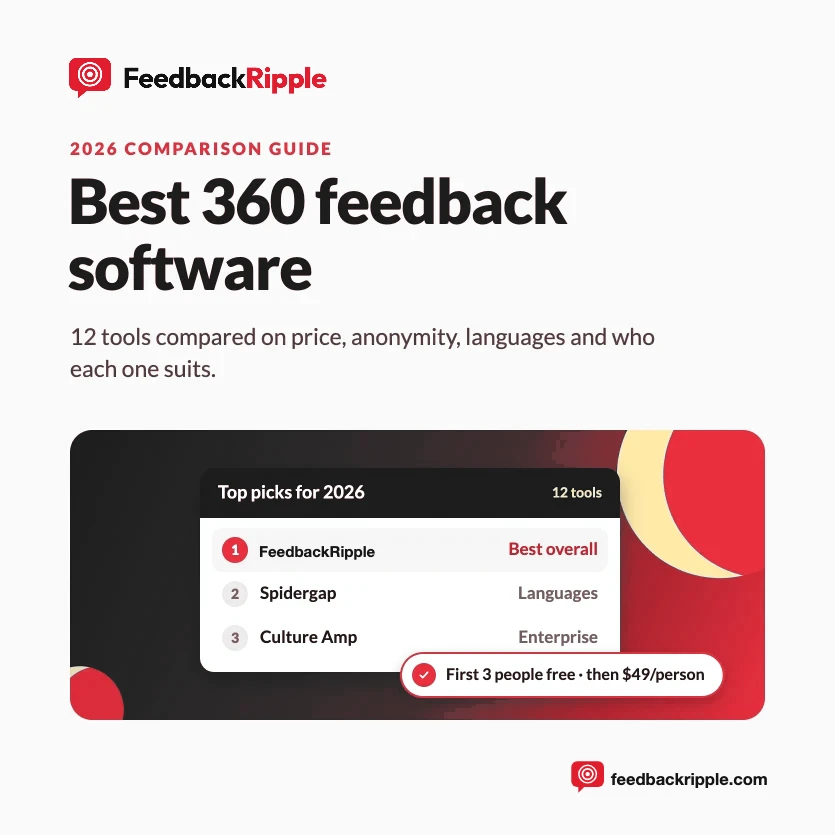
12 Best 360 Feedback Software Tools for 2026 (Compared)
12 Best 360 Feedback Software Tools for 2026 (Compared)
FeedbackRipple is the best 360 feedback software in 2026 for most coaches, HR and L&D teams. It turns feedback into a report that tells each person what to do next, keeps raters anonymous by how the data is stored, runs surveys in 15 languages, and follows up for 90 days with Lucy, its AI coach. Your first 3 people are free, and paid plans start at $49 per person.
Key takeaways
- FeedbackRipple is our top pick for coaches and HR teams: a report that says what to do next, anonymity built into how answers are stored, 15 survey languages and Lucy, a 90-day AI coach. Your first 3 people are free.
- Dedicated 360 tools charge per person reviewed. Performance suites charge every employee, every month, and some have minimums, like Lattice’s $4,000 a year.
- Need 100+ languages? Look at Spidergap or EchoSpan. Live in Microsoft Teams? Teamflect. Running company-wide listening? Qualtrics or Culture Amp.
- Keep 360s for development, not pay decisions, and check a tool’s anonymity rules before you buy.
Most 360 feedback ends the same way. People spend an hour answering honest questions, the person being reviewed gets a 20-page PDF of charts, and three months later nothing has changed. The problem is rarely the survey. It's what happens before and after it: whether raters trust that they're anonymous, and whether anyone helps the person turn scores into a plan.
So we didn't just compare price lists. We looked at the whole 360 from start to finish: setting it up, getting honest answers, reading the report and acting on it. We also looked at things most "best of" lists skip, like running a 360 in several languages, keeping data private across countries, and what you can do for free.
In this guide
- Which 360 feedback software is best?
- How do the tools compare?
- How we scored each tool
- 1. FeedbackRipple
- 2. Spidergap
- 3. Culture Amp
- 4. Lattice
- 5. Qualtrics EmployeeXM
- 6. Leapsome
- 7. 15Five
- 8. PerformYard
- 9. Teamflect
- 10. EchoSpan
- 11. CheckPoint 360°
- 12. Google Forms or SurveyMonkey
- Best picks by need
- Standalone 360 tool or performance suite?
- Global rollout checklist
- How much 360 feedback software costs
Which 360 feedback software is best?
Each tool suits a different kind of 360. Here are our picks by use case:
- FeedbackRipple: Best overall. A dedicated 360 tool for coaches and HR teams, with a report that says what to do next, anonymity built into how answers are stored, 15 survey languages and a 90-day AI coach. First 3 people free, then from $49 per person.
- Spidergap: Best for leadership 360s in many languages. A long-running dedicated 360 tool with clear reports and translation into 100+ languages, from $1,099 a year for 10 people.
- Culture Amp: Best for companies that already run engagement surveys. 360s sit inside a wider performance and engagement platform, priced by quote.
- Lattice: Best for 360s inside performance reviews. Peer feedback is part of each review cycle, with goals and 1-on-1s alongside.
- Qualtrics EmployeeXM: Best for large enterprises. Deep survey science and analytics for organizations with a people-analytics team and an enterprise budget.
- Leapsome: Best all-in-one platform for European teams. Berlin-based, modular, with reviews, goals, learning and surveys in one place.
- 15Five: Best for manager coaching and check-ins. 360s come with weekly check-ins and manager development, from $11 per user per month on Perform.
- PerformYard: Best for flexible review processes. Easy to shape around how your company already reviews people, including client and upward feedback.
- Teamflect: Best for Microsoft Teams users. Reviews and 360s run inside Teams and Outlook, with a free plan for up to 10 users.
- EchoSpan: Best for highly configurable 360 projects. A veteran 360 specialist with editions and paid add-ons for languages, analytics and SSO.
- CheckPoint 360°: Best ready-made leadership model. A fixed, research-based leadership survey from Wiley, usually run with a certified partner.
- Google Forms or SurveyMonkey: Best free DIY option. Fine for one or two informal 360s, as long as you can handle anonymity and reports by hand.
Disclosure: FeedbackRipple publishes this guide and is one of the tools in it. We put it first because it’s the option we know best for coaches and HR teams, and we list its limits as plainly as everyone else’s. Prices were checked in November 2026 from vendor pages and software directories; check the vendor’s own page before you buy.
How do the best 360 feedback tools compare?
Here's a side-by-side look at price, free options, languages and the kind of buyer each tool is built for. Prices are in USD and checked in November 2026. "Quote" means the vendor doesn't publish a price.
| Tool | Starting price | Free option | Type | Survey languages | Anonymity safeguards | Integrations | Best for |
|---|---|---|---|---|---|---|---|
| FeedbackRipple | $49 per person, or $469/yr for 12 people | Yes, first 3 people | Dedicated 360 | 15 | Answers stored with no link to raters, small groups merged, confidential mode on by default, comment privacy check | Slack, BambooHR, HiBob, Workday, Fireflies | Coaches, HR and L&D teams who want people to act on feedback |
| Spidergap | $1,099/yr for 10 people | One free trial 360 | Dedicated 360 | 100+ | Anonymized feedback, minimum group sizes | SSO on Pro | Leadership development, global teams |
| Culture Amp | Quote (per employee, annual) | No | Performance + engagement suite | Many | Reporting thresholds | HRIS, Slack, Teams | Mid-size and large companies |
| Lattice | $10/seat/mo (Performance), $4,000/yr minimum | No | Performance suite | Several | Anonymous peer feedback settings | HRIS, Slack, Teams | 360s inside review cycles |
| Qualtrics EmployeeXM | Quote | No | Enterprise experience platform | Many | Configurable thresholds | Workday, SAP and more | Large enterprises |
| Leapsome | Quote (per employee, modular) | 14-day trial | All-in-one people platform | Many | Anonymous reviews option | HRIS, Slack, Teams | European and global mid-size teams |
| 15Five | $11/user/mo (Perform) | No | Performance + engagement suite | Several | Anonymous options | HRIS, Slack, Teams | Manager coaching and check-ins |
| PerformYard | About $5–$10/person/mo (third-party estimates) | No | Performance management | English-first | Anonymous reviewer settings | HRIS | Custom review processes |
| Teamflect | $0 up to 10 users, then about $7–$14/user/mo | Yes, up to 10 users | Performance suite in Microsoft Teams | Several | Anonymous feedback option | Teams, Outlook, Planner, HRIS | Microsoft 365 companies |
| EchoSpan | Calculator; add-ons from $17/review | 14-day trial | Dedicated 360 | 100+ (paid add-on) | Rater minimums | SSO add-on | Configurable, larger 360 projects |
| CheckPoint 360° | Quote per participant (via partners) | No | Fixed leadership assessment | Several | Group minimums | None | Standard leadership model with a coach |
| Google Forms / SurveyMonkey | Free / $30 per user/mo | Yes | General survey tool | Any (you translate) | None built in | Sheets, exports | One-off, informal 360s |
Language counts and integrations come from each vendor's public pages. "Many" or "Several" means the vendor supports multiple languages but doesn't publish a single number we could confirm.
How we scored each tool
A 360 only works when raters are honest and the person does something with the results. So we scored every tool on six things that decide whether that happens, not on how long its feature list is:
- Report people can act on. Does the report explain what the scores mean and suggest next steps, or is it charts only?
- Anonymity safeguards. Minimum group sizes, protection against working out who said what, and help for raters who might give themselves away in a comment.
- Follow-through. Development plans, check-ins and a way to measure change after the report.
- Global readiness. Survey languages, data location, and how well it handles raters in different time zones.
- Price and fair start. Published prices, a free way to try it, and whether small teams and coaches can afford it.
- Admin effort. How long setup takes, and how much of the chasing and reporting is automatic.
| Tool | Actionable report | Anonymity safeguards | Follow-through | Global readiness | Price and free start | Admin effort |
|---|---|---|---|---|---|---|
| FeedbackRipple | ●●● Strong | ●●● Strong | ●●● Strong | ●●○ Good | ●●● Strong | ●●● Strong |
| Spidergap | ●●● Strong | ●●○ Good | ●●○ Good | ●●● Strong | ●●○ Good | ●●○ Good |
| Culture Amp | ●●○ Good | ●●○ Good | ●●○ Good | ●●● Strong | ●○○ Limited | ●●○ Good |
| Lattice | ●●○ Good | ●●○ Good | ●●○ Good | ●●○ Good | ●○○ Limited | ●●○ Good |
| Qualtrics EmployeeXM | ●●○ Good | ●●● Strong | ●●○ Good | ●●● Strong | ●○○ Limited | ●○○ Limited |
| Leapsome | ●●○ Good | ●●○ Good | ●●● Strong | ●●● Strong | ●○○ Limited | ●●○ Good |
| 15Five | ●●○ Good | ●●○ Good | ●●● Strong | ●●○ Good | ●●○ Good | ●●○ Good |
| PerformYard | ●●○ Good | ●●○ Good | ●●○ Good | ●○○ Limited | ●●○ Good | ●●● Strong |
| Teamflect | ●●○ Good | ●●○ Good | ●●○ Good | ●●○ Good | ●●● Strong | ●●● Strong |
| EchoSpan | ●●○ Good | ●●○ Good | ●●○ Good | ●●● Strong | ●●○ Good | ●●○ Good |
| CheckPoint 360° | ●●○ Good | ●●○ Good | ●●○ Good | ●●○ Good | ●○○ Limited | ●●○ Good |
| Google Forms / SurveyMonkey | ●○○ Limited | ●○○ Limited | ●○○ Limited | ●●○ Good | ●●● Strong | ●○○ Limited |
Scores reflect our reading of each vendor's public product pages, help centers, pricing pages and trials where one was available, checked in November 2026. FeedbackRipple is our product; see how we compared.
Tip: Before you commit to a yearly plan, run one real 360 in a free trial with 3 to 5 people. Watch how many raters finish, how comments read in the report, and whether the person knows what to do next.
1. FeedbackRipple: Best overall 360 feedback software
- Starting price: Free for your first 3 people, then $49 per person
- Best for: Executive coaches, HR and L&D teams
- Languages: 15 survey languages, comments translated
FeedbackRipple is a dedicated 360 feedback tool built around one idea: feedback is only useful if the person knows what to do next. Most 360 tools stop when the report is sent. FeedbackRipple covers the whole journey, from writing the questions to checking, 90 days later, whether anything changed.
It was built by a certified executive coach for two kinds of buyers: coaches who run 360s for their clients, and HR and L&D teams who run them across managers and leaders. Pricing is per person reviewed, and raters and questions are unlimited.
Key features
A report that says what to do next
Every report shows the person's top 5 strengths and top 5 areas to improve, blind spots and hidden strengths, and comments grouped by relationship. After each part comes plain-language guidance: what to try in the next 30 days and how you'll know it's working. A personal development plan is pre-filled with the areas that need most work. See the feedback report.
Anonymity built into the data
Answers are stored with no link back to who gave them. Groups smaller than 3 are merged into "All colleagues", so nobody can subtract one group from another to find a single rater. Confidential mode is on by default: admins see progress, not answers. Read how anonymity works.
A comment helper that protects raters
Before a rater submits, FeedbackRipple can point out comments that might reveal who wrote them (a date, a meeting, "as the only designer") and suggest safer wording. Suggestions stay hidden until the rater asks to see them, and the rater always decides.
Set up a 360 by describing it
Type one sentence, like "a new manager 360 for Maya, due in 3 weeks", and FeedbackRipple drafts the questionnaire, raters and deadline for you to review. You can also start from expert templates or a library of 82 questions in 18 themes. See AI 360 setup.
Surveys raters actually finish
One section per step, open questions at the end, a "Need help" button that answers common questions, and the option to pause and come back. Raters can answer in any of 15 languages, and their comments are translated into English in the report. See the rater survey.
Admin work that runs itself
Reminders go out on a schedule, you can see who hasn't answered, and FeedbackRipple warns you before closing if someone's report wouldn't have enough answers to stay anonymous. People can nominate their own raters for you to approve. See automation and integrations.
Group results and HR insights
For teams, FeedbackRipple rolls up results across a group, ranks the gaps that matter most and lets you ask plain questions, like "What changed since last year?". It can draft L&D recommendations from the grouped data, never from one person's answers. See HR insights.
Follow-through and impact
An impact survey asks the person's colleagues, weeks later, whether they've seen a change. You can re-run a 360 for the same person free within 12 months. See development plans.
Meet Lucy, the 90-day coach in every report
Lucy is FeedbackRipple's AI coach. After reading their report, the person can ask Lucy what a score means, pick 2 or 3 focus areas and turn them into a development plan. Lucy then checks in at 30, 60 and 90 days and can suggest a quick follow-up 360 to measure progress.
- Lucy only starts when the person chooses to, after agreeing to how it works.
- Lucy's conversations are private to the person. Admins never see the plan or the chat.
- Lucy is designed around the ICF Core Competencies and Code of Ethics. Your coach or manager is still the one who decides.
Works with the tools you already use.
- Slack: invitations and reminders as direct messages, and short surveys answered right inside Slack
- BambooHR, HiBob and Workday: fill each person's raters from your org chart
- Fireflies: use meeting notes as context when drafting a 360
- Google and Microsoft sign-in, plus your own logo and colors on surveys, reports and emails
Pros
- The only tool here whose report ends in clear next steps and a ready-made development plan
- Anonymity rules are built into how answers are stored, not just how they're displayed
- Follows up for 90 days with Lucy, check-ins and an impact survey
- Published prices, first 3 people free, no credit card
- Usually less than half the price of other dedicated 360 tools
- AI only runs when someone clicks, and your data isn't used to train AI models
Cons
- A newer product, so it has fewer third-party reviews than long-running tools
- 15 survey languages, fewer than the 100+ offered by Spidergap and EchoSpan
- Hosted on AWS in Sydney; there's no choice of US or EU data location yet
- SSO is on the roadmap but not available yet
- Not a full performance suite: no OKRs, compensation or payroll
Who it's best for
Executive and leadership coaches who want a professional 360 for each client without paying enterprise prices, with their own logo and separate client workspaces. HR and L&D teams running 360s for managers and leaders who want results to turn into development, not a filed PDF. Small and mid-size companies that want a dedicated 360 tool rather than a whole performance suite.
Pricing
- Free trial: your first 3 people reviewed, every feature, no card
- Pay as you go: $49 per person, no subscription
- Coach: $469 a year for 12 people, then $39 each
- Team (most popular): $1,069 a year for 30 people, then $29 each
- Enterprise: from $5,029 a year for 250 people, then $19 each
Yearly plans can also be paid monthly. See full FeedbackRipple pricing.
FeedbackRipple · First 3 people free
Try FeedbackRipple free
Set up a 360 by describing it in one sentence, invite raters and get a report that says what to do next. Your first 3 people are free, no credit card.
2. Spidergap: Best for leadership 360s in many languages
- Starting price: $1,099/yr for 10 people
- Best for: Leadership development, global teams
- Languages: 100+
Spidergap has been running 360s since 2011 and is one of the best-known dedicated 360 tools. Its reports are easy to read, with a clear summary of strengths, development areas and blind spots, plus a development plan. Its biggest strength for global buyers is translation into more than 100 languages.
Key features
- Best-practice questionnaire template you can fully change
- Employee-friendly report with a personal development plan
- Your own logo, anonymized feedback and translation into 100+ languages
- Free reassessment within 12 months and help from 360 experts
- ISO 27001 certified, with EU hosting
Pros
- Proven, focused 360 tool with a strong reputation
- Excellent language coverage
- One free trial 360 with expert support
Cons
- Starts at $1,099 a year, even if you only need 3 people
- No AI help for setup, comments or follow-up that we could find on its public pages
- Follow-up after the report is mostly up to you
Pricing
Starter is $1,099 a year for 10 people, then $89 each. Pro is $2,199 a year for 10 people, then $59 each, and adds self-enrollment and SSO. Enterprise is by quote. Compare in detail: FeedbackRipple vs Spidergap.
3. Culture Amp: Best for companies already running engagement surveys
- Starting price: Quote, per employee, billed yearly
- Best for: Mid-size and large companies
- Type: Performance + engagement suite
Culture Amp is best known for engagement surveys. Its Perform module adds performance reviews with 360, peer and manager feedback, goals and 1-on-1s, and its Develop module covers individual, leadership and manager 360s. If you already use Culture Amp for engagement, adding 360s keeps everything in one place.
Key features
- 360, peer and manager feedback within review cycles
- Leadership and manager 360 templates backed by people science
- Strong analytics and benchmarks across engagement and performance
- AI help for writing and summarizing feedback
Pros
- Combines engagement and performance data
- Well-researched templates
- Good for large, multi-country companies
Cons
- No public pricing; a third-party estimate puts the minimum around $4,500 a year
- Priced per employee, so you pay for everyone, not just the people reviewed
- More platform than a coach or small team needs
Pricing
Quote only, billed yearly per employee and by module (Engage, Perform, Develop). See FeedbackRipple vs Culture Amp.
4. Lattice: Best for 360s inside performance reviews
- Starting price: $10/seat/month (Performance)
- Best for: Companies standardizing review cycles
- Minimum: $4,000 a year
Lattice is a popular performance management platform. Its 360 feedback lives inside review cycles: people nominate peers, managers approve, and the feedback sits beside self and manager reviews. It's a good choice if your 360s are part of your regular review process rather than separate development projects.
Key features
- Peer, upward and self reviews in one cycle, with calibration
- Goals and OKRs, 1-on-1s and growth plans
- An AI agent for HR and manager tools
- Strong HRIS and Slack integrations
Pros
- Polished, widely adopted product
- Everything performance-related in one place
- Published per-seat prices
Cons
- $4,000 yearly minimum and annual billing only
- 360s are tied to reviews, which can make raters less candid
- Not built for coaches running 360s for outside clients
Pricing
Performance is $10 per seat per month and Foundations (Performance plus Goals) is $13, billed yearly, with a $4,000 minimum. See FeedbackRipple vs Lattice.
5. Qualtrics EmployeeXM: Best for large enterprises
- Starting price: Quote
- Best for: Enterprises with people-analytics teams
- Type: Employee experience platform
Qualtrics is a survey research powerhouse. Its 360 Development offering runs on the same platform as engagement, pulse and lifecycle surveys, so 360 results can sit alongside everything else you know about the employee experience. It's built for scale, closing skill gaps across thousands of people.
Key features
- 360 development programs on the same data layer as engagement and lifecycle surveys
- Advanced analytics, text analysis and dashboards
- Deep integrations with enterprise HR systems
- Expert frameworks and services
Pros
- Enterprise-grade analytics and security
- Handles very large, global programs
- One platform for all employee listening
Cons
- Quote-only pricing, priced by employee count
- Setup often needs a project team or partner
- Far more than a coach or small company needs
Pricing
Quote only. 360 Development is priced by number of employees as part of the EmployeeXM suite.
6. Leapsome: Best all-in-one platform for European teams
- Starting price: Quote, per employee, by module
- Best for: Mid-size companies in Europe and beyond
- Trial: 14 days
Leapsome is a Berlin-based people platform that combines reviews and 360s with goals, engagement surveys, learning, 1-on-1s and compensation. Its 360s connect to learning: feedback can lead to suggested learning paths. European buyers often shortlist it for its GDPR-minded approach.
Key features
- Performance reviews and 360s with templates for leadership reviews
- Learning paths recommended from feedback
- Goals, OKRs, surveys and 1-on-1s in one platform
- AI copilot and summaries
Pros
- Very broad, connected feature set
- Strong fit for European data expectations
- Links feedback to learning
Cons
- Modular per-employee pricing adds up quickly
- One-year minimum contracts
- Heavy for teams that only want 360s
Pricing
Leapsome doesn't publish a full price list. Its HRIS foundation was listed at about $7 per employee per month in October 2026, with each module priced on top. Expect a quote.
7. 15Five: Best for manager coaching and check-ins
- Starting price: $11/user/month (Perform)
- Best for: Companies building manager habits
- Free plan: No
15Five is built around weekly check-ins and manager effectiveness. Its Perform plan adds performance reviews, 360 feedback, goals and career paths. 360s here are part of a continuous performance rhythm rather than standalone development projects.
Key features
- 360 feedback within performance reviews
- Weekly check-ins, 1-on-1s and recognition
- Manager training and an HR outcomes dashboard on Total Platform
- AI help for reviews and managers
Pros
- Published prices with no minimum seats
- Strong focus on managers and ongoing habits
- Engagement and performance together
Cons
- You pay per user for everyone, not per person reviewed
- 360s aren't the main focus
- No free plan
Pricing
Engage is $4, Perform (with 360s) is $11 and Total Platform is $16 per user per month, billed yearly.
8. PerformYard: Best for flexible review processes
- Starting price: About $5–$10/person/month (estimates)
- Best for: HR teams with their own review process
- Free trial: No
PerformYard lets HR shape reviews around how the company already works, rather than forcing a fixed process. 360s can include peers, direct reports and even clients, and the tool handles sign-offs and reminders. Reviewers like how simple it is for employees.
Key features
- 360, upward, peer and external client reviews
- Flexible review cycles with sign-off routing
- Goals, check-ins and 9-box reporting
- Optional AI writing help
Pros
- Very flexible review design
- Easy for employees to use
- Responsive support
Cons
- No public price list, no free trial, and an annual minimum
- Light on development guidance in reports
- English-first
Pricing
Quote. Third-party sources put it at roughly $5 to $10 per person per month, billed yearly.
9. Teamflect: Best for Microsoft Teams users
- Starting price: Free up to 10 users
- Best for: Microsoft 365 companies
- Works in: Teams and Outlook
Teamflect runs reviews, goals, 1-on-1s and 360 feedback inside Microsoft Teams. If your company lives in Teams, people can request and give feedback without opening another app. It also supports external and anonymous feedback, with AI summaries.
Key features
- 360 feedback and instant feedback in Teams chat
- External and anonymous feedback
- Tasks synced with Planner and To Do
- AI-assisted feedback summaries
Pros
- Very easy adoption for Teams users
- Free plan for up to 10 users
- Affordable paid plans
Cons
- Much less useful outside Microsoft 365
- A performance suite first, with lighter 360 reports
- Prices vary between sections of its pricing page
Pricing
Starter is free for up to 10 users. Paid plans run roughly $7 to $14 per user per month, with about 22% off for yearly billing.
10. EchoSpan: Best for highly configurable 360 projects
- Starting price: Calculator on its site
- Best for: Larger or complex 360 programs
- Trial: 14 days
EchoSpan has specialized in 360s since 2005. It offers three editions (360 Essentials, Professional and Professional Plus) and lots of options, from competency libraries to custom reports. Many extras are paid add-ons, so the final price depends on what you switch on.
Key features
- Competency library and configurable reports
- Multi-language surveys in 100+ languages (add-on)
- Insights toolkit and project management help (add-ons)
- SSO and enterprise support (add-ons)
Pros
- Long track record in 360s
- Highly configurable
- Wide language support
Cons
- Base prices sit behind a calculator
- Add-ons cost extra: multi-language $17 per review, insights $44 per review, SSO $1,200 a year
- Older-feeling interface
Pricing
Use the calculator on its site. Directories list editions from about $6 per user per month. See FeedbackRipple vs EchoSpan.
11. CheckPoint 360°: Best ready-made leadership model
- Starting price: Quote per participant
- Best for: Coach-led leadership programs
- Sold by: Wiley partners
CheckPoint 360° is a fixed leadership survey from Wiley, with about 70 questions across a set of core leadership competencies such as communication, adaptability, task management and developing others. You don't write questions; you use a tested model. It's usually bought and debriefed through a certified partner or coach.
Pros
- Research-based leadership model
- Consistent results across leaders
- Good fit with coach-led programs
Cons
- You can't fit questions to your own values or roles
- Pricing and access go through partners
- A long survey for raters
Pricing
Priced per participant through Wiley's partners. Ask a partner for a quote.
12. Google Forms or SurveyMonkey: Best free DIY option
- Starting price: Free (Google Forms)
- Best for: One-off, informal 360s
- SurveyMonkey: $30/user/month, 3-user minimum
You can run a basic 360 with a general survey tool: one form per person, a link per rater group, and a spreadsheet to pull results together. It costs nothing with Google Forms, and it works for one or two informal 360s.
Pros
- Free or already paid for
- Fully flexible questions
- Familiar for raters
Cons
- No anonymity rules: small groups can expose raters
- Every report is built by hand
- No reminders per rater, plans or follow-up
Pricing
Google Forms is free. SurveyMonkey Team Advantage is $30 per user per month, billed yearly, with a 3-user minimum. Read running 360s in SurveyMonkey or Google Forms before you start, or grab our free 360 feedback survey template.
Best 360 feedback software by need
Best free and budget 360 feedback software
FeedbackRipple lets you review your first 3 people free with every feature, then pay $49 per person with no subscription. Teamflect is free for up to 10 users if you work in Microsoft Teams. Google Forms is free if you're happy to handle anonymity and reports yourself. Spidergap's free trial covers one 360.
Best for executive and leadership coaches
FeedbackRipple's Coach plan ($469 a year for 12 clients) adds your logo, separate client workspaces and report approval before release. Spidergap and CheckPoint 360° are well-known alternatives, at higher prices per person. See 360 feedback for executive coaches.
Best for small and mid-size businesses
FeedbackRipple (Team plan, 30 people for $1,069 a year) for dedicated 360s; 15Five or PerformYard if you also want a full review process.
Best for enterprises
Qualtrics EmployeeXM and Culture Amp for company-wide listening programs. FeedbackRipple Enterprise covers 250 people from $5,029 a year with Workday sync and invoice billing, if you want dedicated 360s without an enterprise suite.
Best for leadership development 360s
Leadership 360s work best when they're about growth, not ratings for pay. FeedbackRipple (leadership and senior leader templates, guidance and a 90-day plan), Spidergap and CheckPoint 360° are built for this. See our leadership 360 assessment.
Best for Microsoft Teams or Slack companies
Teamflect if you live in Microsoft Teams. FeedbackRipple if you use Slack: invites and reminders arrive as direct messages, and short surveys can be answered without leaving Slack.
Best for global teams
Spidergap and EchoSpan for the widest language coverage. FeedbackRipple for 15 languages with comments translated into English in the report, so a manager in New York can read feedback written in Spanish or Japanese.
Standalone 360 tool or performance suite: how to choose
360 tools come in two kinds, and picking the wrong kind is the most common mistake buyers make.
A standalone 360 tool (FeedbackRipple, Spidergap, EchoSpan, CheckPoint 360°) does one thing well: collect honest feedback from several groups and turn it into a development report. You pay for the people you review, and you can run it whenever you need it, for a leadership program or a coaching client.
A performance suite (Lattice, Culture Amp, 15Five, Leapsome, PerformYard, Teamflect) includes 360s as one part of reviews, goals, check-ins and sometimes compensation. You pay per employee for everyone, every year.
| Choose… | If you… |
|---|---|
| A standalone 360 tool | Run 360s for development, leadership programs or coaching clients; review a subset of people; want stronger anonymity and better reports; already have an HRIS or review tool |
| A performance suite | Want one system for reviews, goals and 1-on-1s across the whole company; are ready to pay per employee; are happy for 360s to be part of formal reviews |
One warning: mixing 360s with pay or promotion decisions tends to make raters less honest. Many organizations keep 360s for development only, even when they own a suite. For more on this, read how to choose 360 feedback software.
Global 360 rollout checklist
Running a 360 across countries adds a few things most guides skip. Use this list before you choose a tool:
- Languages: Can raters answer in their own language? Are comments translated for the person and their coach, or left untranslated?
- Data location: Where are answers stored, and does that meet your rules? EU companies often ask for EU hosting; check before you sign.
- GDPR and privacy notices: Is there a data processing agreement? Can you delete a 360 and everything in it when you're done?
- AI and your data: If the tool uses AI, is your data used to train models? Can AI be switched off or left unused?
- Anonymity in small teams: Remote and regional teams are often small. Does the tool merge small groups automatically?
- Time zones: Do deadlines and reminders use each organization's time zone?
- Cultural fit of the scale: Some cultures avoid the top or bottom of a scale. Choose clear, behavior-based questions and word labels, not just numbers.
- Manager visibility: In some countries, works councils or local law restrict what managers can see. Check confidential or private-report settings.
Tip: If your raters speak different languages, keep questions short and behavior-based, like “Gives clear feedback in one-to-ones”. Short, concrete questions translate far better than long ones.
What should you look for in 360 feedback software?
- Anonymity that holds up. Minimum group sizes, no way to filter results down to one rater, and help for raters writing comments.
- Good questions. A library and templates with one observable behavior per question, so feedback is specific.
- Easy for raters. Short, mobile-friendly surveys in their language, with a way to stop and come back.
- A report people understand. Plain words, top strengths and gaps, and suggestions for what to do next.
- Follow-through. A development plan, check-ins and a way to measure change.
- Less admin. Automatic reminders, rater nominations and org-chart sync.
- Fair, clear pricing. Published prices and a way to try before you buy.
How much does 360 feedback software cost?
Most dedicated 360 feedback software costs about $20 to $110 per person reviewed per year. Dedicated 360 tools usually charge per person reviewed, while performance suites charge $4 to $16 per employee per month for everyone. Free options exist for small teams.
- Free: FeedbackRipple (first 3 people), Teamflect (up to 10 users), Google Forms.
- Dedicated 360 tools: FeedbackRipple from $49 per person or $469 a year for 12; Spidergap from $1,099 a year for 10; EchoSpan by calculator plus add-ons; CheckPoint 360° per participant through partners.
- Performance suites: 15Five $11 per user per month (Perform), Lattice $10 per seat per month with a $4,000 minimum, and Culture Amp, Leapsome, PerformYard and Qualtrics by quote.
Here's what 30 people reviewed costs for a year in a few common setups:
| Setup | Cost for 30 people a year |
|---|---|
| FeedbackRipple Team | $1,069 |
| Spidergap Starter (10 + 20 × $89) | $2,879 |
| Lattice Performance (if you have 30 employees) | $4,000 (minimum applies) |
| 15Five Perform (company of 100 employees) | $13,200 |
How we compared these tools
We compared each tool on the six areas in our scoring: actionable reports, anonymity safeguards, follow-through, global readiness, price and admin effort. Competitor details come from each vendor's public website, pricing page, help center and free trial where available, and from software directories such as Capterra and G2, checked in November 2026. We'll update this guide every month as prices and features change.
FeedbackRipple is our product, and we've ranked it first. Every other tool is described as fairly as we can from public information, including where it's the better choice. If you spot something out of date, email hello@feedbackripple.com.
First 3 people free · No credit card
Run a 360 people actually act on
Anonymous by design, a report that says what to do next, and Lucy to follow up for 90 days. Try every feature with your first 3 people, then pay only for the people you review.