
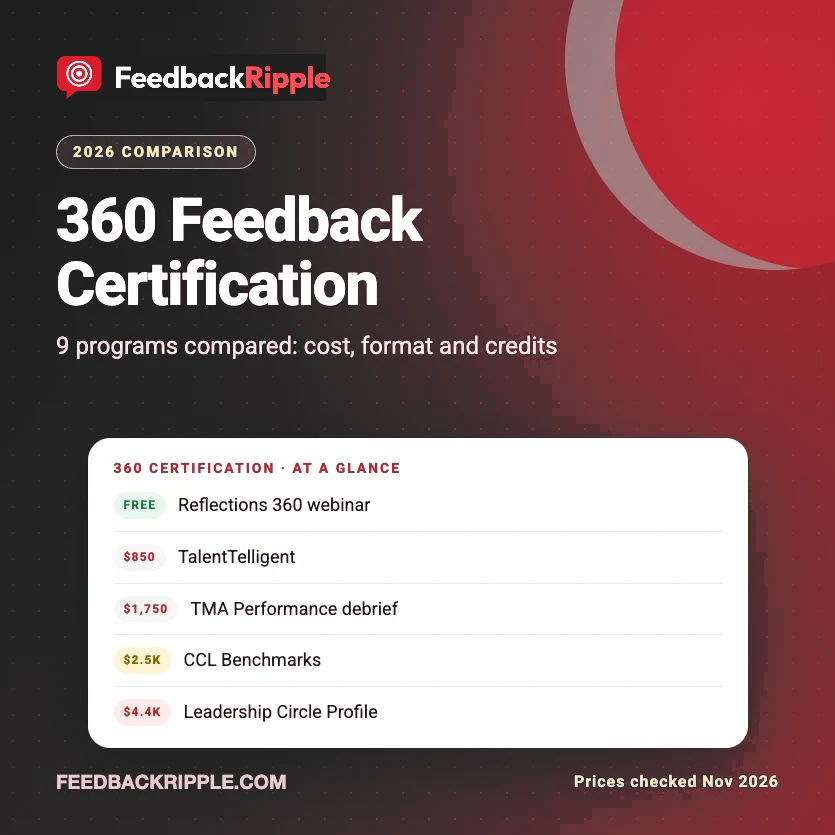
360 Feedback Certification: 9 Programs Compared (Cost, Format and Credits, 2026)
360 Feedback Certification: 9 Programs Compared (Cost, Format and Credits, 2026)
A 360 feedback certification is training that qualifies you to run a specific 360 assessment and debrief its results with leaders. Most programs are run by the company that owns the tool, cost roughly $850 to $4,400, and take from a few hours to about 29 hours. You usually only need one if you want to use that vendor’s 360. If you simply want to run good 360s and coach people through them, debrief skills matter more than a badge, and some tools (including ours) don’t require certification at all. Prices below were last checked on November 20, 2026.
Key takeaways
- Most certifications are tool licences. Korn Ferry, CCL, Leadership Circle and Zenger Folkman certify you to use their 360, not 360s in general.
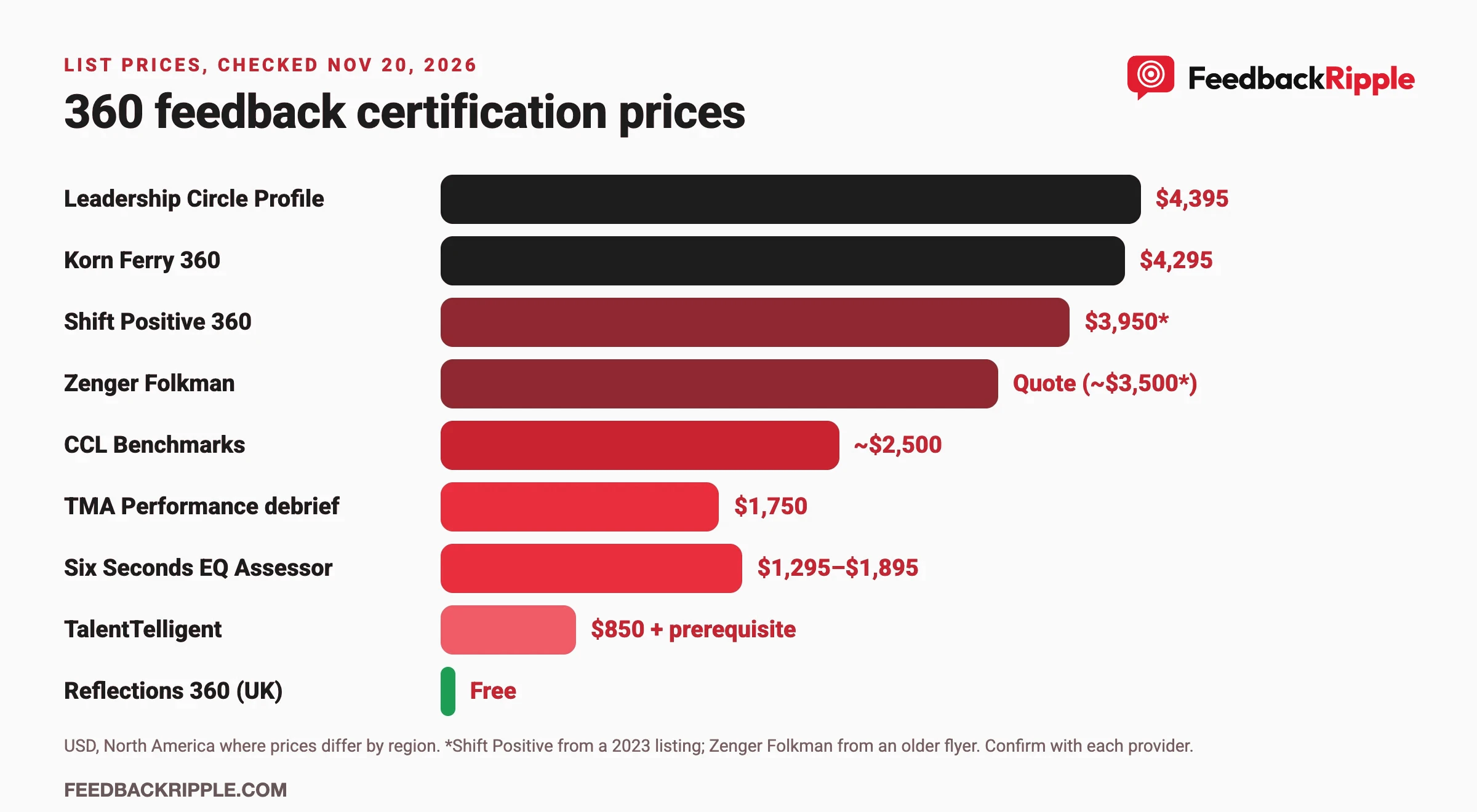
- Costs range widely: from a free webinar (Reflections 360) and $850 (TalentTelligent) to $4,295 (Korn Ferry) and $4,395 (Leadership Circle).
- Coaches can earn credits. Leadership Circle’s program is approved for 29.25 ICF CCEUs; TMA Performance’s debrief certification earns 7 SHRM PDCs.
- A general debrief course is the best fit if you want skills you can use with any 360.
- You don’t need a certification to run a 360. You need a sound tool, protected anonymity and a good debrief.
If you’ve searched for “360 feedback certification”, you’ve probably noticed something: almost every result is a different company selling its own program, and very few show a price. So you end up with six tabs open, trying to work out which one actually fits. And that’s truly frustrating when the prices range from free to over $4,000.
Here’s a single, honest comparison instead. One quick disclosure first: FeedbackRipple is 360 feedback software, not a certification body, and we don’t sell a certification. So you won’t find us in the table. But we work with coaches and HR teams every day, so we can genuinely help you decide whether you need one, and which.
In this guide
What a 360 feedback certification is
A 360 feedback certification is a course, usually followed by practice or an exam, that teaches you to set up a 360, read the report and run a debrief conversation. In practice, there are two quite different kinds:
- Tool certifications. These licence you to administer one vendor’s 360, for instance CCL’s Benchmarks or the Leadership Circle Profile. You typically can’t buy or run that 360 until you’re certified.
- Debrief and coaching skill programs. These focus on how to interpret any 360 report and coach someone through it. The badge matters less; the skill transfers.
Most certifications tend to be aimed at three groups: external coaches, internal HR and L&D teams, and consultants who run leadership programs. If you’re a rater or someone receiving a 360, you don’t need one. Our guides on how to give 360 feedback and what 360 degree feedback is will serve you better.
9 360 feedback certifications compared
Here’s the side-by-side view. Prices are list prices in US dollars unless noted, checked on November 20, 2026. They change, and many vendors offer regional, early-bird or group pricing, so always confirm before you book.
| Program | Price | Format and time | Credits | What you can use afterwards |
|---|---|---|---|---|
| Leadership Circle Profile | $4,395 (North America); €2,999 (EU shop) | Virtual or in person, about 29 hours over 3–5 days | ICF 29.25 CCEUs; SHRM and ATD accredited | Leadership Circle Profile 360 |
| Korn Ferry 360 | $4,295 (NA); £3,250 (EMEA) | Blended: eLearning plus three 3-hour live virtual sessions | HRCI, per Korn Ferry | Korn Ferry 360 and Leadership Architect |
| Shift Positive 360 | $3,950 (2023 listing) | Live online, 4 sessions of 3 hours | 15 ICF CCE hours | Shift Positive 360 (narrative 360) |
| Zenger Folkman Extraordinary Leader | Quote (an older flyer listed $3,500 incl. your own 360 and debrief) | Live online, 3 half-day sessions, or in person | Not listed | Extraordinary Leader 360 |
| CCL 360 Assessment Certification | About $2,500 | Self-paced online, about 10 hours, finish within 90 days, plus exam | Continuing education credits | CCL Benchmarks suite and Skillscope |
| TMA Performance (DecisionWise) Debrief Certification | $1,750 | Live virtual | 7 SHRM PDCs | Debrief method; DecisionWise/Spectiv 360 |
| Six Seconds EQ Assessor (SEI 360) | $1,295–$1,895 by region | Hybrid: eLearning plus live sessions | Not listed for this course | SEI and SEI 360 (emotional intelligence) |
| TalentTelligent 360 Coaching and Feedback | $850 (plus a required Foundations course) | Self-paced eLearning with facilitated check-ins | Not listed | TalentTelligent 360 surveys |
| Reflections 360 (UK) | Free | Certification webinar | None | Reflections 360 survey builder and report |
Program profiles
1. Leadership Circle Profile Certification
The Leadership Circle Profile is popular with executive coaches, given that it measures both creative leadership competencies and reactive tendencies. Certification takes about 29 hours over 3–5 days, is approved for 29.25 ICF CCEUs, and is also SHRM- and ATD-accredited. It’s designed for people with one-to-one coaching experience, and it lists at $4,395 in the North American shop. Best for: external coaches who want a deep, coaching-led 360 and ICF credits.
2. Korn Ferry 360 Certification
Korn Ferry’s program blends eLearning with three live virtual sessions, including small-group feedback practice. It costs $4,295 in North America and £3,250 in EMEA, and it’s built around Korn Ferry’s Leadership Architect competency library. Best for: HR teams in organizations that already use Korn Ferry tools.
3. Shift Positive 360 Certification
Shift Positive takes a positive psychology approach and uses a narrative, interview-style 360. Its certification appeared on ICF’s events site at $3,950 for four 3-hour online sessions, with 15 ICF CCE hours. That listing is from 2023, so do check the current price. Best for: coaches who prefer qualitative, strengths-focused 360s.
4. Zenger Folkman Extraordinary Leader 360 Assessment Certification
Zenger Folkman’s certification trains experienced coaches to debrief the Extraordinary Leader 360 using a strengths-based approach. You take the 360 yourself first, then attend the certification (recent virtual dates run over three half-days). Pricing is by quote today; an older flyer listed $3,500 including your own assessment and a debrief with a Master Coach. Best for: organizations committed to a strengths-based leadership model.
5. CCL 360 Assessment Certification
The Center for Creative Leadership’s course is self-paced, about 10 hours, and has to be finished (with the exam) within 90 days of purchase. Afterwards you’re authorized to run CCL’s Benchmarks suite and Skillscope. Third-party listings put it at about $2,500. In Australia, New Zealand and Asia, The Myers-Briggs Company runs CCL Benchmarks certification as a workshop. Best for: HR and L&D teams that want a well-known, research-backed 360 and a flexible schedule.
6. TMA Performance (DecisionWise) 360 Feedback Debrief Certification
This program is one of the few that focuses on the debrief itself: reading results, handling emotional reactions and turning feedback into action plans. It costs $1,750 per participant and earns 7 SHRM PDCs. Best for: HR business partners and coaches who want transferable debrief skills at a moderate price, so that they can use them with any 360.
7. Six Seconds EQ Assessor (SEI 360)
If your focus is emotional intelligence, Six Seconds’ EQ Assessor certification unlocks the SEI and the SEI 360, a multi-rater emotional intelligence tool. It mixes eLearning and live sessions, and Six Seconds lists the investment at $1,295 to $1,895 depending on region. Best for: coaches and trainers who specialize in emotional intelligence. (We also cover emotional intelligence 360s.)
8. TalentTelligent 360 Coaching and Feedback Certification
TalentTelligent’s course is one of the most affordable paid options at $850, self-paced with facilitated check-ins. Note that it requires their Foundations course first. It prepares you to run leader, manager and individual contributor 360s from their library. Best for: HR teams on a budget who want a ready-made competency library.
9. Reflections 360 (UK)
Advanced People Strategies’ Reflections 360 offers a free certification webinar that shows you how to build custom 360 surveys and interpret its multi-rater report. Best for: UK teams who want to try a tool-specific certification without a big upfront cost.
Notice a pattern? Every program except the TMA debrief course is mainly about one vendor’s tool. That’s fine if you’ve chosen that tool. But it’s worth knowing before you pay $4,000 for a badge you can only use with one product.
FeedbackRipple · First 3 people free
Run a 360 with no certification needed
FeedbackRipple drafts the questions, protects anonymity and gives you a report that ends with what to try next, so you can focus on the debrief. Your first 3 people are free.
Tool certification vs debrief and coaching skills
This is the part no vendor page explains, and it’s really the key decision:

| Tool certification | Debrief and coaching skills | |
|---|---|---|
| What you get | A licence to buy and run one vendor’s 360 | Skills you can use with any 360 report |
| Typical cost | $2,500–$4,400 | Free to about $1,750 |
| When it’s required | When you want that specific 360 | Never required, but always useful |
| Ongoing costs | Per-assessment fees, sometimes refresher courses | Usually none |
| Best for | Organizations standardizing on one model | Coaches and HR teams working with several tools |
So you have to ask yourself one question first: “Do I want this particular 360, or do I want to be good at 360s?” If it’s the first, get that vendor’s certification. If it’s the second, a debrief course (or a coaching qualification you may already hold) plus a tool that doesn’t gate access is usually the better investment. In practice, that choice can help you save thousands, especially if you work with clients who already use different tools.
How much a 360 certification costs (including free options)
Based on the programs above, here’s roughly what to budget:
- Free: vendor webinars such as Reflections 360, plus free guides from 360 vendors (including our 60-minute debrief guide and kit).
- Under $1,000: TalentTelligent ($850, plus its prerequisite) and short online courses on 360 basics, which teach the concepts but aren’t certifications.
- $1,000–$2,500: TMA Performance’s debrief certification ($1,750), Six Seconds EQ Assessor ($1,295–$1,895) and CCL (about $2,500).
- $3,500–$4,400: Zenger Folkman, Shift Positive, Korn Ferry and Leadership Circle.
And remember the second cost: with tool certifications, you typically still pay for each assessment you run afterwards, and some programs charge for refreshers. For instance, Korn Ferry sells a $500 eLearning refresher for its 360.
Best 360 certification by role

| Your role | Your goal | Good fit |
|---|---|---|
| External executive coach | A deep 360 plus ICF credits | Leadership Circle; Shift Positive |
| External coach on a budget | Debrief skills with any tool | TMA Performance debrief certification |
| Internal HR business partner | Run 360s for managers | CCL (self-paced) or a no-certification tool |
| L&D team | A 360 inside a leadership program | CCL, Zenger Folkman or Korn Ferry, matched to your competency model |
| EQ specialist | Measure emotional intelligence | Six Seconds EQ Assessor |
| Small HR team | Low cost, quick start | TalentTelligent, Reflections 360 or a no-certification tool |
How to use FeedbackRipple after your certification
Here’s a question we hear from certified coaches and HR teams: “I’ve done the certification. Now how do I actually run 360s, for clients or inside my own company, without the admin taking over?” So here’s how it works in FeedbackRipple, using screens from the real app.
1. Bring your competency framework
Most certifications teach you to think in competencies. In FeedbackRipple, you can build a competency model in a few minutes, or import the framework you already use from Excel or CSV (one row per behavior, with the competency, its definition, the expected level and the behavior). You can also name the rating levels the way you were trained, for instance Basic to Expert.
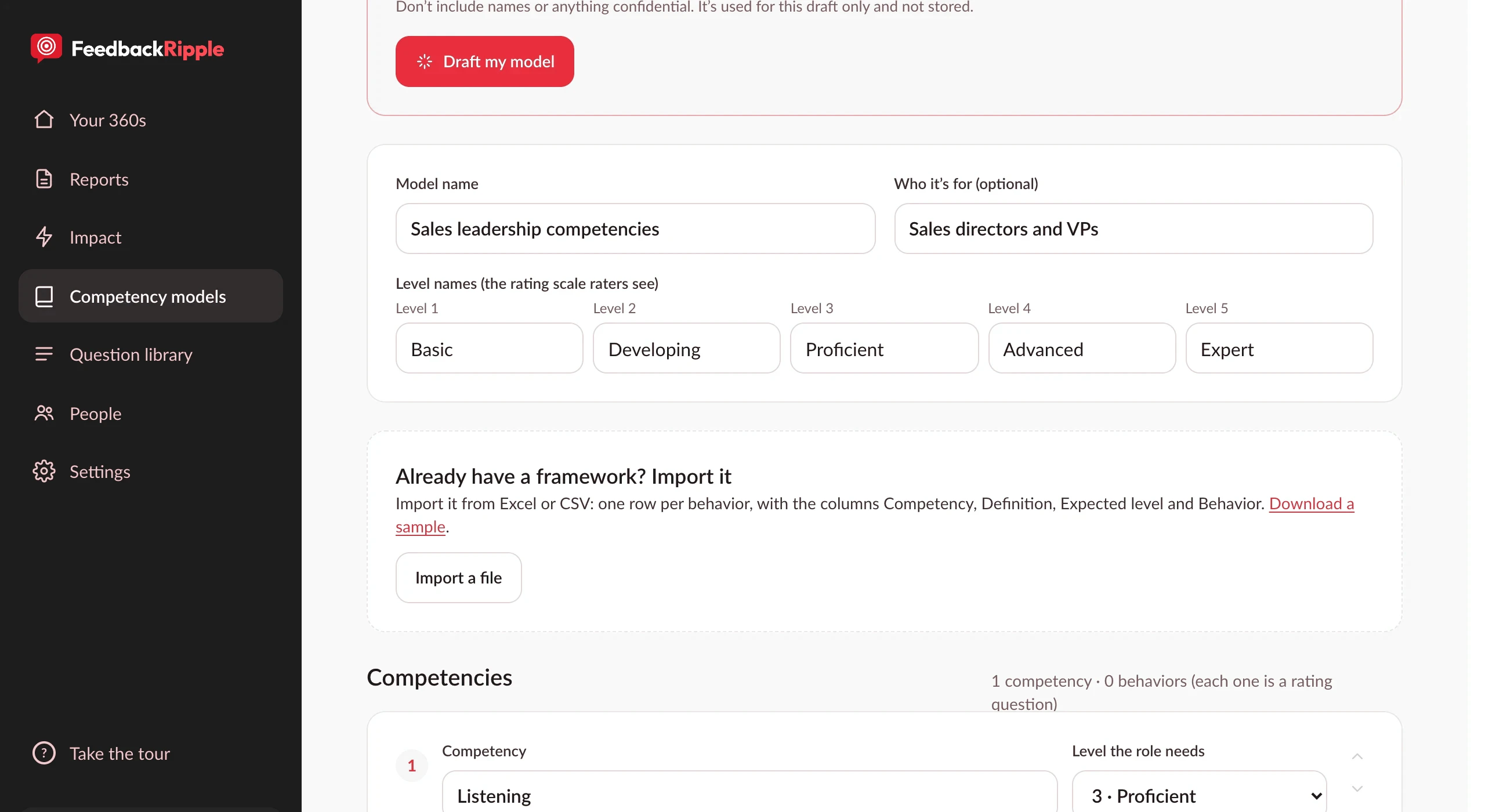
One honest note: a vendor’s own competency library (Korn Ferry’s Leadership Architect, for example) is usually licensed to that vendor’s tool. So import your own or your organization’s framework, and check your licence before you copy anything from a certification program.
2. Set up a client’s 360 in one sentence
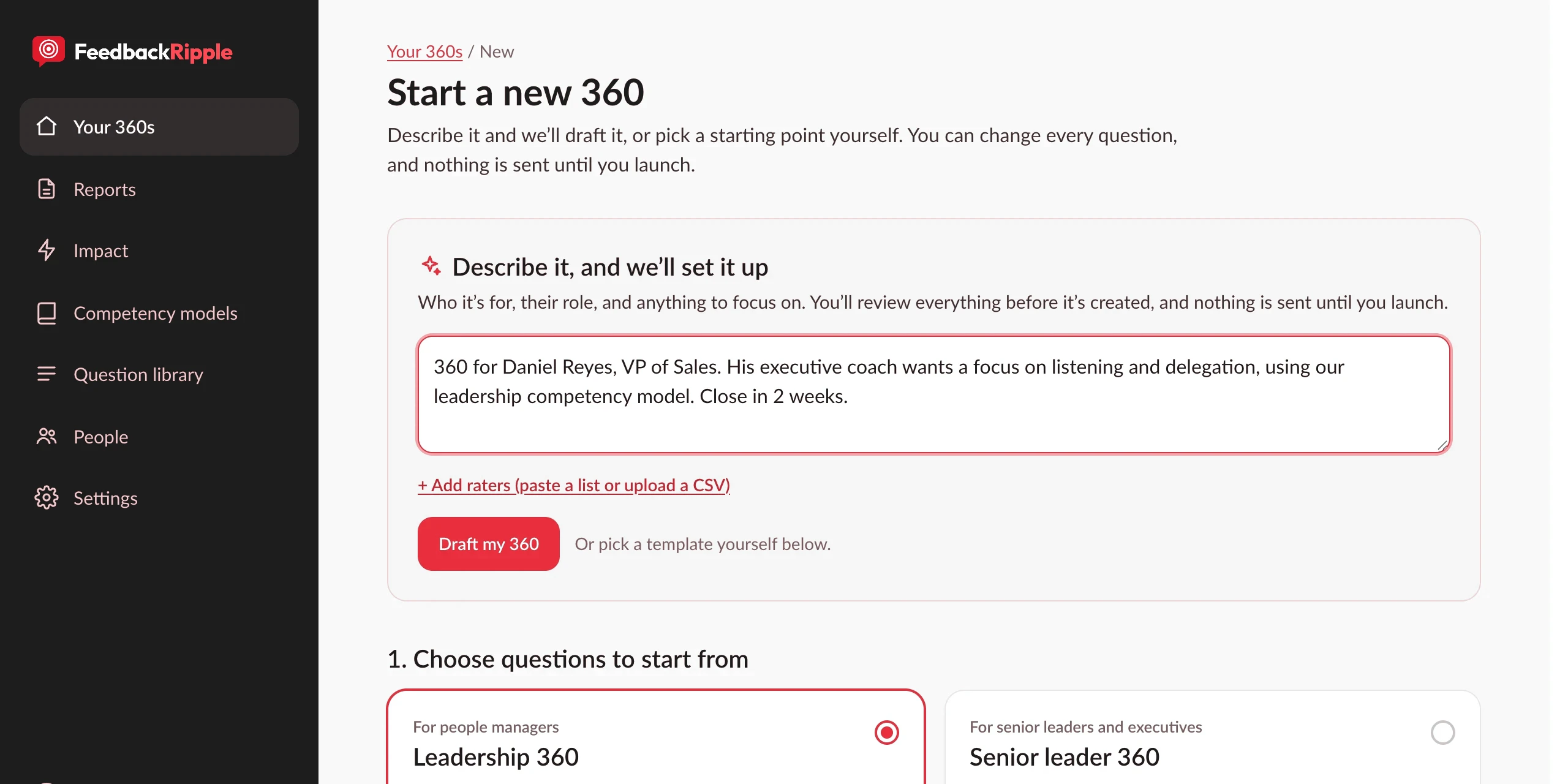
Instead of building every survey by hand, you simply describe the 360: who it’s for, their role and what to focus on. FeedbackRipple drafts the questions and rater groups, and you review and change everything before anything is sent. You can also paste a rater list or upload a CSV.
3. Run every client or team from one dashboard
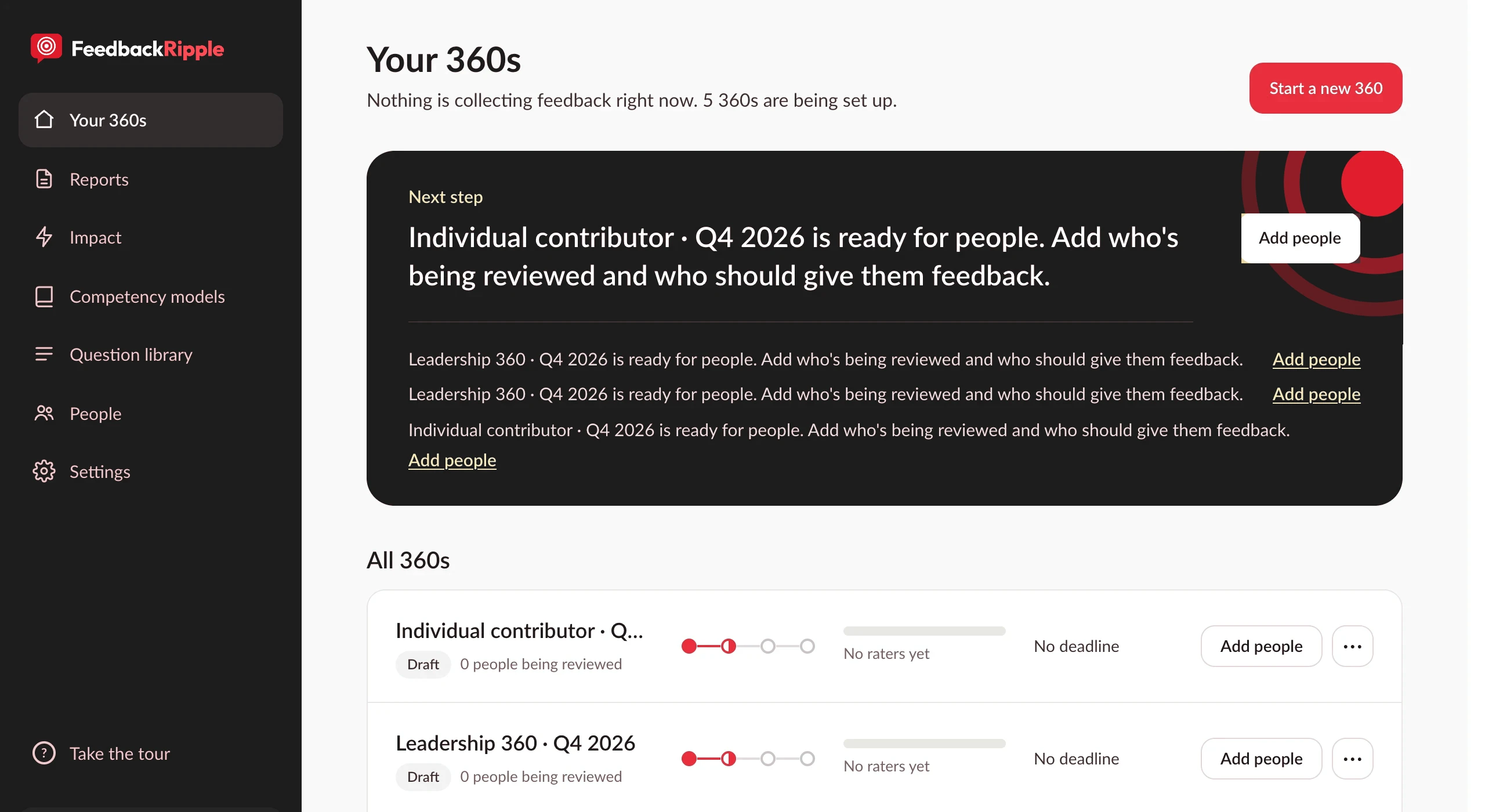
The dashboard shows every 360 you’re running, where each one is, and the single next step to take, so that nothing stalls while you’re busy coaching. Invites, reminders and the minimum group of three are handled for you.
4. Debrief with a report built for coaching
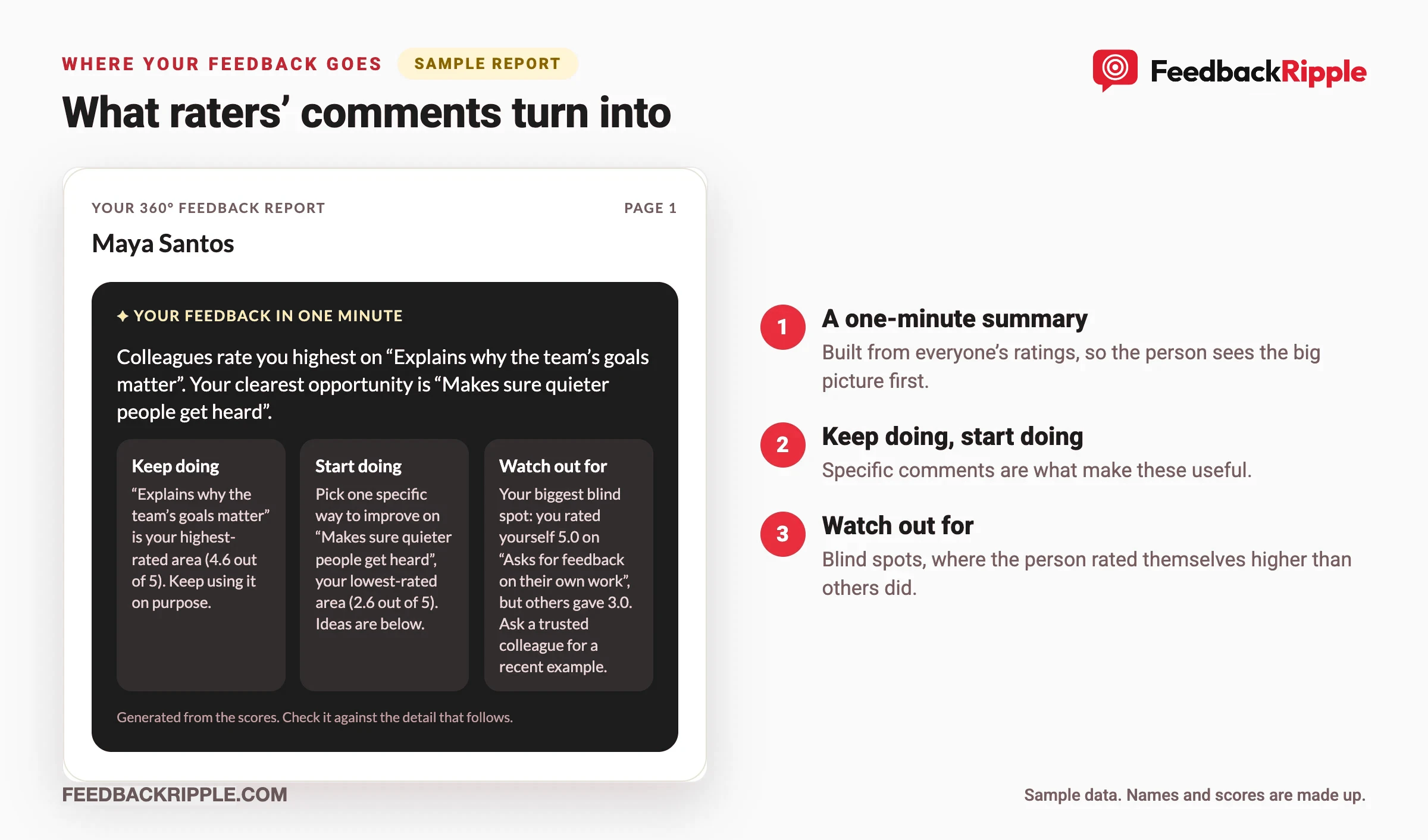
This is where your certification training really pays off. Each report opens with a one-minute summary, then shows self vs others gaps by rater group, written comments, and things to try in the next 30 days, which gives your debrief a clear structure. Reports go to each person privately, and with confidential mode on, admins can’t open them, which matters when you’re coaching inside a company.
5. Follow up for 90 days
After the debrief, Lucy, our AI coach, helps the person turn their feedback into a plan and checks in at 30, 60 and 90 days. A few days after each report, a one-question impact survey also tells you how useful people found the process, which is handy evidence for clients and leadership teams.
For external coaches vs internal teams
- External coaches: run each client’s 360 under your own account, import the framework you work with, and use the report as the agenda for your first coaching session. Coach plans start at $469 a year for 12 people.
- Internal HR and L&D: roll the same competency model out to a whole cohort, keep reports confidential to each person and their debrief partner, and use the impact survey and group results to show the program is working. See FeedbackRipple for HR and L&D teams.
Is a 360 feedback certification worth it?
It can be, but it really depends on why you want one. A certification is genuinely worth it when you’ve chosen a 360 that requires one, when you need ICF or SHRM credits anyway, or when clients expect a recognized name on your proposal.
It’s usually not worth it when you just want to start running 360s. The biggest risks in a 360 are bias, fragile anonymity and a report that leads nowhere (we cover these in 360 degree feedback pros and cons), and a certificate doesn’t fix those on its own. Good debrief habits do, and they tend to matter far more to the person receiving the feedback.
Running 360s without a certification
To give you a concrete example, at FeedbackRipple, we don’t simply hand coaches a survey link and leave the rest to them. We made a deliberate choice not to gate the tool behind a certification, and to build the guidance into the product instead:
- Questions drafted for you: describe the 360 in one sentence and it suggests behavior-based questions you can edit.
- Anonymity by design: rater groups under three are merged automatically.
- A report built for the debrief: a one-minute summary, self vs others gaps, and things to try in the next 30 days.
- Follow-up: Lucy, our AI coach, follows up with the person for 90 days.
And if you want to build your debrief skills without paying for a course, start with our free guides: how to deliver 360 feedback results (with a free debrief kit) and 360 feedback questions. Our founder, Venchito Tampon, is a certified executive coach, and those guides reflect how we think a debrief should run.
FeedbackRipple · First 3 people free
Try FeedbackRipple free with your next client
No certification, no setup fee. Your first 3 people are free, and coach plans start at $469 a year for 12 people.


How to Deliver 360 Feedback Results: A 60-Minute Debrief Guide (Free Kit)
How to Deliver 360 Feedback Results: A 60-Minute Debrief Guide (Free Kit)
To deliver 360 feedback results well, treat it as a coaching conversation, not a report hand-over. Read the report first, share it with the person a day or two before you meet, and hold a private 60-minute debrief: start with what they noticed, look at strengths before gaps, find two or three themes, and agree one to three goals. Then check in at 30, 60 and 90 days. Below is a full debrief agenda with timings, an opening script, how to handle tough reactions, and a free debrief kit (PDF).
Key takeaways
- Never just email the report. Results without a conversation tend to get skimmed, misread or taken personally.
- Give the person the report 24–48 hours before the debrief, so that the first emotional reaction happens before you meet.
- Look for themes and gaps between self and others, not individual scores or single comments.
- Never try to work out who said what, and steer the person away from it too.
- End with one to three goals and dates for follow-up. That’s usually where real change comes from.
Here’s what usually goes wrong with 360s: everyone puts real effort into answering the survey, and then the results arrive as a 20-page PDF in someone’s inbox. They read the one harsh comment ten times, skip the strengths, and nothing actually changes.
So the debrief is truly where a 360 succeeds or fails. This guide walks you through it step by step, whether you’re a manager, someone in HR or an executive coach. And if you need to help raters write better feedback in the first place, see our guide on how to give 360 feedback.
In this guide
Who should deliver 360 feedback results?
It depends on why you ran the 360 and how much trust there is. In practice, there are three common options:
| Who | Works best when… | Watch out for… |
|---|---|---|
| The person’s manager | The relationship is good and the 360 is for development | The manager’s own ratings are in the report, which can make it awkward |
| HR or L&D | You’re running 360s for a group and want consistent debriefs | Less context on the person’s day-to-day work |
| An executive coach | It’s a senior leader, or the results are sensitive | Costs more, so it’s usually kept for leaders |
A good middle ground for many teams: HR or a coach runs the first debrief, and the manager joins a follow-up conversation about goals and support. Our page for executive coaches covers coach-led debriefs in more detail.
Before the debrief: how to prepare
Preparation usually takes 30 to 45 minutes, and it really shapes how the conversation goes. Here’s a checklist:
- Read the whole report yourself, including every comment, so that nothing surprises you in the room.
- Check the anonymity rules. Most tools only show a rater group when at least three people answered. Know what the person can and can’t see.
- Note two or three themes. Look for patterns across rater groups and between ratings and comments.
- Spot the biggest self vs others gaps. Blind spots (rated themselves higher) and hidden strengths (rated themselves lower) usually lead to the best conversations.
- Flag any outlier comments that could hurt, and plan how you’ll put them in context.
- Send the report 24–48 hours before, with a short note: “Have a read, notice what stands out, and we’ll go through it together on Thursday.”
- Book 60 minutes in a private space (or a video call with cameras on), not squeezed between other meetings.
What to look for in the report
Most 360 reports compare how the person rated themselves with how others rated them. That comparison is genuinely the most useful part, given that it shows what the person can’t see on their own. It typically falls into four patterns:
| Pattern | What it means | How to use it in the debrief |
|---|---|---|
| Agreed strength | High self-rating, high from others | Celebrate it, then ask where else they could use it |
| Hidden strength | Low self-rating, high from others | Often the most encouraging moment of the debrief, so don’t rush it |
| Blind spot | High self-rating, lower from others | Usually the most valuable conversation; explore it with curiosity, not blame |
| Agreed gap | Low self-rating, low from others | They already know; focus on what’s gotten in the way and what support would help |
But don’t over-read small differences. A gap of a few tenths of a point between rater groups is usually noise, especially when only three or four people answered. And a single low score from one group matters less than the same theme showing up in ratings and comments from several groups.
Here’s how that comparison looks in a sample FeedbackRipple report. Each rater group sits next to the person’s own view, so blind spots and hidden strengths are easy to spot before the debrief:

A 60-minute debrief agenda
Here’s a structure that works for most debriefs. You can stretch it to 90 minutes for senior leaders, but try not to go much shorter:
| Time | Step | What happens |
|---|---|---|
| 0–5 min | Open | Set the purpose (development, not judgment), confirm confidentiality, ask how they’re feeling |
| 5–15 min | Their first reactions | What surprised them, what felt right, what they’re unsure about |
| 15–25 min | Strengths | The top-rated areas and the comments that back them up |
| 25–40 min | Gaps and blind spots | Two or three themes, self vs others gaps, what might be behind them |
| 40–55 min | Goals | Pick one to three things to work on, with first steps |
| 55–60 min | Close | Agree follow-up dates, who they’ll share goals with, and thank them |

What to say: an opening script and questions to ask
You don’t have to use these word for word, but it can help to have the first few sentences ready, given that the opening sets the tone for everything after it.
Sample opening
“Thanks for making time for this. The point of today is simply to help you get the most out of the feedback, not to judge you. Everything we talk about stays between us unless you choose to share it. Before we look at anything together, how did it feel reading the report?”
Then use open questions, so that the person does most of the thinking. And try to ask more than you tell; people typically commit far more to conclusions they reach themselves:
- What stood out to you first?
- What surprised you? What didn’t?
- Which strengths do you recognize? Where else could you use them?
- Where do you see the biggest gap between how you see yourself and how others see you?
- Why do you think people might see it that way?
- If you worked on one thing over the next three months, what would make the biggest difference?
- What support would you need, and from whom?
Tip: Let silence do some of the work. After a question, wait. People often say the most useful thing after a pause.
FeedbackRipple · First 3 people free
Make debriefs easier
FeedbackRipple reports group comments into themes, show self vs others gaps and suggest next steps, so that your debrief starts from insight, not a pile of scores. Your first 3 people are free.
Handling tough reactions
Most people have at least one moment in a debrief where the feedback stings. That’s normal, and it usually passes. Here’s what tends to help:
| Reaction | What it can sound like | What you can say |
|---|---|---|
| Defensive | “That’s not fair, they don’t see what I deal with.” | “That might be true. Let’s not decide whether it’s fair yet. What do you think they might be seeing?” |
| Upset | “I didn’t realize people felt this way.” | “It’s a lot to take in. Do you want a minute, or would it help to look at the strengths first?” |
| Hunting for the rater | “I bet this was Sam.” | “I understand the urge, but guessing usually leads us the wrong way. Let’s focus on what the comment says, not who wrote it.” |
| Fixated on one harsh comment | “Someone thinks I’m a terrible manager.” | “That’s one voice. Let’s see whether it shows up anywhere else in the report. If it doesn’t, it’s worth noting but not building a plan around.” |
| Dismissive | “It’s fine, nothing new here.” | “What would you like to be different the next time you get feedback like this?” |
If someone gets very upset, it’s okay to pause and continue another day. In practice, a second short meeting usually goes much better than pushing through.
Turning themes into goals
By the end of the debrief, the person should leave with one to three goals they actually chose. More than three tends to mean none of them happen. For instance, a theme like “team members find it hard to get time with you” could become:
- Goal: Be more available to my team.
- What I’ll do: Hold a 30-minute open slot every Wednesday and reply to direct messages within one working day.
- How I’ll know it’s working: Team members say it’s easier to reach me in our next pulse check.
- Who I’ll share it with: My manager and my team.
Sharing goals with the people who gave the feedback really helps. It shows them their input mattered, and they’re far more likely to notice the change.
In a FeedbackRipple report, each area to improve already comes with what people are seeing, why it matters and a few things to try in the next 30 days, so you can start the goals conversation from there:

Follow-up: 30, 60 and 90 days
A debrief is the start, not the end. A simple follow-up rhythm keeps goals from fading:

- 30 days: a short check-in. What have they tried? What got in the way?
- 60 days: ask two or three of the original raters for quick, informal input on the goal.
- 90 days: review progress, decide whether to keep, change or close each goal, and consider a short pulse survey on the same behaviors.
Many teams run a full 360 again after 12 to 18 months to measure change, using the same questions so that the results are comparable.
Received your own 360 report? Read it once all the way through and then put it down for a day. Next, look for themes rather than single comments, compare your self-ratings with everyone else’s, and note one or two things you want to ask about. Then go into your debrief with questions, not a defense.
Remote and global debriefs
If you’re debriefing someone in another office or country, a few things tend to help:
- Use video with cameras on. So much of a debrief is reading reactions, and that’s hard by phone or chat.
- Mind the time zone. Don’t schedule a tough conversation at the end of someone’s long day.
- Adjust for directness. In some cultures, direct criticism in writing can feel much harsher than intended, so you have to add context in the conversation.
- Watch the anonymity threshold in small teams. Remote teams are often small, so check that each rater group still has enough people before showing it.
- Offer the report in their language where you can. Reading feedback in a second language makes nuance much harder to catch.
Free 360 debrief kit (PDF)
To make all this easier, here’s a free two-page debrief kit you can print or share: the 60-minute agenda, the opening script, questions to ask, and an action plan template with 30/60/90-day check-ins. No sign-up needed: download the 360 debrief kit (PDF).
How FeedbackRipple helps with debriefs
To give you a concrete example, at FeedbackRipple, we don’t simply generate a report and leave the rest to you. The report already groups comments into themes, highlights blind spots and hidden strengths, and suggests things to try in the next 30 days. Coaches can read it before the debrief, and Lucy, our AI coach, follows up with the person for 90 days, so that goals don’t quietly disappear after the meeting.
FeedbackRipple · First 3 people free
Run your first 360 free
Collect anonymous feedback, get a report that’s built for debriefs, and follow up for 90 days. Your first 3 people are free, no credit card.