
80+ Positive Feedback Examples for Work (Copy and Adapt)
Good positive feedback names a specific thing someone did and the difference it made, for instance: “Your summary of the client call meant the whole team walked into Monday’s meeting already aligned. Thank you.” Below you’ll find 80+ positive feedback examples you can copy and adapt: by situation (great work, teamwork, communication, leadership and more), by relationship (manager to employee, peer to peer, to your manager), and in short versions for Slack or a performance review.
Key takeaways
- Specific beats nice. “Great job” feels good for a second; “Your checklist cut onboarding questions in half” tells people what to repeat.
- Use a simple shape: what you saw, the impact it had, and a thank-you or “keep doing this”.
- Give it soon. Positive feedback tends to land best within a day or two of the moment.
- Match the channel to the person. Some people love public praise; others really prefer a private message.
- Don’t wrap criticism in it. Keep praise and improvement points in separate conversations so that the praise is believed.
Most of us know positive feedback genuinely matters. But when the moment comes, it usually comes out as “Great job!” or “Thanks, legend.” And while that’s kind, it doesn’t actually tell the person what they did well, so they can’t do it again on purpose.
So here’s a practical list of positive feedback examples for work. Each one names a real behavior and the impact it had. You can copy them as they are, but they work best when you swap in the details of what actually happened.
What makes positive feedback effective
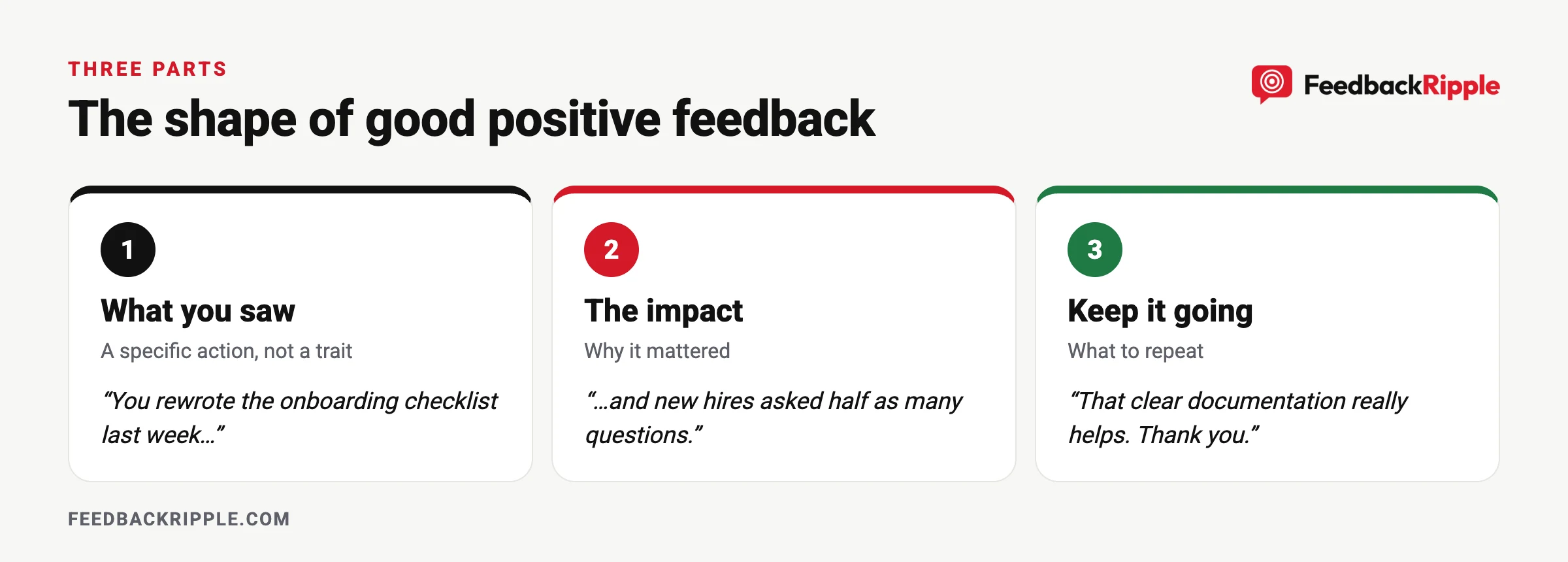
Effective positive feedback is specific, timely and about behavior. It tells the person what they did, why it mattered, and that you’d like to see more of it. In practice, the easiest way to get there is a three-part shape:
| Part | What it answers | Example |
|---|---|---|
| What you saw | What exactly did they do? | “You rewrote the onboarding checklist last week…” |
| The impact | Why did it matter? | “…and the new hires asked us half as many questions.” |
| Keep it going | What should they repeat? | “That kind of clear documentation really helps. Thank you.” |
This is a lighter version of the Situation-Behavior-Impact model that many managers learn. You don’t need to follow it word for word. But if your feedback has a concrete behavior and a real impact in it, it’ll usually land.
Positive feedback examples by situation
For great quality work
- “The report you sent this morning was so clear that leadership approved the budget without a single follow-up question. That’s rare, and it’s down to how you structured it.”
- “I noticed you double-checked every figure in the deck before it went out. It saved us from a really awkward correction with the client.”
- “Your code review comments were specific and kind. Two people told me they actually learned something from them.”
- “The new landing page you designed is converting better than the old one, and it looks great on mobile. Thank you for sweating the details.”
- “You turned a messy brief into a plan everyone could follow. That made the whole project feel calmer.”
- “Your proposal answered the client’s concerns before they even raised them. That’s what won us the second meeting.”
For going above and beyond
- “You stayed on the call until the customer’s issue was fully fixed, even though your shift had ended. They mentioned you by name in their thank-you email.”
- “Thanks for covering Priya’s accounts while she was out. Nothing slipped, and she came back to a tidy handover.”
- “You spotted the data issue before launch and fixed it without being asked. That probably saved us a week of clean-up.”
- “You didn’t have to write the FAQ for the support team, but you did, and it’s already cutting ticket times.”
- “I know the deadline moved up twice. The way you reorganized your week so that we still shipped on time was genuinely impressive.”
- “Volunteering to mentor the new interns says a lot about you. They already look to you for help.”
For teamwork and collaboration
- “You made sure everyone had a say in the planning session, including the quieter people. The plan is better because of it.”
- “Thank you for sharing your template with the other team instead of keeping it to yourself. It saved them hours.”
- “When the two teams disagreed, you found the common ground and kept things moving. That’s a real skill.”
- “You always tell people when you’ve finished your part, so nobody is left guessing. It makes working with you easy.”
- “I noticed you gave credit to the whole team in the update, not just yourself. People really noticed too.”
- “You jumped in to help with testing without being asked. That’s why we hit the release date.”
For communication
- “Your project update was short, clear and had the decision we needed right at the top. More of those, please.”
- “You explained the change to the customer in plain language, and they thanked us for being upfront. Nice work.”
- “I appreciated how you raised the risk early in the meeting, rather than after. It gave us time to plan around it.”
- “Your email to the vendor was firm but friendly. We got what we needed and kept a good relationship.”
- “You listened to the whole concern before answering, and the client clearly felt heard. That changed the tone of the call.”
- “The way you summarized the meeting in three bullet points meant nobody had to watch the recording.”
For problem-solving and initiative
- “You noticed the same question kept coming up and built a quick guide to answer it. That’s exactly the kind of initiative we need.”
- “When the supplier fell through, you had two alternatives lined up within a day. Calm, quick and practical.”
- “Your idea to automate the weekly report has saved the team about three hours every Friday.”
- “You didn’t just flag the problem; you came with a proposed fix and the trade-offs. That made the decision easy.”
- “Thanks for testing a small version before rolling it out to everyone. It caught two issues early.”
For leadership
- “You gave the team a clear priority for the week, and it showed: fewer side quests and a much calmer Friday.”
- “I noticed you asked for the team’s view before deciding. People told me they felt genuinely included.”
- “The way you handled the reorganization news, openly and with time for questions, built a lot of trust.”
- “You delegated the client workshop to Sam and backed him up instead of taking over. He grew a lot from it.”
- “Your one-to-ones are clearly working. Your team raises problems earlier than anyone else’s.”
- “You stayed calm when the launch went sideways, and that kept everyone else calm too.”
For learning and growth
- “Six months ago you were nervous about presenting. Today you handled tough questions from the board really well.”
- “You asked for feedback on your first draft, and then actually used it. That’s why the second version is so strong.”
- “I can see you’ve been practicing the new tool. Your reports are faster and cleaner already.”
- “Taking on the analytics course in your own time is paying off. Your recommendations are much sharper.”
- “You owned the mistake on the invoice, fixed it and changed the process so that it won’t happen again. That’s exactly right.”
For customer service
- “The customer came in frustrated and left thanking you. The way you listened first made all the difference.”
- “You followed up with the client a week later without being asked. That’s the kind of care people remember.”
- “Your response times this month have been the fastest on the team, and your satisfaction scores went up too.”
- “You explained a confusing bill so clearly that the customer upgraded instead of cancelling.”
- “Thanks for flagging the recurring complaint to the product team. It’s now on the roadmap.”
For reliability and time management
- “You’ve hit every deadline this quarter, and when something did slip, you told us early. That makes planning so much easier.”
- “I always know where your work stands, given that you keep the board up to date. Thank you.”
- “You protected focus time for the hard work and it shows: the analysis is the deepest we’ve had.”
- “You’re the person people trust with the details. That reputation is earned, and I wanted you to know I see it.”
- “Thanks for being so prepared for the review. We finished in half the time.”
FeedbackRipple · First 3 people free
See what people do well, from everyone around them
FeedbackRipple collects anonymous feedback from managers, peers and direct reports, and every report opens with top strengths. Your first 3 people are free.
Positive feedback examples by relationship
The same compliment sounds different depending on who’s giving it. Here’s how it tends to shift:
Manager to employee
- “I want you to know I noticed how you handled the escalation yesterday. You stayed calm, kept the customer informed and fixed it. That’s exactly what I’d hope for.”
- “Your work on the pricing analysis is a big reason we made the right call. I mentioned it to the leadership team too.”
- “You’ve grown so much in client meetings this year. You lead them now rather than just supporting.”
- “Thanks for taking the time to train the new starters. It’s made my job easier and theirs much less stressful.”
- “I trust your judgment on this project, and I wanted to say that out loud.”
Peer to peer
- “Thanks for reviewing my draft so quickly. Your comment about the opening really improved it.”
- “Working with you on the launch was genuinely easy. You always said what you’d do, then did it.”
- “You explained the new system to me without making me feel slow. I really appreciated that.”
- “Your idea in the retro was the best one we had. You should share it with the wider team.”
- “Thanks for having my back in the meeting when my point got talked over.”
Employee to manager
Positive feedback upward is rarer, which is exactly why it matters. Keep it sincere and specific (we have more on this in our page on upward feedback):
- “The way you shielded us from the last-minute scope changes let us actually finish the project. Thank you.”
- “I really value our one-to-ones. You always leave time for my questions, not just status updates.”
- “Thanks for trusting me with the client presentation. It was a big step for me.”
- “You explained the reasons behind the reorganization, which made it much easier to accept.”
- “When I made that mistake last month, you helped me fix it instead of blaming me. I learned a lot from how you handled it.”
For a new team member
- “You’ve picked up our tools really quickly. Your first ticket summaries are already clearer than some of ours.”
- “Asking questions early, like you’ve been doing, is exactly right. It’s saving you and us time.”
- “Great first week. The customer you spoke to on Wednesday said you were really helpful.”
- “You’ve already spotted two things we should do differently. Keep those fresh eyes coming.”
For remote and hybrid teammates
- “Your written updates mean I never have to chase you for status, even across time zones. Thank you.”
- “You always turn your camera on for the hard conversations, and it really helps them go well.”
- “Recording the walkthrough so that the Singapore team could watch it later was a thoughtful touch.”
- “You make remote meetings feel inclusive by checking in with people who haven’t spoken yet.”
Short positive feedback examples for Slack, Teams or email
Not every piece of praise needs a meeting. Here are quick messages you can send in a minute:
- “That demo was great. The way you handled the pricing question was spot on.”
- “Thanks for the fast turnaround on the contract. You saved the deal this week.”
- “Your dashboard is now the first thing I open every morning. Really useful.”
- “Shout-out to Ana for the onboarding guide. Three new starters used it this week without a single question.”
- “Loved how you summarized that thread. Exactly what we needed.”
- “Just wanted to say: the client mentioned you by name today. Great work.”
A public shout-out works well for team wins. But for personal growth or sensitive topics, a private message usually feels more sincere. If you’re not sure which a person prefers, simply ask them.
Positive feedback examples for performance reviews
In a review, positive feedback should summarize a pattern over time, not a single moment. These examples are written that way:
- “Throughout the year, Maya consistently delivered accurate, well-structured reports ahead of deadlines, and two of them directly shaped budget decisions.”
- “Leo has become the go-to person for onboarding. Every new hire he supported this year reached full productivity faster than our average.”
- “Sara’s calm handling of escalations is a real strength. Customer satisfaction on her cases rose from 82% to 91% this year.”
- “Daniel took on line management for the first time and built a team that raises issues early and supports each other.”
- “Jo consistently shares knowledge with the wider team, through guides, demos and code reviews, which has made the whole team faster.”
For more performance-style comments, including written 360 comments from peers and direct reports, see our 360 feedback examples.
Weak vs strong: 8 positive feedback rewrites
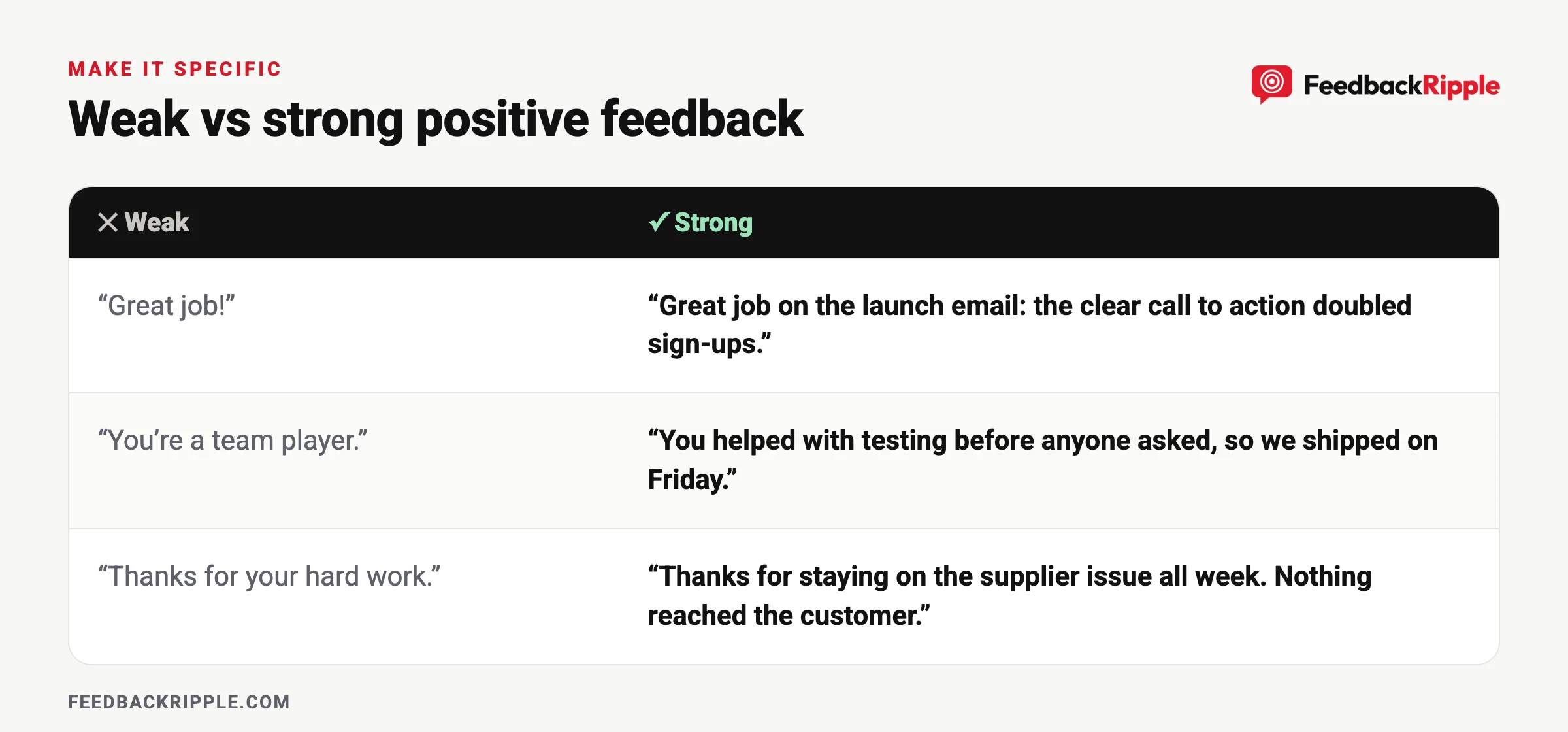
Here’s how small changes turn generic praise into feedback people can actually use:
| Weak | Strong |
|---|---|
| “Great job!” | “Great job on the launch email: the clear call to action doubled our sign-ups.” |
| “You’re a team player.” | “You offered to help with testing before anyone asked, and that’s why we shipped on Friday.” |
| “Nice presentation.” | “Your presentation answered the CFO’s question before she asked it. That built a lot of credibility.” |
| “Thanks for your hard work.” | “Thanks for staying on top of the supplier issue all week. Nothing reached the customer.” |
| “You’re so organized.” | “Your project board means I always know what’s next. It saves me real time.” |
| “Good communication.” | “You told the client about the delay early, so that they could plan around it. They appreciated it.” |
| “You’re a great manager.” | “You always explain the why behind priorities, which makes it easier to make good calls on my own.” |
| “Well done this year.” | “This year you took over the biggest account and grew it by 20% without losing a single contact.” |
How to give positive feedback

- Be specific. Name the behavior and the impact. If you can’t, you probably need a moment to think of a real example first.
- Be timely. Aim for the same day or the next. Feedback tends to lose its punch after a week.
- Be sincere. You have to mean it, so only say what you actually mean. People can usually tell when praise is a warm-up for something else.
- Pick the right channel. Public for team wins, private for personal growth, written when you want it to be remembered.
- Make it regular. A team that only hears praise at review time typically assumes it isn’t noticed the rest of the year.
To give you a concrete example, at FeedbackRipple, we don’t simply show people their lowest scores. Every 360 report opens with their top strengths, as seen by their manager, peers and direct reports, given that people tend to act on feedback more when they first know what to keep doing.
Mistakes to avoid with positive feedback
- The feedback sandwich. Wrapping criticism in praise teaches people to brace for the “but”. Keep them separate.
- Only praising results. Praise effort and approach too, especially when someone did the right things and the outcome still missed.
- Praising some people far more than others. Check who you tend to recognize. Quieter people are often overlooked.
- Comparing people. “You’re better at this than Sam” creates rivalry, not motivation.
- Overdoing it. If everything is “amazing”, nothing is. Save big words for truly big moments.
And if you also need to give tougher feedback, the same principles apply: be specific, focus on behavior and impact, and give it soon. Our guide on how to give 360 feedback covers both. Specific praise can help people repeat exactly what worked.
FeedbackRipple · First 3 people free
Make positive feedback part of every review
FeedbackRipple gathers anonymous feedback from the people around each person and turns it into a report with strengths, blind spots and what to try next. Your first 3 people are free.
The author

Venchito Tampon
Venchito Tampon is the Founder of FeedbackRipple, 360 feedback software that tells people what to do next. It helps executive coaches and HR and L&D teams run anonymous 360s, turn the results into clear guidance and follow through on development plans.
He is a Certified Executive Coach, certified by Symbiosis Coaching, an ICF-accredited coaching organization. He brings that coaching lens to FeedbackRipple: every report ends with clear next steps, not just charts.
He is also the CEO and Founder of eLearning Solutions Lab, a Philippines-based eLearning production company specializing in custom eLearning development and rapid eLearning solutions for global clients.
He founded Rainmakers Training & Consultancy, a corporate training and leadership development firm where he has trained and spoken at 250+ conventions, seminars, and workshops across the Philippines and internationally, including Singapore, Slovakia, and Australia. He has worked with top corporations including SM Hypermarket, Shell, and National Bookstore.
His other ventures include ExpirePilot, document expiration tracking software for small businesses, SharpRocket, a digital marketing and SEO company, and Hills & Valleys Cafe, a local café with available franchising.
He is a certified member of The Philippine Society for Talent Development (PSTD), the premier organization for Talent Development practitioners in the country, and an active Go Negosyo Mentor under the Mentor Me program.