
SBI Feedback Model: Situation-Behavior-Impact Explained (15 Examples)
SBI Feedback Model: Situation-Behavior-Impact Explained (15 Examples)
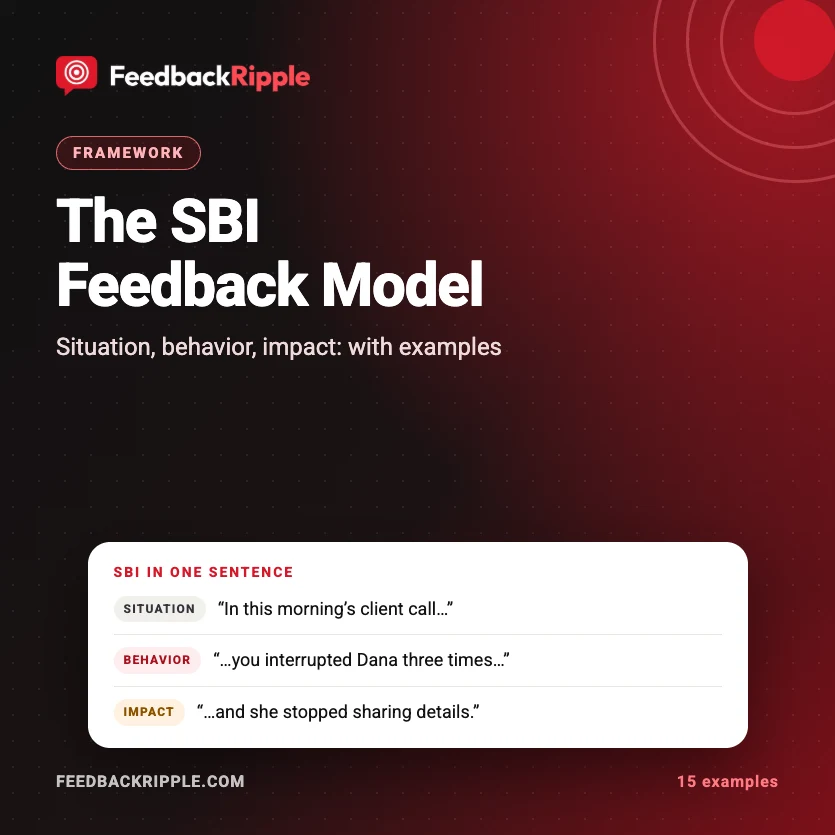
The SBI feedback model is a simple way to give feedback in three parts: the Situation (when and where), the Behavior (what the person actually did) and the Impact (the effect it had), for instance: “In this morning’s client call, you interrupted Dana three times, and she stopped sharing details.” It was developed by the Center for Creative Leadership, and it works for both positive and negative feedback. Below you’ll find how each step works, 15 SBI examples you can adapt, the SBII variation and how SBI compares with other feedback models.
Key takeaways
- Three parts: Situation, Behavior, Impact. Keep each one short.
- Behavior is the hard part. Describe what a camera would see, not your interpretation of it.
- Impact makes it matter. It tells the person why the behavior is worth changing (or repeating).
- It works both ways. SBI is just as useful for praise as for criticism.
- Add a question. Asking about intent or next steps turns SBI from a statement into a conversation.
Most feedback goes wrong in one of two ways. It’s either too vague to act on (“Good job!”, “You need to be more professional”), or it sounds like a judgment of the person rather than of what they did. The SBI model fixes both problems with one simple structure.
And because it’s so short, you can actually use it in the moment: in a one-to-one, after a meeting, or in a written comment.
In this guide
What is the SBI feedback model?
SBI stands for Situation-Behavior-Impact. It’s a feedback framework created by the Center for Creative Leadership (CCL), and it’s now one of the most widely used feedback models in leadership and management training.
The idea is truly simple: instead of giving an opinion about someone, you describe a specific moment, what they did in it and what happened as a result. Given that it’s based on observable facts, it tends to make people less defensive, and it gives them something genuinely concrete to repeat or change.
The 3 steps of the SBI model
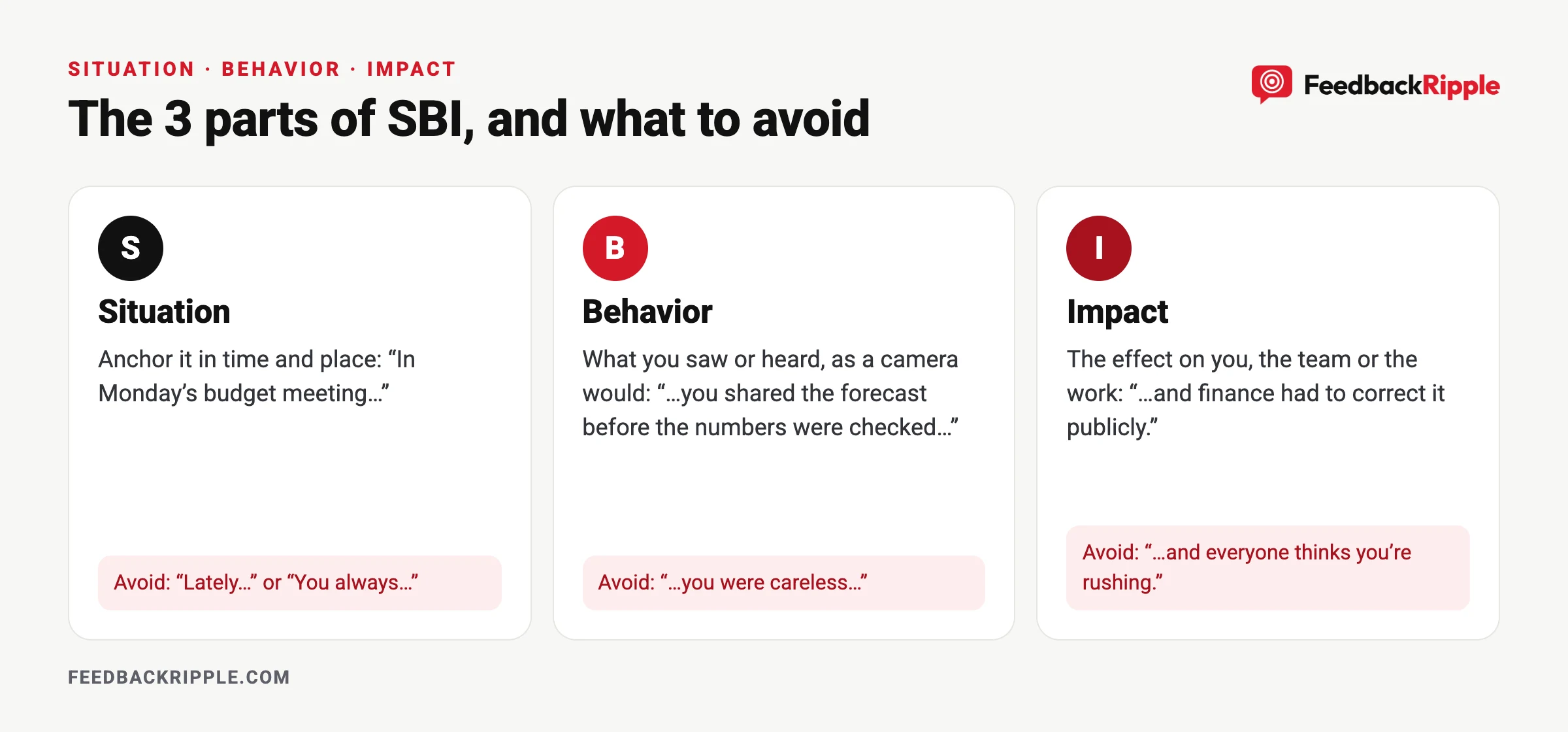
1. Situation
Start by anchoring the feedback to a specific time and place: “In Monday’s budget meeting…” or “On the call with the supplier yesterday…”. This simply helps the other person remember the moment. Avoid “lately” or “you always”, which turn one moment into a pattern they’ll want to argue with.
2. Behavior
Describe what the person actually said or did. Here’s a useful test: could a video camera have recorded it? “You shared the forecast before the numbers were checked” passes. “You were careless” doesn’t; it’s your interpretation.
3. Impact
Explain the effect of the behavior on you, the team, the customer or the work: “…and finance had to correct it in front of the leadership team.” Speak about the impact you saw or felt. You can’t know how everyone else feels, so avoid “everyone thinks…”.
You have to keep it short: one sentence per part. If your SBI takes more than 30 seconds to say, you’re usually adding opinions.
15 SBI feedback examples
Positive SBI examples
- “In this morning’s standup (S), you flagged the API risk before anyone asked (B). That gave us two extra days to fix it before the release (I).”
- “At yesterday’s client workshop (S), you summarized each decision on the whiteboard as we went (B). The client said it was the clearest session they’ve had with us (I).”
- “During the outage on Saturday (S), you posted an update in the incident channel every 30 minutes (B). Support could answer customers without chasing engineering (I).”
- “In your first month (S), you wrote down every question you asked during onboarding and turned them into a guide (B). Our two newest hires used it and needed far less help (I).”
- “In the team retro (S), you asked Ben what he thought before giving your own view (B). He shared an idea we’re now actually using (I).”
For more praise you can adapt, see our positive feedback examples.
Negative (constructive) SBI examples
- “In Tuesday’s planning session (S), you said the estimate was “easy” before the team had discussed it (B). Two people told me afterwards they didn’t feel they could disagree (I).”
- “On the proposal sent last Friday (S), the pricing table had last year’s rates (B). The client questioned the whole document, and we had to reissue it (I).”
- “In the last three one-to-ones (S), you arrived without the updates we agreed on (B). We spent the time catching up instead of solving problems (I).”
- “When the release slipped last week (S), I heard about it from the client first (B). I couldn’t answer their questions, and it damaged their trust in us (I).”
- “In the all-hands Q&A (S), you answered the question about bonuses with a joke (B). Several people left the meeting more worried than before (I).”
More copy-ready examples are in our negative feedback examples.
SBI examples for managers (upward)
- “In our last three one-to-ones (S), we ran out of time before we got to my development plan (B). I’m not sure what I should be working on next quarter (I).”
- “When the priorities changed on Wednesday (S), you explained the reasons in the team channel (B). It made it much easier for us to re-plan without frustration (I).”
- “In the client review (S), you answered questions directed at me (B). The client now sends everything to you, and I can’t build the relationship (I).”
- “After my presentation last week (S), you gave me two specific things to improve (B). I used both in the next one, and it went much better (I).”
- “When my project was cancelled (S), you told me in person before the announcement (B). It meant a lot, and I trusted the decision more (I).”
SBII: adding intent to the SBI model
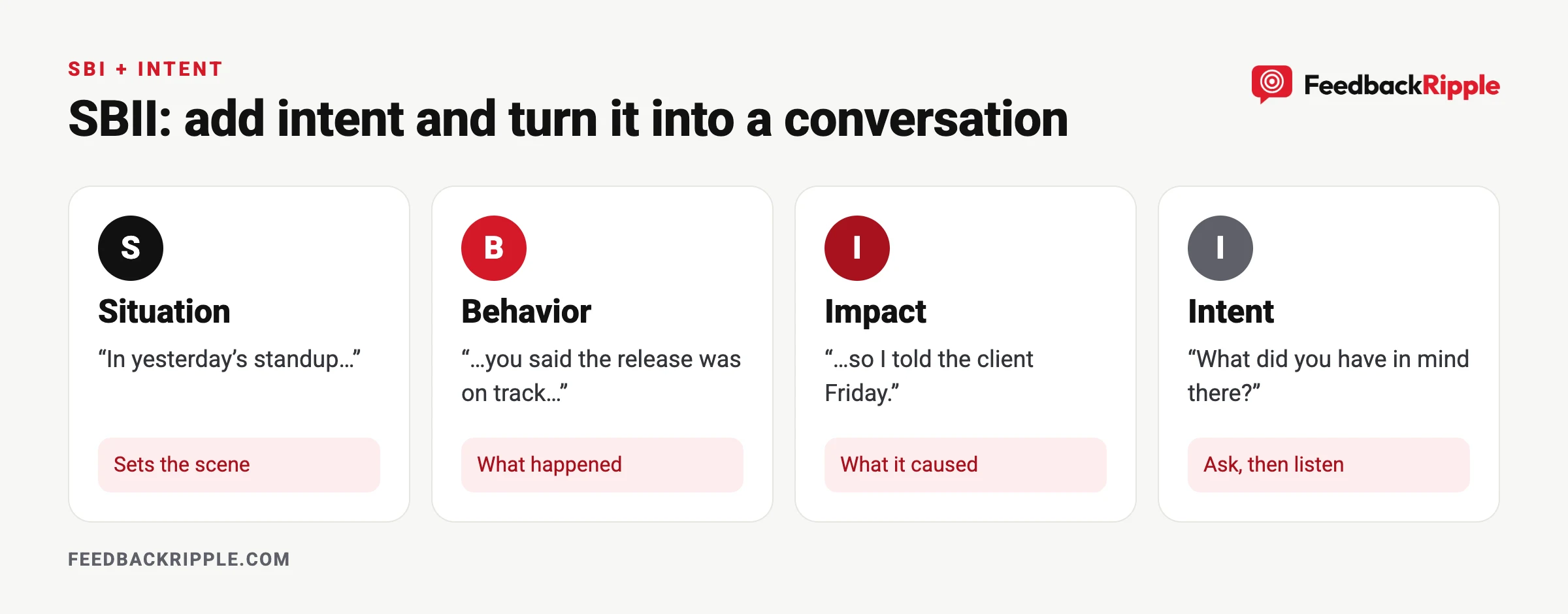
CCL later extended the model with a fourth step, Intent, sometimes written as SBII. After you describe the impact, you ask about what the person was trying to do: “What did you have in mind there?” or “What were you hoping would happen?”
But this matters, because impact and intent are often different. The colleague who answered the client’s questions for you may have been trying to help, not to take over. So asking about intent can help you avoid assuming the worst, and it typically turns feedback into a real two-way conversation.
How to use SBI in a feedback conversation
- Ask first. “Do you have five minutes for some feedback about the client call?” A quick check like this tends to lower defenses.
- Deliver the SBI. Say it plainly, in two or three sentences, then stop talking.
- Ask about intent or their view. “How did you see it?” You’ll often learn something.
- Agree what’s next. For negative feedback, agree one change. For positive feedback, simply say “keep doing this”.
- Follow up. Notice when the change happens, and say so, using SBI again.
Common SBI mistakes
- Hiding a judgment in the behavior. “You were rude to the client” isn’t a behavior. “You said ‘that’s not my problem’ to the client” is.
- A vague situation. “Recently” or “in meetings” makes it hard for the person to remember, and easy to dispute.
- Exaggerating the impact. Keep it to what actually happened. “We lost the account” when you didn’t will cost you trust.
- Speaking for others. “The team thinks…” is hearsay. Share your own observation, or encourage others to share theirs.
- Using SBI as a script. If it sounds rehearsed, it can feel cold. Use your own words; the structure is what matters.
SBI vs other feedback models
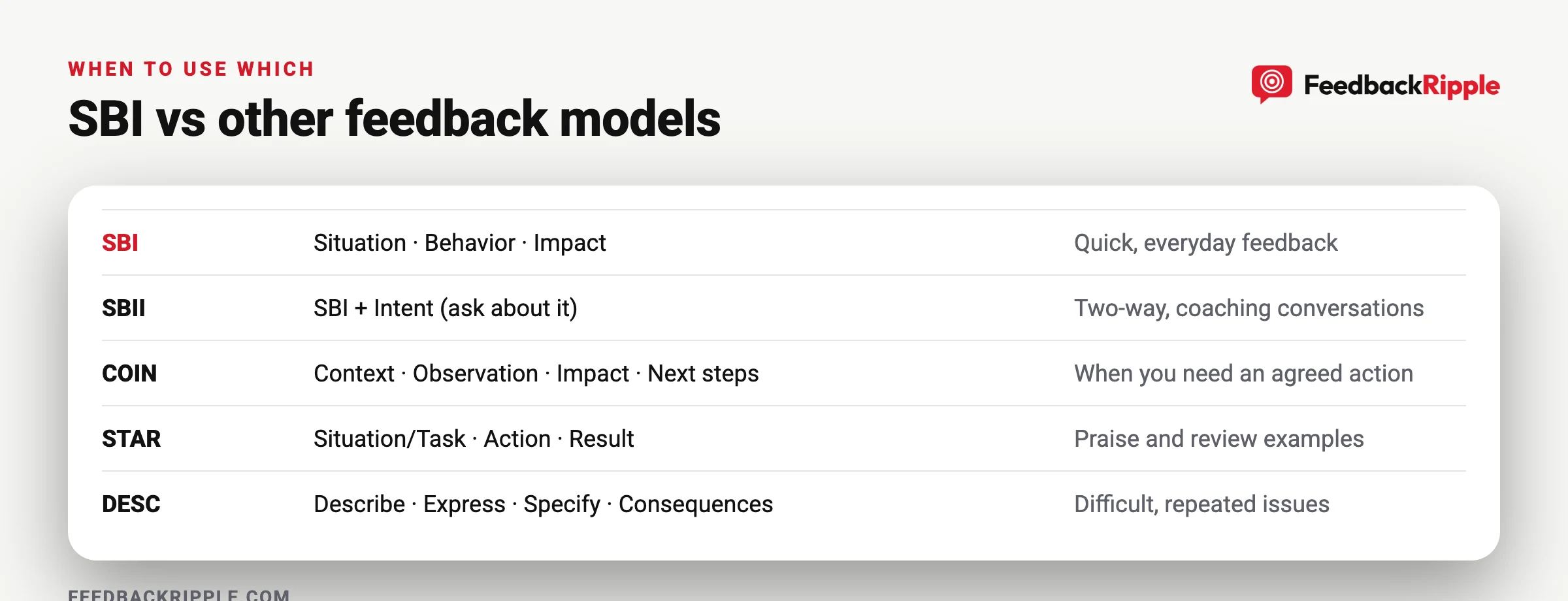
| Model | Steps | Best for |
|---|---|---|
| SBI | Situation, Behavior, Impact | Quick, everyday feedback, positive or negative |
| SBII | Situation, Behavior, Impact, Intent | Two-way coaching conversations |
| COIN | Context, Observation, Impact, Next steps | When you need an agreed action |
| STAR | Situation/Task, Action, Result | Praise and examples in performance reviews |
| DESC | Describe, Express, Specify, Consequences | Difficult or repeated issues |
In practice, most of these are variations on the same idea: be specific, describe behavior and explain why it matters. SBI is simply the shortest, which is why it’s usually the easiest to start with.
Using SBI in written and 360 feedback
SBI isn’t only for conversations. It works really well in written comments, too, such as performance reviews and 360 feedback, where vague comments like “great team player” are common and hard to act on. People tend to accept SBI feedback more easily because it sticks to what happened.
To give you a concrete example, at FeedbackRipple, we don’t simply ask raters for scores. Each 360 survey can include open-text questions, so that managers, peers and direct reports can explain what they saw and why it mattered, and those comments appear in the person’s feedback report alongside the ratings. Asking raters to “give one specific example” in the question is an easy way to nudge them toward SBI.
If you’re running a 360 process, our guide on how to give 360 feedback shows how to write comments the person can actually use, and our 360 feedback examples give you ready-made wording.
FeedbackRipple · First 3 people free
Collect feedback people can act on
FeedbackRipple gathers anonymous feedback from the people around each person and turns it into a report with strengths, blind spots and what to try next. Your first 3 people are free.

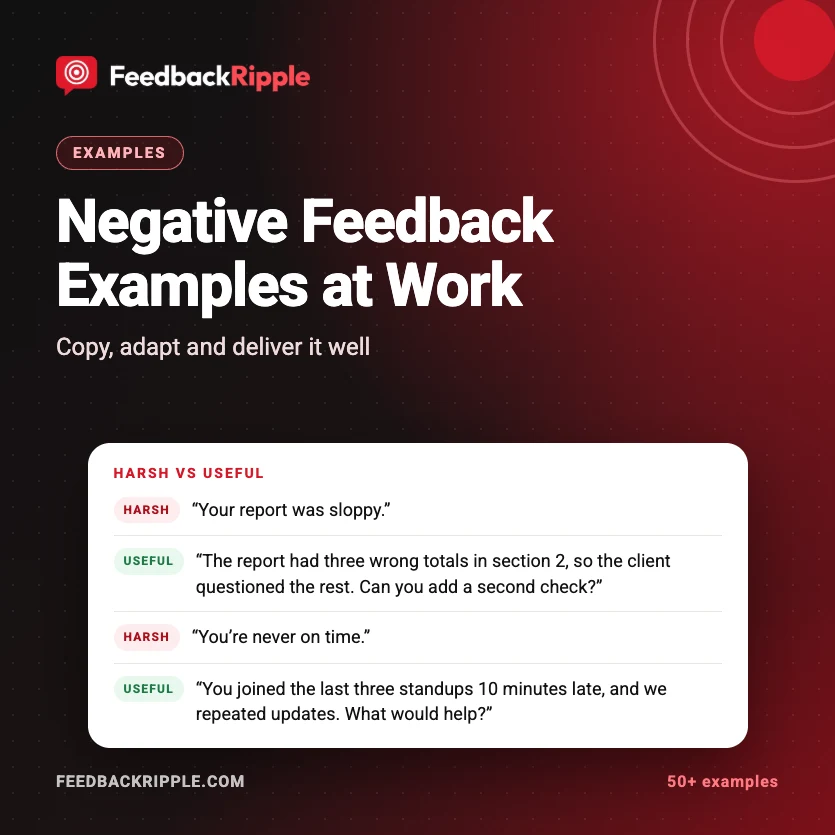
50+ Negative Feedback Examples at Work (and How to Give Them)
50+ Negative Feedback Examples at Work (and How to Give Them)
Good negative feedback describes a specific behavior, the impact it had and what you’d like to see instead, for instance: “In this morning’s client call you interrupted Dana three times, and she stopped sharing details. Next time, can you let her finish before you answer?” Below you’ll find 50+ negative feedback examples for work you can copy and adapt: by situation, by relationship (manager, peer, to your manager), for performance reviews, plus harsh vs useful rewrites and a simple way to deliver them.
Key takeaways
- Negative feedback isn’t an attack. It’s genuinely useful information about a behavior and its impact, so that the person can actually change it.
- Use a simple shape: situation, behavior, impact, then a request or a question.
- Describe, don’t label. “You missed two deadlines” is fair; “You’re unreliable” is a judgment people tend to fight.
- Give it soon and in private. A week later, or in front of the team, it usually lands as punishment.
- End with a next step. Agree one change and when you’ll check in.
Nobody really enjoys giving negative feedback. So most of us either avoid it until the problem is huge, or blurt it out in a way that makes the other person defensive. But here’s the thing: people usually want to know when something isn’t working. What they don’t want is to be surprised, labeled or embarrassed.
This guide gives you the words. You can use the examples as they are, or simply swap in your own situation, names and numbers.
In this guide
What is negative feedback at work?
Negative feedback at work (also called constructive or corrective feedback) tells someone that a behavior or result didn’t meet expectations, and why it matters. It’s not the same as criticism of the person. In practice, the best negative feedback focuses on something the person can change, not on who they are.
(If you landed here looking for negative feedback loops in biology, such as body temperature or blood sugar regulation, this guide is about workplace feedback instead.)
The shape of useful negative feedback
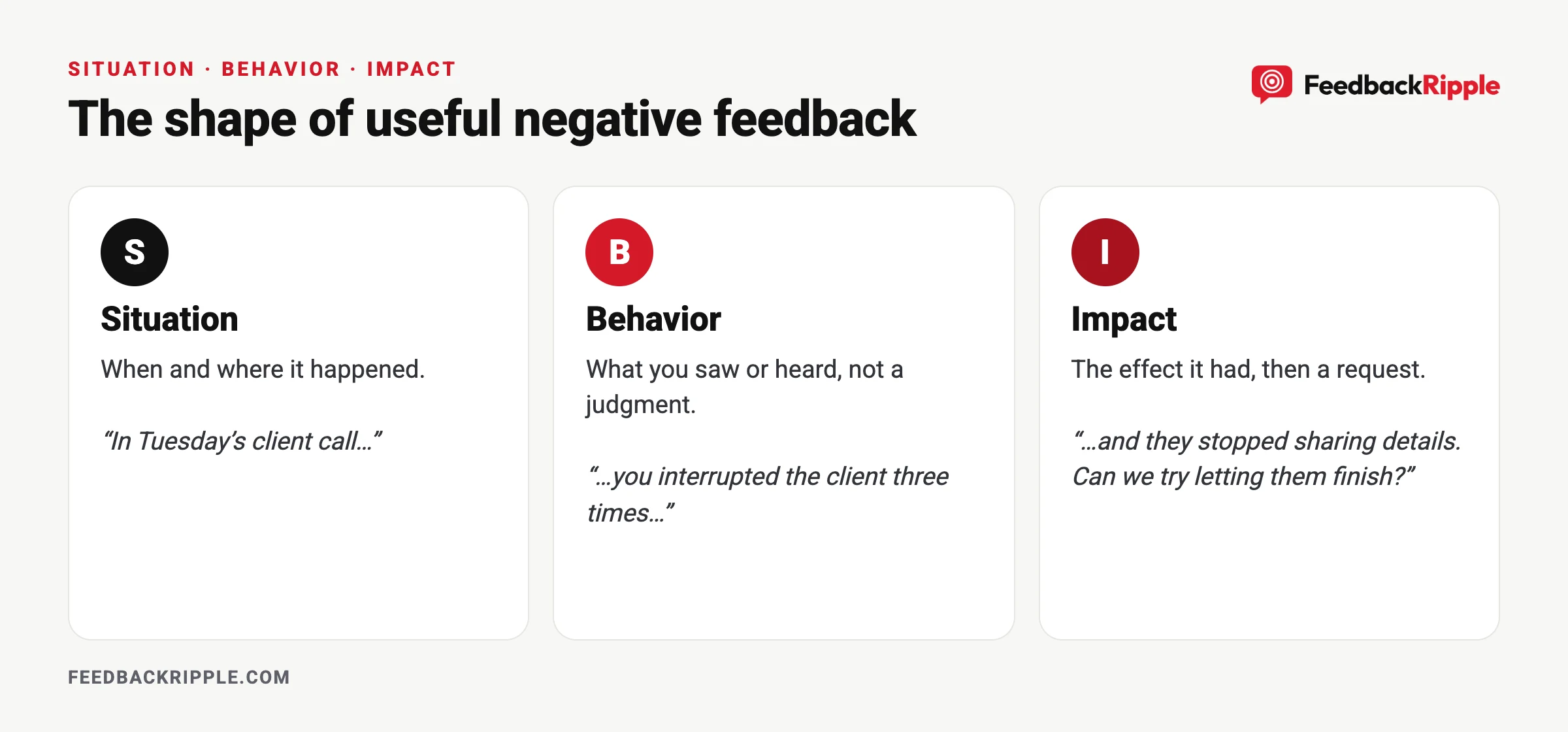
Most good examples follow the same three parts, usually called SBI:
- Situation: when and where it happened. “In Tuesday’s client call…”
- Behavior: what you saw or heard, without judgment. “…you interrupted the client three times…”
- Impact: the effect it had. “…and they stopped sharing details.”
Then add a request or a question: “Can we try letting them finish?” or “What was going on there?” That last part is what turns criticism into a conversation.
Negative feedback examples by situation
Missed deadlines
- “The report was due Monday and came in Thursday. Because of that, we sent the client our numbers late. What got in the way, and how can we avoid it next time?”
- “You’ve missed three of the last five sprint deadlines. I want to understand why before it affects the release.”
- “When you realize something will be late, please tell me that day. Finding out on the due date leaves us no options.”
- “The deadline itself moved twice without anyone being told. Can you flag changes in the project channel so that everyone can plan?”
Quality of work
- “The proposal had several numbers that didn’t match the appendix, and the client noticed. Can you add a second check before anything goes out?”
- “Your code works, but it had no tests, so the review took twice as long. Let’s agree tests are part of “done”.”
- “The design missed two of the requirements in the brief. Can we go through the brief together before you start the next one?”
- “The first draft was fine, but the final version still had the typos we flagged. I need the review comments addressed before it ships.”
Communication
- “In the update to the director, the key risk was in paragraph five. Can you lead with the main point next time?”
- “I didn’t hear about the supplier problem until the customer called me. I’d really prefer to hear bad news early, even if it’s incomplete.”
- “Your messages in the team channel have been quite short lately, and a couple of people read them as frustration. Is everything OK?”
- “You said yes to the extra work in the meeting, then told me afterwards you didn’t have time. I’d rather you push back in the room.”
Meetings and collaboration
- “In the last two retros you rejected ideas before people finished explaining them. Could you ask a question first?”
- “You joined the last three standups 10 minutes late, and we had to repeat updates. What would help you get there on time?”
- “You were on your phone for most of the planning session, and we missed your input on the estimates.”
- “You took over the client call without checking with Sam, who was leading it. Let’s agree roles before the next one.”
Attitude and behavior
- “When Lee raised the testing issue, you rolled your eyes. He noticed, and he didn’t speak again for the rest of the meeting.”
- “You’ve made a few jokes about the support team’s skills. Even if they’re meant lightly, they affect how people work with them.”
- “When things go wrong, I hear you blame other teams first. I’d like us to focus on what we can fix ourselves.”
- “You raised your voice at Priya in the corridor yesterday. That’s not OK here, whatever the pressure.”
Ownership and initiative
- “The bug was assigned to you for two weeks without an update. If you’re stuck, please say so, so that we can help.”
- “You flagged the problem, which I appreciate. But I also need you to suggest a fix, not just raise it.”
- “You waited for me to approve things that are within your role. You can decide on these yourself.”
Leadership and management
- “Two people on your team told me they don’t know what they’re working on next quarter. Can we look at how you share priorities?”
- “You tend to fix your team’s work yourself rather than explaining what’s wrong. They aren’t learning, and you’re working late.”
- “In your one-to-ones you mostly talk about status. Your team would benefit from time on their own growth too.”
- “You gave Mark’s feedback in front of the whole team. Please keep that kind of conversation private.”
Quieter problems in a team often only surface in anonymous feedback, given that people may not say them to a manager directly. If you’re collecting that kind of input, our 360 feedback examples show how peers and direct reports tend to phrase it.
Negative feedback examples by relationship
Manager to employee
- “I want to talk about the handover last Friday. Several tasks weren’t documented, and the weekend team spent hours working them out. Can we build a checklist?”
- “Your results are strong, but how you get there matters too. Three people have said they feel steamrolled in planning.”
- “I’ve noticed you’ve been less engaged in the last month: fewer ideas, cameras off, quick replies. I’m not judging, I just want to check in.”
Peer to peer
- “Can I share something? When you changed my slides without telling me, I presented numbers I didn’t recognize. Next time, can you message me first?”
- “I know we’re both busy, but I’ve been waiting on your review for a week. Could you give me a date?”
- “In the meeting, you said the delay was my team’s fault. I don’t think that’s accurate, and I’d like to sort it out between us.”
Employee to manager
Giving negative feedback upward takes more courage, so keep it specific and focused on the work (our page on upward feedback covers how to make it safe):
- “When priorities change on the same day, our team usually loses the work already done. Could we get a heads-up before changes are final?”
- “Our one-to-ones have been cancelled three times this month. They really matter to me. Could we protect them?”
- “In the team meeting, my idea was presented without my name. I’d appreciate credit when that happens.”
- “I’d find it easier to improve if feedback came during the project, not only at the review.”
For a remote or hybrid teammate
- “Your status in chat shows available, but messages often go unanswered for a day. Can we agree a response time?”
- “On calls, your camera is off when you present, so people lose focus. Could you turn it on for your part?”
- “Your written updates are long and the decision is hard to find. Could you put it in the first line?”
Negative feedback examples for performance reviews
In a review, negative feedback should describe a pattern and what needs to change, never a surprise. Typically, nothing here should be news to the person:
- “Ana’s work is accurate, but deadlines remain an area to improve: four of ten projects this year were late, usually without early warning. The goal for next year is to flag risks within a day.”
- “Tom’s technical skills are strong. He needs to develop how he gives feedback in code reviews, which several peers described as blunt and discouraging.”
- “Jess sometimes takes on too much and then misses commitments. We’ve agreed she’ll check capacity with me before accepting new projects.”
- “Raj needs to delegate more. His team’s growth has slowed because he still handles most client contact himself.”
Harsh vs useful: 8 negative feedback rewrites
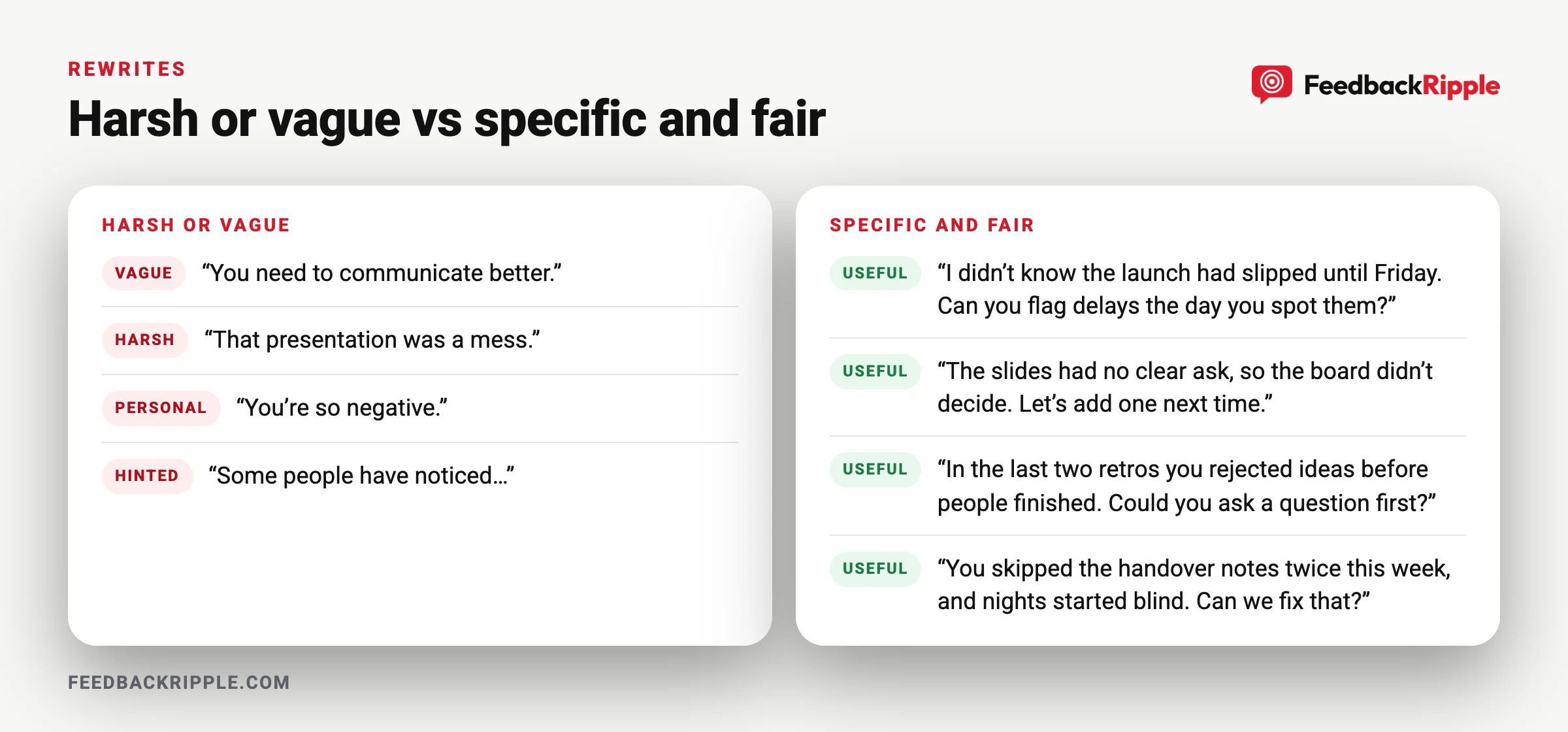
| Harsh or vague | Specific and useful |
|---|---|
| “Your work is sloppy.” | “The report had three wrong totals in section 2, so the client questioned the rest. Can you add a second check?” |
| “You’re never on time.” | “You joined the last three standups 10 minutes late, and we repeated updates. What would help?” |
| “You need to communicate better.” | “I didn’t know the launch had slipped until Friday. Can you flag delays the day you spot them?” |
| “That presentation was a mess.” | “The slides had no clear ask, so the board didn’t decide. Let’s add one next time.” |
| “You’re so negative.” | “In the last two retros you rejected ideas before people finished. Could you ask a question first?” |
| “Some people have noticed…” | “I noticed you skipped the handover notes twice this week, and nights started blind. Can we fix that?” |
| “You’re not a team player.” | “You declined to help with testing twice when we were behind. I need you to pitch in on release weeks.” |
| “You should be more confident.” | “You had the right answer in the meeting but didn’t share it. I’d really like you to speak up next time.” |
How to give negative feedback
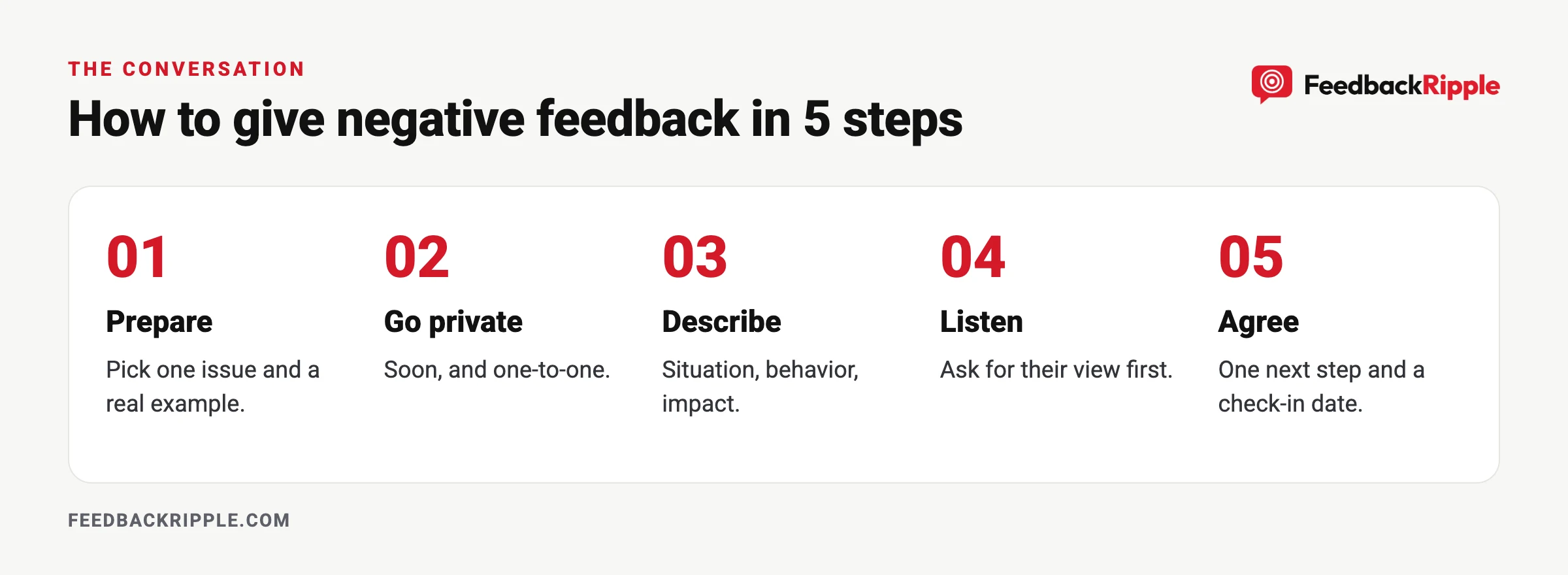
- Prepare. Pick one issue, not five, and have a real example ready.
- Go private, and go soon. Within a day or two, one-to-one. You have to give people the chance to respond without an audience.
- Describe it. Use situation, behavior and impact. Leave out labels like “lazy” or “difficult”.
- Listen. Ask for their view: “How did you see it?” There’s often context you don’t have.
- Agree a next step. One change, and a date to check in. Then actually check in.
Balance matters over time, not inside one conversation. If people hear plenty of specific praise (see our positive feedback examples), negative feedback tends to land as help rather than as a verdict.
To give you a concrete example, at FeedbackRipple, we don’t simply hand people a list of low scores. Their feedback report shows written comments from their manager, peers and direct reports, with peer and direct-report answers kept anonymous so that people can be honest about what needs to change.
Mistakes to avoid with negative feedback
- Waiting for the review. If the first time someone hears about a problem is in their annual review, the process has truly failed.
- The feedback sandwich. Hiding criticism between two compliments usually confuses the message and makes future praise feel suspicious.
- Speaking for others. “People are saying…” makes the person anxious and gives them nothing to act on. Share what you saw.
- Piling up issues. Ten points at once feels like an ambush. Pick the one or two that matter most.
- Doing it by email. Written criticism is easy to misread. Talk first, then follow up in writing.
And if you want a fuller method for both kinds of feedback, our guide on how to give 360 feedback walks through it step by step.
FeedbackRipple · First 3 people free
Get honest feedback people can act on
FeedbackRipple gathers anonymous feedback from the people around each person and turns it into a report with strengths, blind spots and what to try next. Your first 3 people are free.
80+ Positive Feedback Examples for Work (Copy and Adapt)
80+ Positive Feedback Examples for Work (Copy and Adapt)
Good positive feedback names a specific thing someone did and the difference it made, for instance: “Your summary of the client call meant the whole team walked into Monday’s meeting already aligned. Thank you.” Below you’ll find 80+ positive feedback examples you can copy and adapt: by situation (great work, teamwork, communication, leadership and more), by relationship (manager to employee, peer to peer, to your manager), and in short versions for Slack or a performance review.
Key takeaways
- Specific beats nice. “Great job” feels good for a second; “Your checklist cut onboarding questions in half” tells people what to repeat.
- Use a simple shape: what you saw, the impact it had, and a thank-you or “keep doing this”.
- Give it soon. Positive feedback tends to land best within a day or two of the moment.
- Match the channel to the person. Some people love public praise; others really prefer a private message.
- Don’t wrap criticism in it. Keep praise and improvement points in separate conversations so that the praise is believed.
Most of us know positive feedback genuinely matters. But when the moment comes, it usually comes out as “Great job!” or “Thanks, legend.” And while that’s kind, it doesn’t actually tell the person what they did well, so they can’t do it again on purpose.
So here’s a practical list of positive feedback examples for work. Each one names a real behavior and the impact it had. You can copy them as they are, but they work best when you swap in the details of what actually happened.
In this guide
What makes positive feedback effective
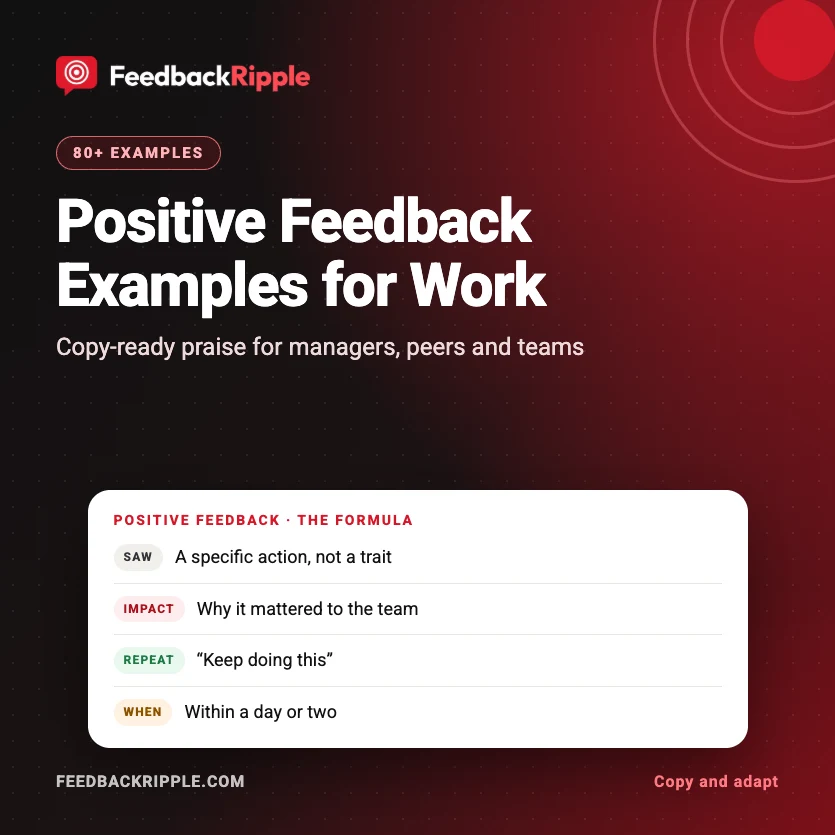
Effective positive feedback is specific, timely and about behavior. It tells the person what they did, why it mattered, and that you’d like to see more of it. In practice, the easiest way to get there is a three-part shape:
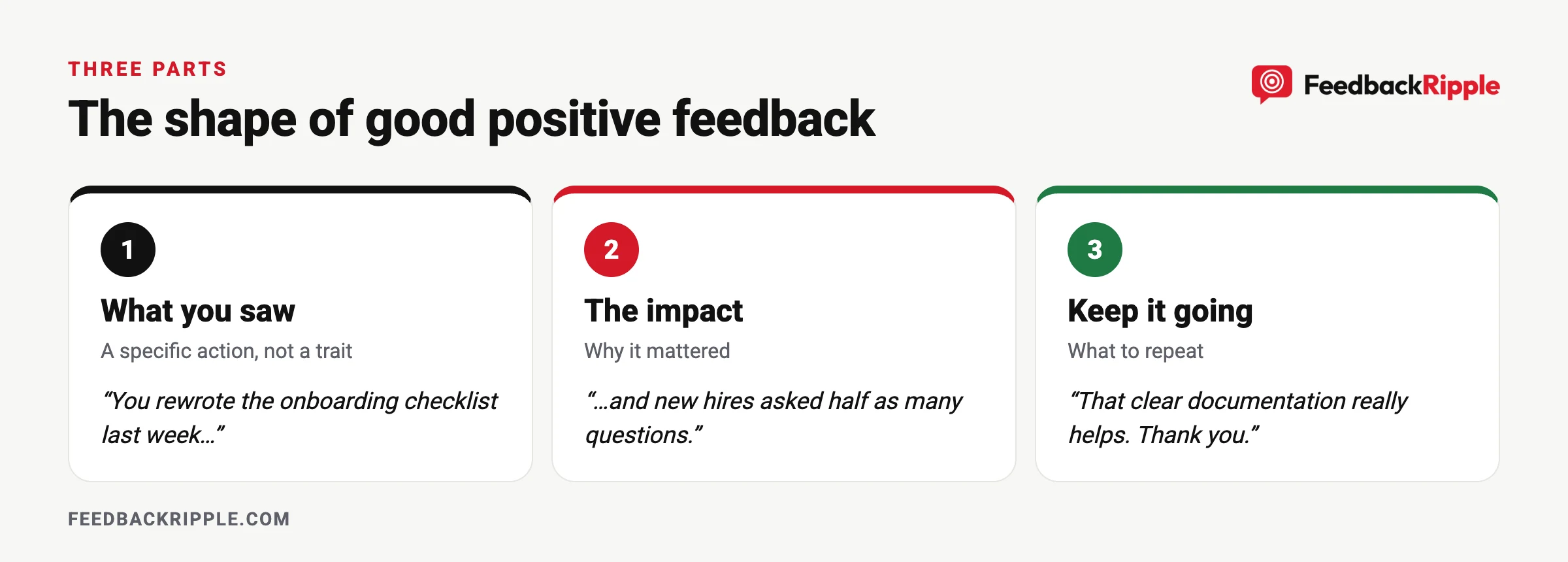
| Part | What it answers | Example |
|---|---|---|
| What you saw | What exactly did they do? | “You rewrote the onboarding checklist last week…” |
| The impact | Why did it matter? | “…and the new hires asked us half as many questions.” |
| Keep it going | What should they repeat? | “That kind of clear documentation really helps. Thank you.” |
This is a lighter version of the Situation-Behavior-Impact model that many managers learn. You don’t need to follow it word for word. But if your feedback has a concrete behavior and a real impact in it, it’ll usually land.
Positive feedback examples by situation
For great quality work
- “The report you sent this morning was so clear that leadership approved the budget without a single follow-up question. That’s rare, and it’s down to how you structured it.”
- “I noticed you double-checked every figure in the deck before it went out. It saved us from a really awkward correction with the client.”
- “Your code review comments were specific and kind. Two people told me they actually learned something from them.”
- “The new landing page you designed is converting better than the old one, and it looks great on mobile. Thank you for sweating the details.”
- “You turned a messy brief into a plan everyone could follow. That made the whole project feel calmer.”
- “Your proposal answered the client’s concerns before they even raised them. That’s what won us the second meeting.”
For going above and beyond
- “You stayed on the call until the customer’s issue was fully fixed, even though your shift had ended. They mentioned you by name in their thank-you email.”
- “Thanks for covering Priya’s accounts while she was out. Nothing slipped, and she came back to a tidy handover.”
- “You spotted the data issue before launch and fixed it without being asked. That probably saved us a week of clean-up.”
- “You didn’t have to write the FAQ for the support team, but you did, and it’s already cutting ticket times.”
- “I know the deadline moved up twice. The way you reorganized your week so that we still shipped on time was genuinely impressive.”
- “Volunteering to mentor the new interns says a lot about you. They already look to you for help.”
For teamwork and collaboration
- “You made sure everyone had a say in the planning session, including the quieter people. The plan is better because of it.”
- “Thank you for sharing your template with the other team instead of keeping it to yourself. It saved them hours.”
- “When the two teams disagreed, you found the common ground and kept things moving. That’s a real skill.”
- “You always tell people when you’ve finished your part, so nobody is left guessing. It makes working with you easy.”
- “I noticed you gave credit to the whole team in the update, not just yourself. People really noticed too.”
- “You jumped in to help with testing without being asked. That’s why we hit the release date.”
For communication
- “Your project update was short, clear and had the decision we needed right at the top. More of those, please.”
- “You explained the change to the customer in plain language, and they thanked us for being upfront. Nice work.”
- “I appreciated how you raised the risk early in the meeting, rather than after. It gave us time to plan around it.”
- “Your email to the vendor was firm but friendly. We got what we needed and kept a good relationship.”
- “You listened to the whole concern before answering, and the client clearly felt heard. That changed the tone of the call.”
- “The way you summarized the meeting in three bullet points meant nobody had to watch the recording.”
For problem-solving and initiative
- “You noticed the same question kept coming up and built a quick guide to answer it. That’s exactly the kind of initiative we need.”
- “When the supplier fell through, you had two alternatives lined up within a day. Calm, quick and practical.”
- “Your idea to automate the weekly report has saved the team about three hours every Friday.”
- “You didn’t just flag the problem; you came with a proposed fix and the trade-offs. That made the decision easy.”
- “Thanks for testing a small version before rolling it out to everyone. It caught two issues early.”
For leadership
- “You gave the team a clear priority for the week, and it showed: fewer side quests and a much calmer Friday.”
- “I noticed you asked for the team’s view before deciding. People told me they felt genuinely included.”
- “The way you handled the reorganization news, openly and with time for questions, built a lot of trust.”
- “You delegated the client workshop to Sam and backed him up instead of taking over. He grew a lot from it.”
- “Your one-to-ones are clearly working. Your team raises problems earlier than anyone else’s.”
- “You stayed calm when the launch went sideways, and that kept everyone else calm too.”
For learning and growth
- “Six months ago you were nervous about presenting. Today you handled tough questions from the board really well.”
- “You asked for feedback on your first draft, and then actually used it. That’s why the second version is so strong.”
- “I can see you’ve been practicing the new tool. Your reports are faster and cleaner already.”
- “Taking on the analytics course in your own time is paying off. Your recommendations are much sharper.”
- “You owned the mistake on the invoice, fixed it and changed the process so that it won’t happen again. That’s exactly right.”
For customer service
- “The customer came in frustrated and left thanking you. The way you listened first made all the difference.”
- “You followed up with the client a week later without being asked. That’s the kind of care people remember.”
- “Your response times this month have been the fastest on the team, and your satisfaction scores went up too.”
- “You explained a confusing bill so clearly that the customer upgraded instead of cancelling.”
- “Thanks for flagging the recurring complaint to the product team. It’s now on the roadmap.”
For reliability and time management
- “You’ve hit every deadline this quarter, and when something did slip, you told us early. That makes planning so much easier.”
- “I always know where your work stands, given that you keep the board up to date. Thank you.”
- “You protected focus time for the hard work and it shows: the analysis is the deepest we’ve had.”
- “You’re the person people trust with the details. That reputation is earned, and I wanted you to know I see it.”
- “Thanks for being so prepared for the review. We finished in half the time.”
FeedbackRipple · First 3 people free
See what people do well, from everyone around them
FeedbackRipple collects anonymous feedback from managers, peers and direct reports, and every report opens with top strengths. Your first 3 people are free.
Positive feedback examples by relationship
The same compliment sounds different depending on who’s giving it. Here’s how it tends to shift:
Manager to employee
- “I want you to know I noticed how you handled the escalation yesterday. You stayed calm, kept the customer informed and fixed it. That’s exactly what I’d hope for.”
- “Your work on the pricing analysis is a big reason we made the right call. I mentioned it to the leadership team too.”
- “You’ve grown so much in client meetings this year. You lead them now rather than just supporting.”
- “Thanks for taking the time to train the new starters. It’s made my job easier and theirs much less stressful.”
- “I trust your judgment on this project, and I wanted to say that out loud.”
Peer to peer
- “Thanks for reviewing my draft so quickly. Your comment about the opening really improved it.”
- “Working with you on the launch was genuinely easy. You always said what you’d do, then did it.”
- “You explained the new system to me without making me feel slow. I really appreciated that.”
- “Your idea in the retro was the best one we had. You should share it with the wider team.”
- “Thanks for having my back in the meeting when my point got talked over.”
Employee to manager
Positive feedback upward is rarer, which is exactly why it matters. Keep it sincere and specific (we have more on this in our page on upward feedback):
- “The way you shielded us from the last-minute scope changes let us actually finish the project. Thank you.”
- “I really value our one-to-ones. You always leave time for my questions, not just status updates.”
- “Thanks for trusting me with the client presentation. It was a big step for me.”
- “You explained the reasons behind the reorganization, which made it much easier to accept.”
- “When I made that mistake last month, you helped me fix it instead of blaming me. I learned a lot from how you handled it.”
For a new team member
- “You’ve picked up our tools really quickly. Your first ticket summaries are already clearer than some of ours.”
- “Asking questions early, like you’ve been doing, is exactly right. It’s saving you and us time.”
- “Great first week. The customer you spoke to on Wednesday said you were really helpful.”
- “You’ve already spotted two things we should do differently. Keep those fresh eyes coming.”
For remote and hybrid teammates
- “Your written updates mean I never have to chase you for status, even across time zones. Thank you.”
- “You always turn your camera on for the hard conversations, and it really helps them go well.”
- “Recording the walkthrough so that the Singapore team could watch it later was a thoughtful touch.”
- “You make remote meetings feel inclusive by checking in with people who haven’t spoken yet.”
Short positive feedback examples for Slack, Teams or email
Not every piece of praise needs a meeting. Here are quick messages you can send in a minute:
- “That demo was great. The way you handled the pricing question was spot on.”
- “Thanks for the fast turnaround on the contract. You saved the deal this week.”
- “Your dashboard is now the first thing I open every morning. Really useful.”
- “Shout-out to Ana for the onboarding guide. Three new starters used it this week without a single question.”
- “Loved how you summarized that thread. Exactly what we needed.”
- “Just wanted to say: the client mentioned you by name today. Great work.”
A public shout-out works well for team wins. But for personal growth or sensitive topics, a private message usually feels more sincere. If you’re not sure which a person prefers, simply ask them.
Positive feedback examples for performance reviews
In a review, positive feedback should summarize a pattern over time, not a single moment. These examples are written that way:
- “Throughout the year, Maya consistently delivered accurate, well-structured reports ahead of deadlines, and two of them directly shaped budget decisions.”
- “Leo has become the go-to person for onboarding. Every new hire he supported this year reached full productivity faster than our average.”
- “Sara’s calm handling of escalations is a real strength. Customer satisfaction on her cases rose from 82% to 91% this year.”
- “Daniel took on line management for the first time and built a team that raises issues early and supports each other.”
- “Jo consistently shares knowledge with the wider team, through guides, demos and code reviews, which has made the whole team faster.”
For more performance-style comments, including written 360 comments from peers and direct reports, see our 360 feedback examples.
Weak vs strong: 8 positive feedback rewrites
Here’s how small changes turn generic praise into feedback people can actually use:
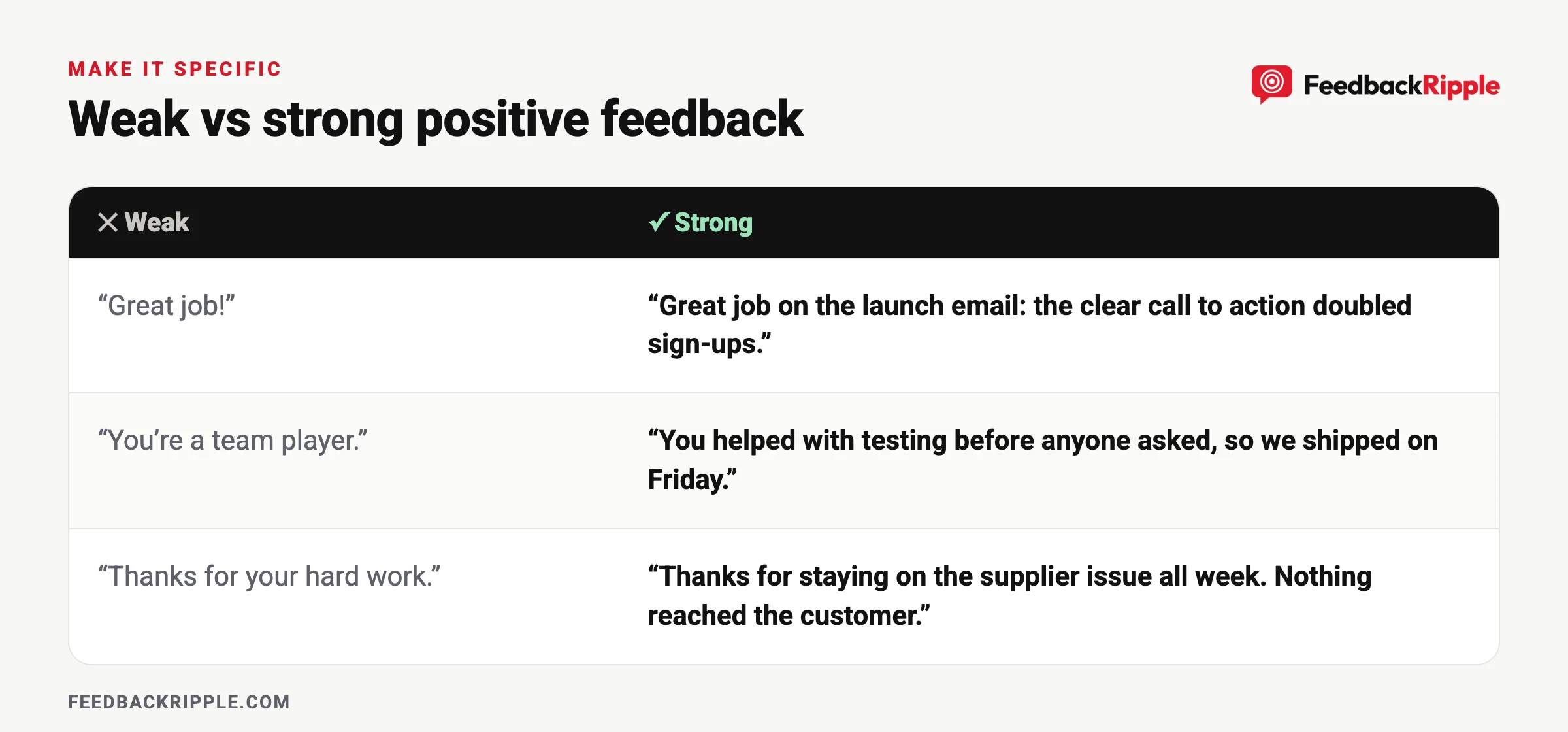
| Weak | Strong |
|---|---|
| “Great job!” | “Great job on the launch email: the clear call to action doubled our sign-ups.” |
| “You’re a team player.” | “You offered to help with testing before anyone asked, and that’s why we shipped on Friday.” |
| “Nice presentation.” | “Your presentation answered the CFO’s question before she asked it. That built a lot of credibility.” |
| “Thanks for your hard work.” | “Thanks for staying on top of the supplier issue all week. Nothing reached the customer.” |
| “You’re so organized.” | “Your project board means I always know what’s next. It saves me real time.” |
| “Good communication.” | “You told the client about the delay early, so that they could plan around it. They appreciated it.” |
| “You’re a great manager.” | “You always explain the why behind priorities, which makes it easier to make good calls on my own.” |
| “Well done this year.” | “This year you took over the biggest account and grew it by 20% without losing a single contact.” |
How to give positive feedback

- Be specific. Name the behavior and the impact. If you can’t, you probably need a moment to think of a real example first.
- Be timely. Aim for the same day or the next. Feedback tends to lose its punch after a week.
- Be sincere. You have to mean it, so only say what you actually mean. People can usually tell when praise is a warm-up for something else.
- Pick the right channel. Public for team wins, private for personal growth, written when you want it to be remembered.
- Make it regular. A team that only hears praise at review time typically assumes it isn’t noticed the rest of the year.
To give you a concrete example, at FeedbackRipple, we don’t simply show people their lowest scores. Every 360 report opens with their top strengths, as seen by their manager, peers and direct reports, given that people tend to act on feedback more when they first know what to keep doing.
Mistakes to avoid with positive feedback
- The feedback sandwich. Wrapping criticism in praise teaches people to brace for the “but”. Keep them separate.
- Only praising results. Praise effort and approach too, especially when someone did the right things and the outcome still missed.
- Praising some people far more than others. Check who you tend to recognize. Quieter people are often overlooked.
- Comparing people. “You’re better at this than Sam” creates rivalry, not motivation.
- Overdoing it. If everything is “amazing”, nothing is. Save big words for truly big moments.
And if you also need to give tougher feedback, the same principles apply: be specific, focus on behavior and impact, and give it soon. Our guide on how to give 360 feedback covers both. Specific praise can help people repeat exactly what worked.
FeedbackRipple · First 3 people free
Make positive feedback part of every review
FeedbackRipple gathers anonymous feedback from the people around each person and turns it into a report with strengths, blind spots and what to try next. Your first 3 people are free.