
SBI Feedback Model: Situation-Behavior-Impact Explained (15 Examples)
The SBI feedback model is a simple way to give feedback in three parts: the Situation (when and where), the Behavior (what the person actually did) and the Impact (the effect it had), for instance: “In this morning’s client call, you interrupted Dana three times, and she stopped sharing details.” It was developed by the Center for Creative Leadership, and it works for both positive and negative feedback. Below you’ll find how each step works, 15 SBI examples you can adapt, the SBII variation and how SBI compares with other feedback models.
Key takeaways
- Three parts: Situation, Behavior, Impact. Keep each one short.
- Behavior is the hard part. Describe what a camera would see, not your interpretation of it.
- Impact makes it matter. It tells the person why the behavior is worth changing (or repeating).
- It works both ways. SBI is just as useful for praise as for criticism.
- Add a question. Asking about intent or next steps turns SBI from a statement into a conversation.
Most feedback goes wrong in one of two ways. It’s either too vague to act on (“Good job!”, “You need to be more professional”), or it sounds like a judgment of the person rather than of what they did. The SBI model fixes both problems with one simple structure.
And because it’s so short, you can actually use it in the moment: in a one-to-one, after a meeting, or in a written comment.
What is the SBI feedback model?
SBI stands for Situation-Behavior-Impact. It’s a feedback framework created by the Center for Creative Leadership (CCL), and it’s now one of the most widely used feedback models in leadership and management training.
The idea is truly simple: instead of giving an opinion about someone, you describe a specific moment, what they did in it and what happened as a result. Given that it’s based on observable facts, it tends to make people less defensive, and it gives them something genuinely concrete to repeat or change.
The 3 steps of the SBI model
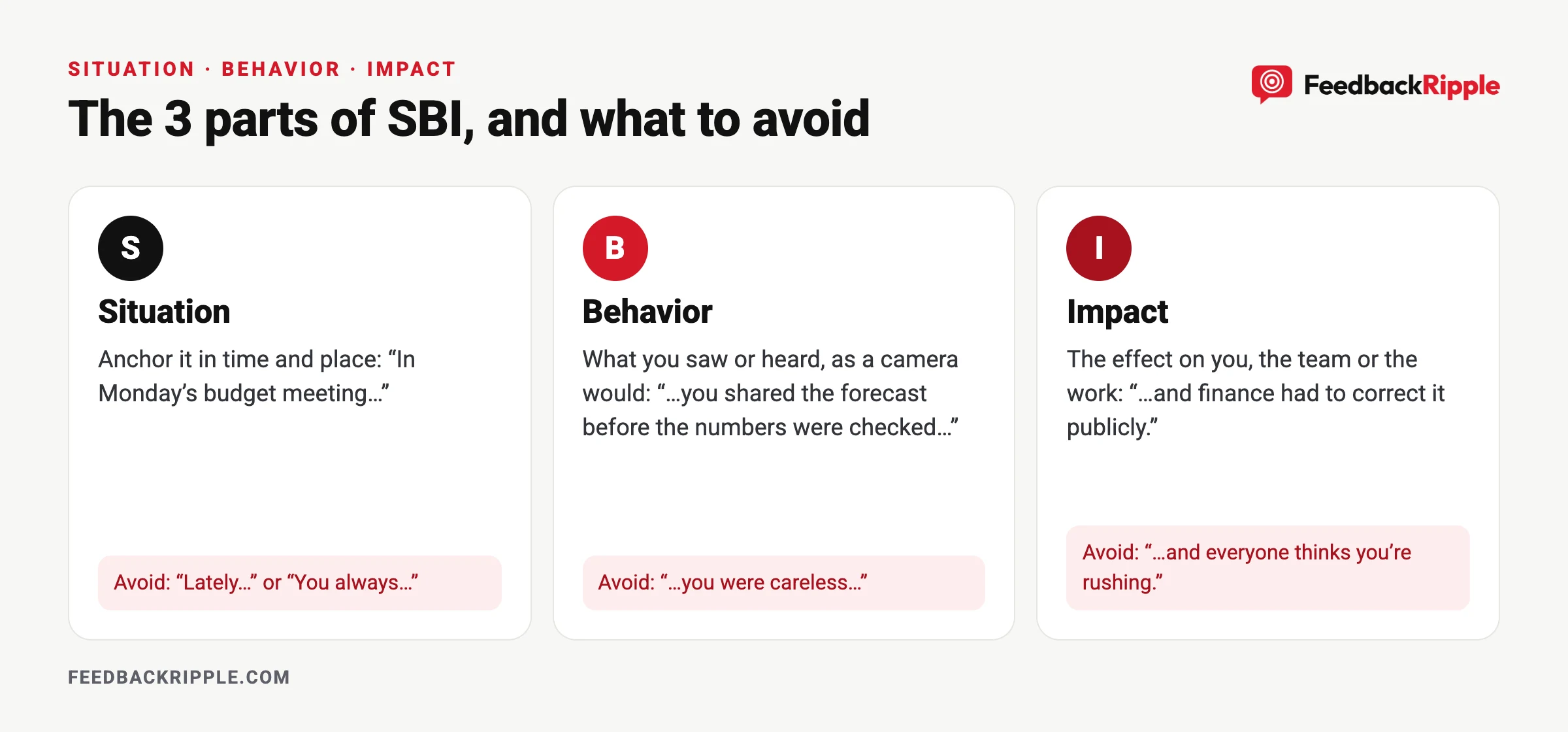
1. Situation
Start by anchoring the feedback to a specific time and place: “In Monday’s budget meeting…” or “On the call with the supplier yesterday…”. This simply helps the other person remember the moment. Avoid “lately” or “you always”, which turn one moment into a pattern they’ll want to argue with.
2. Behavior
Describe what the person actually said or did. Here’s a useful test: could a video camera have recorded it? “You shared the forecast before the numbers were checked” passes. “You were careless” doesn’t; it’s your interpretation.
3. Impact
Explain the effect of the behavior on you, the team, the customer or the work: “…and finance had to correct it in front of the leadership team.” Speak about the impact you saw or felt. You can’t know how everyone else feels, so avoid “everyone thinks…”.
You have to keep it short: one sentence per part. If your SBI takes more than 30 seconds to say, you’re usually adding opinions.
15 SBI feedback examples
Positive SBI examples
- “In this morning’s standup (S), you flagged the API risk before anyone asked (B). That gave us two extra days to fix it before the release (I).”
- “At yesterday’s client workshop (S), you summarized each decision on the whiteboard as we went (B). The client said it was the clearest session they’ve had with us (I).”
- “During the outage on Saturday (S), you posted an update in the incident channel every 30 minutes (B). Support could answer customers without chasing engineering (I).”
- “In your first month (S), you wrote down every question you asked during onboarding and turned them into a guide (B). Our two newest hires used it and needed far less help (I).”
- “In the team retro (S), you asked Ben what he thought before giving your own view (B). He shared an idea we’re now actually using (I).”
For more praise you can adapt, see our positive feedback examples.
Negative (constructive) SBI examples
- “In Tuesday’s planning session (S), you said the estimate was “easy” before the team had discussed it (B). Two people told me afterwards they didn’t feel they could disagree (I).”
- “On the proposal sent last Friday (S), the pricing table had last year’s rates (B). The client questioned the whole document, and we had to reissue it (I).”
- “In the last three one-to-ones (S), you arrived without the updates we agreed on (B). We spent the time catching up instead of solving problems (I).”
- “When the release slipped last week (S), I heard about it from the client first (B). I couldn’t answer their questions, and it damaged their trust in us (I).”
- “In the all-hands Q&A (S), you answered the question about bonuses with a joke (B). Several people left the meeting more worried than before (I).”
More copy-ready examples are in our negative feedback examples.
SBI examples for managers (upward)
- “In our last three one-to-ones (S), we ran out of time before we got to my development plan (B). I’m not sure what I should be working on next quarter (I).”
- “When the priorities changed on Wednesday (S), you explained the reasons in the team channel (B). It made it much easier for us to re-plan without frustration (I).”
- “In the client review (S), you answered questions directed at me (B). The client now sends everything to you, and I can’t build the relationship (I).”
- “After my presentation last week (S), you gave me two specific things to improve (B). I used both in the next one, and it went much better (I).”
- “When my project was cancelled (S), you told me in person before the announcement (B). It meant a lot, and I trusted the decision more (I).”
SBII: adding intent to the SBI model
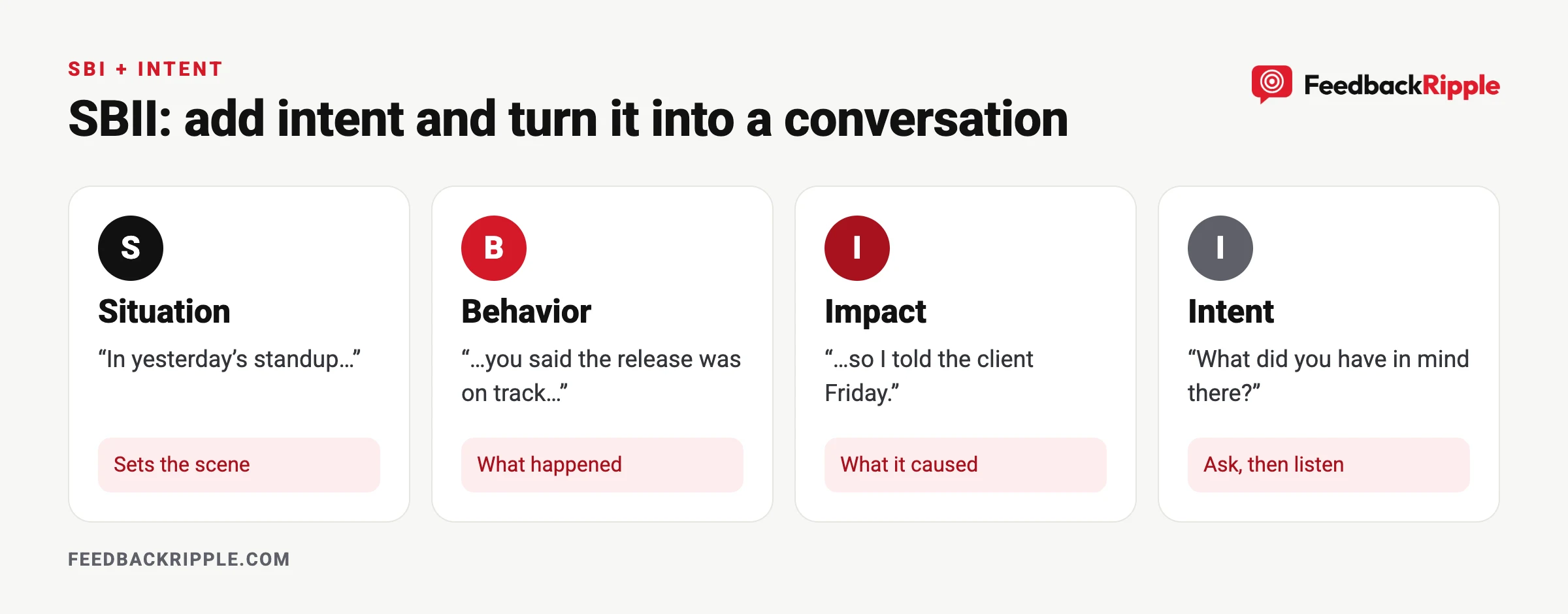
CCL later extended the model with a fourth step, Intent, sometimes written as SBII. After you describe the impact, you ask about what the person was trying to do: “What did you have in mind there?” or “What were you hoping would happen?”
But this matters, because impact and intent are often different. The colleague who answered the client’s questions for you may have been trying to help, not to take over. So asking about intent can help you avoid assuming the worst, and it typically turns feedback into a real two-way conversation.
How to use SBI in a feedback conversation
- Ask first. “Do you have five minutes for some feedback about the client call?” A quick check like this tends to lower defenses.
- Deliver the SBI. Say it plainly, in two or three sentences, then stop talking.
- Ask about intent or their view. “How did you see it?” You’ll often learn something.
- Agree what’s next. For negative feedback, agree one change. For positive feedback, simply say “keep doing this”.
- Follow up. Notice when the change happens, and say so, using SBI again.
Common SBI mistakes
- Hiding a judgment in the behavior. “You were rude to the client” isn’t a behavior. “You said ‘that’s not my problem’ to the client” is.
- A vague situation. “Recently” or “in meetings” makes it hard for the person to remember, and easy to dispute.
- Exaggerating the impact. Keep it to what actually happened. “We lost the account” when you didn’t will cost you trust.
- Speaking for others. “The team thinks…” is hearsay. Share your own observation, or encourage others to share theirs.
- Using SBI as a script. If it sounds rehearsed, it can feel cold. Use your own words; the structure is what matters.
SBI vs other feedback models
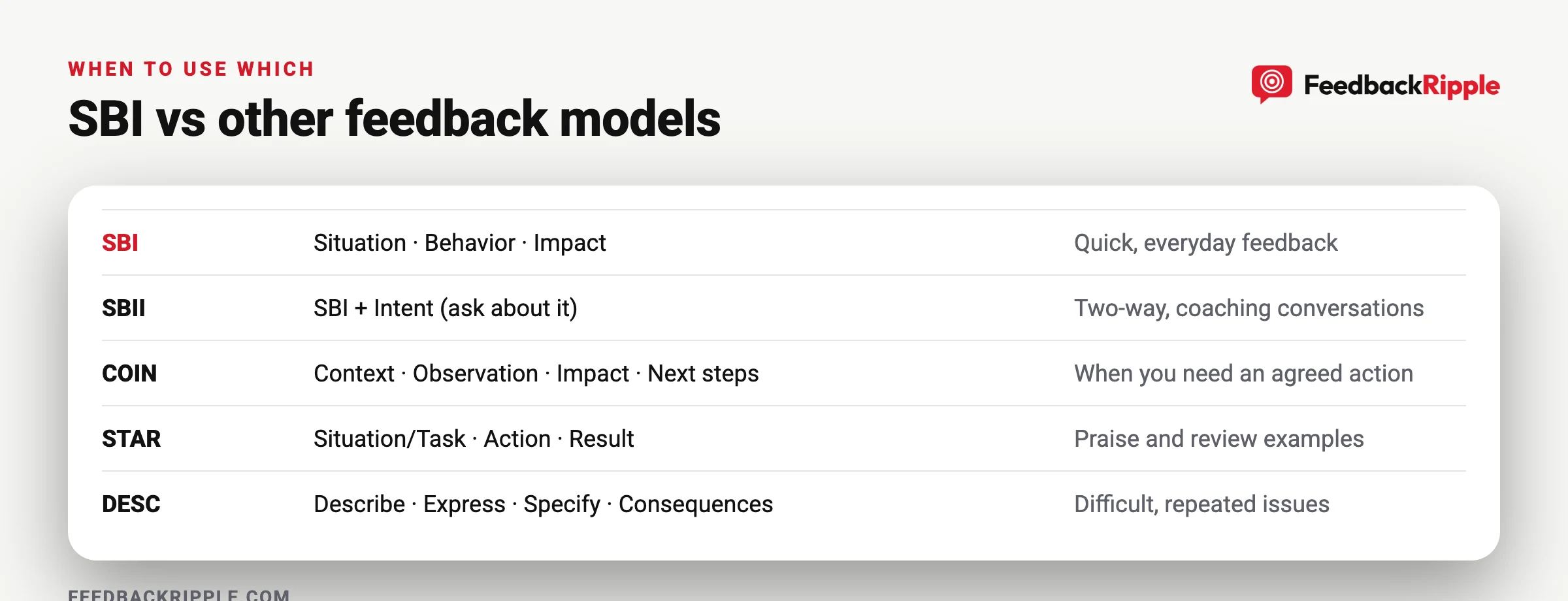
| Model | Steps | Best for |
|---|---|---|
| SBI | Situation, Behavior, Impact | Quick, everyday feedback, positive or negative |
| SBII | Situation, Behavior, Impact, Intent | Two-way coaching conversations |
| COIN | Context, Observation, Impact, Next steps | When you need an agreed action |
| STAR | Situation/Task, Action, Result | Praise and examples in performance reviews |
| DESC | Describe, Express, Specify, Consequences | Difficult or repeated issues |
In practice, most of these are variations on the same idea: be specific, describe behavior and explain why it matters. SBI is simply the shortest, which is why it’s usually the easiest to start with.
Using SBI in written and 360 feedback
SBI isn’t only for conversations. It works really well in written comments, too, such as performance reviews and 360 feedback, where vague comments like “great team player” are common and hard to act on. People tend to accept SBI feedback more easily because it sticks to what happened.
To give you a concrete example, at FeedbackRipple, we don’t simply ask raters for scores. Each 360 survey can include open-text questions, so that managers, peers and direct reports can explain what they saw and why it mattered, and those comments appear in the person’s feedback report alongside the ratings. Asking raters to “give one specific example” in the question is an easy way to nudge them toward SBI.
If you’re running a 360 process, our guide on how to give 360 feedback shows how to write comments the person can actually use, and our 360 feedback examples give you ready-made wording.
FeedbackRipple · First 3 people free
Collect feedback people can act on
FeedbackRipple gathers anonymous feedback from the people around each person and turns it into a report with strengths, blind spots and what to try next. Your first 3 people are free.
The author

Venchito Tampon
Venchito Tampon is the Founder of FeedbackRipple, 360 feedback software that tells people what to do next. It helps executive coaches and HR and L&D teams run anonymous 360s, turn the results into clear guidance and follow through on development plans.
He is a Certified Executive Coach, certified by Symbiosis Coaching, an ICF-accredited coaching organization. He brings that coaching lens to FeedbackRipple: every report ends with clear next steps, not just charts.
He is also the CEO and Founder of eLearning Solutions Lab, a Philippines-based eLearning production company specializing in custom eLearning development and rapid eLearning solutions for global clients.
He founded Rainmakers Training & Consultancy, a corporate training and leadership development firm where he has trained and spoken at 250+ conventions, seminars, and workshops across the Philippines and internationally, including Singapore, Slovakia, and Australia. He has worked with top corporations including SM Hypermarket, Shell, and National Bookstore.
His other ventures include ExpirePilot, document expiration tracking software for small businesses, SharpRocket, a digital marketing and SEO company, and Hills & Valleys Cafe, a local café with available franchising.
He is a certified member of The Philippine Society for Talent Development (PSTD), the premier organization for Talent Development practitioners in the country, and an active Go Negosyo Mentor under the Mentor Me program.