
65+ Peer Review Examples for Coworkers (Strengths and Areas to Improve)
A good peer review comment describes something specific your coworker did, why it mattered and, if needed, one thing they could try differently, for instance: “When the migration failed, Sam’s rollback plan had us back online in 20 minutes. I’d love him to share that habit with the wider team.” Below you’ll find 65+ peer review examples for coworkers, grouped by skill, with both strengths and areas to improve, plus answers to common peer review questions and weak vs strong rewrites.
Key takeaways
- Be specific. Name a project, a meeting or a moment, not a personality trait.
- Use a simple shape: observation, impact, suggestion.
- Balance it. Most peer reviews ask for strengths and areas to improve. Give real examples for both.
- Stay within what you saw. Peer feedback is valuable because of your view of their work, so don’t guess at the rest.
- Write what you’d say to their face. Even when it’s anonymous, it tends to be more useful that way.
Writing a peer review is surprisingly hard. You genuinely like working with this person, so you don’t want to say anything that hurts. But you also know “Great team player!” won’t help them, or their manager, much.
Here’s the good news: you don’t have to be a great writer. You simply need a few concrete examples and a clear structure. And the examples below give you both.
How to write a peer review for a coworker
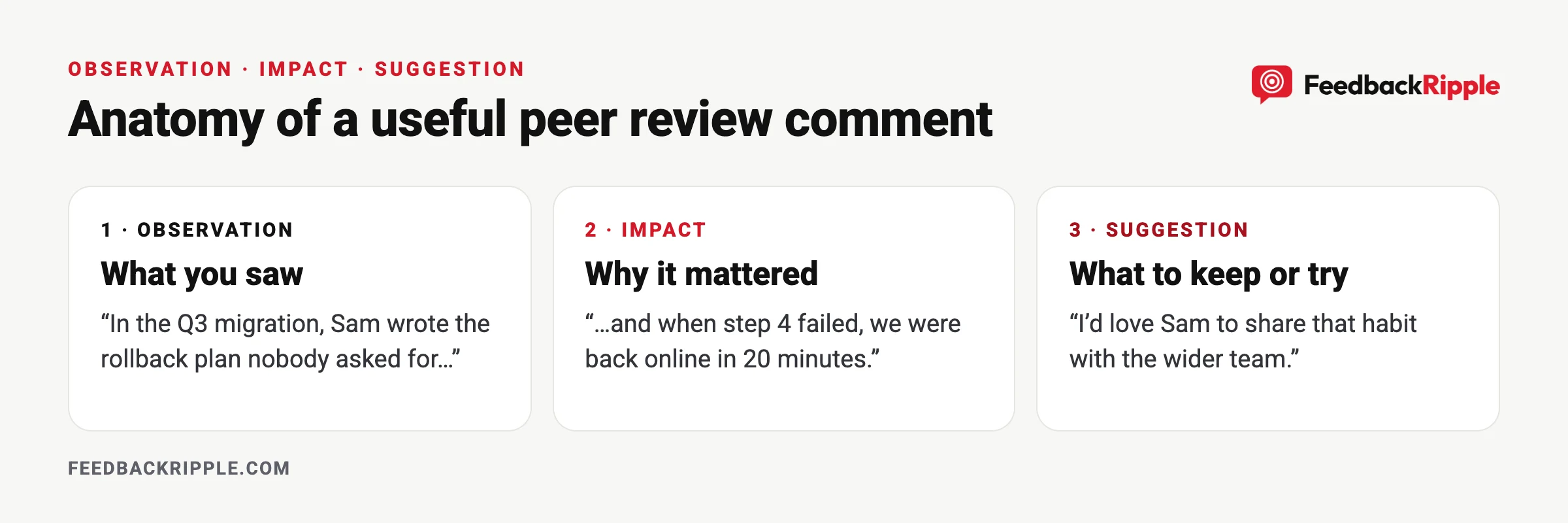
So every useful peer review comment usually has three parts:
- Observation: what you saw them do, in a specific situation.
- Impact: why it mattered to you, the team or the customer.
- Suggestion: what they should keep doing, or one thing to try.
If you’ve heard of the SBI feedback model, this is the same idea: situation, behavior and impact, with a suggestion at the end.
Before you write, look back at your shared projects, chats and calendar from the review period. Two or three real moments are worth more than a page of adjectives.
Peer review examples by skill
Communication
Strengths
- “Your weekly project notes are the clearest in the team. I never have to chase you for status.”
- “You explain technical issues to clients without jargon, which really helps our account managers.”
- “You always say when you disagree in the meeting, not afterwards. It makes decisions faster.”
- “Your handover notes before your leave meant nothing was dropped for two weeks.”
- “You listen to the whole question before answering, so people feel heard.”
Areas to improve
- “Your updates sometimes arrive after the deadline has passed. A short Friday note would help the rest of us plan.”
- “In longer emails, the key decision is often near the end. Leading with it would save time.”
- “You sometimes reply “OK” to requests you don’t have time for. I’d rather you push back so that we can re-plan.”
- “In meetings with senior stakeholders, you tend to go quiet. Your ideas are good, and I’d like to hear them there too.”
Collaboration and teamwork
Strengths
- “You always share context so that others can make decisions without waiting for you.”
- “When the launch was behind, you offered to help with testing before anyone asked.”
- “You give credit to others in demos, which makes people want to work with you.”
- “You’re the person newer teammates go to with questions, and you never make them feel slow.”
- “You resolved the disagreement with the design team by setting up a call instead of a long thread.”
Areas to improve
- “You sometimes take on problems alone. Flagging blockers earlier would let us help sooner.”
- “When plans change, the rest of the team doesn’t always hear about it. Posting in the channel would help.”
- “Code reviews from you can feel blunt. Starting with what works would help people take the comments on board.”
- “You tend to work with the same two or three people. Others in the team would benefit from your experience.”
Quality and reliability
Strengths
- “Your work rarely needs a second review. I trust it the first time.”
- “When you say something will be done by Friday, it’s done by Friday.”
- “You catch edge cases the rest of us miss, especially in the billing logic.”
- “Your test coverage on the API work set a standard the team now follows.”
- “You double-check client numbers before they go out, which has saved us more than once.”
Areas to improve
- “Small errors in reports, like totals and dates, have led to some rework. A quick checklist could help.”
- “You sometimes aim for perfect on low-priority tasks. Good enough would free time for the big ones.”
- “A few tasks were marked done before they were tested. Agreeing on what “done” means would help.”
- “When deadlines slip, it’s usually close to the date. Earlier warning would help us adjust.”
Problem solving
Strengths
- “You find the root cause instead of patching the symptom. The checkout bug fix is a good example.”
- “When we hit a blocker, you come with two or three options, not just the problem.”
- “You use data to settle debates, which keeps discussions calm and quick.”
- “You simplified the onboarding process from twelve steps to five.”
- “You’re not afraid to say “I don’t know” and then go and find out.”
Areas to improve
- “You sometimes jump into a solution before agreeing on the problem with the team. A quick check first would avoid rework.”
- “Your solutions are clever, but some are hard for others to maintain. Simpler would often be better.”
- “You could ask for help sooner. Some problems took days that a quick question could have solved.”
Ownership and initiative
Strengths
- “You saw that our docs were outdated and fixed them without being asked.”
- “When the client complained, you owned the issue and followed up until it was solved.”
- “You proposed the new on-call rota, and it has really reduced burnout.”
- “You treat the product as if it were your own, and it shows in the details.”
Areas to improve
- “You raise great ideas but don’t always follow through on them. Picking one and finishing it would have more impact.”
- “You sometimes wait for permission on decisions that are within your role. You can make more of these calls yourself.”
- “When something isn’t your area, you tend to step back. Pointing people to the right owner would still help.”
Leadership and mentoring
Strengths
- “You mentored two juniors this year, and both now lead their own features.”
- “In stressful weeks, you keep the team calm and focused.”
- “You explain the “why” behind decisions, so that we can make good calls on our own.”
- “You make space for quieter people in discussions by asking them directly.”
- “You give feedback early and kindly, not just at review time.”
Areas to improve
- “You sometimes fix people’s work yourself instead of showing them how. They’d learn more from a short walkthrough.”
- “You take on a lot of the team’s coordination. Delegating some of it would give others growth and give you time.”
- “Your feedback is helpful but often comes through chat. Some of it would land better in person.”
Adaptability
Strengths
- “When priorities changed mid-sprint, you re-planned your work without complaint.”
- “You learned the new analytics tool faster than anyone and then taught the rest of us.”
- “You stay open to other approaches, even when you’ve already started on your own.”
Areas to improve
- “When plans change, your frustration sometimes shows in meetings. Raising concerns one-to-one might work better.”
- “You tend to stick with familiar tools. Trying the new workflow could save you time.”
Answers to common peer review questions
Many peer review forms use the same few questions. Here are examples you can adapt:
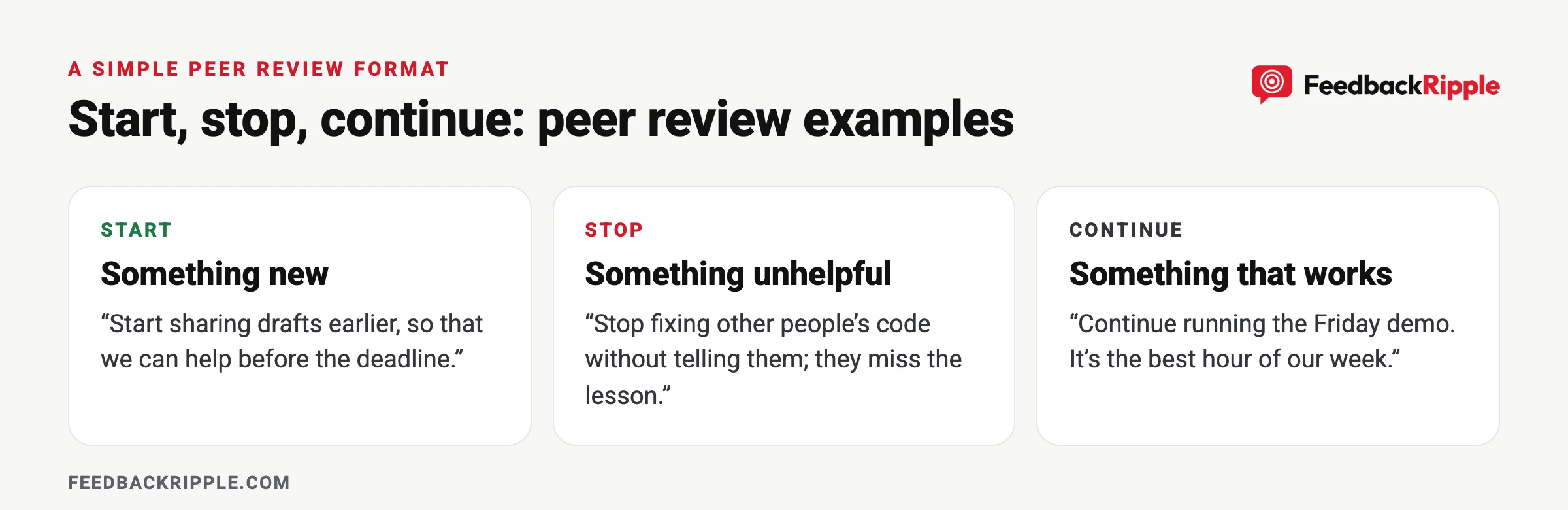
What should this person start, stop and continue doing?
- “Start: sharing drafts earlier, so that we can help before the deadline.”
- “Stop: fixing other people’s code without telling them. They miss the chance to learn.”
- “Continue: running the Friday demo. It’s the best hour of our week.”
What is this person’s greatest strength?
- “Turning messy client requests into clear plans. Every project she scopes runs more smoothly as a result.”
- “His patience. He can explain the same thing five ways until it clicks, without ever sounding frustrated.”
What is one thing this person could do to be more effective?
- “Say no more often. He’s so helpful that his own priorities slip, and the team depends on them.”
- “Share progress earlier. Her final work is excellent, but we usually don’t see it until it’s nearly done.”
Weak vs strong peer review comments
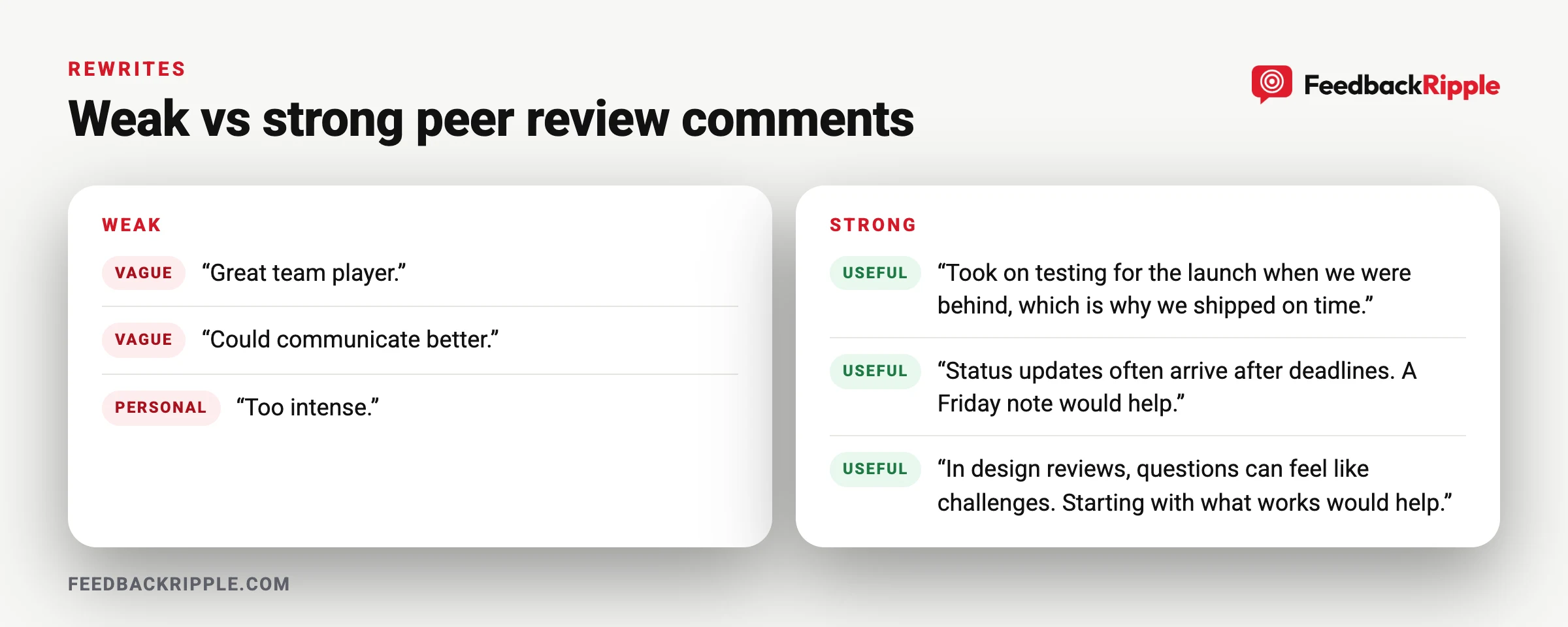
| Weak | Strong |
|---|---|
| “Great team player.” | “Took on testing for the launch when we were behind, which is why we shipped on time.” |
| “Could communicate better.” | “Status updates often arrive after deadlines. A Friday note would help the team plan.” |
| “Too intense.” | “In design reviews, questions can feel like challenges. Starting with what works would help.” |
| “Very smart.” | “Found the root cause of the checkout bug in a day after it had stumped us for a week.” |
| “Needs to be more proactive.” | “Raised the data issue in the retro, but it would have saved a week if raised when first spotted.” |
| “Nice to work with.” | “Always answers questions from new starters patiently. Two of them told me it made their first month.” |
Peer review mistakes to avoid
- Only saying nice things. It feels kind, but it leaves your coworker with nothing to grow on. One honest suggestion is truly a gift.
- Commenting on personality. “Arrogant” or “shy” are labels. Describe the behavior instead.
- Recency bias. Don’t base the whole review on last week. Look back across the full period.
- Reviewing things you didn’t see. You have to stick to your own experience of working with them.
- Saving it all for the review. If something really matters, it’s usually better said in the moment too.
To give you a concrete example, at FeedbackRipple, we don’t simply average everyone’s ratings together. Peer feedback appears as its own rater group in the feedback report, so that people can see how colleagues experience their work compared with their manager and direct reports, with peer comments kept anonymous. In practice, peer feedback typically lands better when it’s specific, given that the person can picture exactly what you mean.
For more examples across all rater groups, see our 360 feedback examples, and if you also need to talk about a coworker’s weaker areas in person, our negative feedback examples can help.
FeedbackRipple · First 3 people free
Run peer reviews people actually use
FeedbackRipple gathers anonymous feedback from peers, managers and direct reports and turns it into a report with strengths, blind spots and what to try next. Your first 3 people are free.
The author

Venchito Tampon
Venchito Tampon is the Founder of FeedbackRipple, 360 feedback software that tells people what to do next. It helps executive coaches and HR and L&D teams run anonymous 360s, turn the results into clear guidance and follow through on development plans.
He is a Certified Executive Coach, certified by Symbiosis Coaching, an ICF-accredited coaching organization. He brings that coaching lens to FeedbackRipple: every report ends with clear next steps, not just charts.
He is also the CEO and Founder of eLearning Solutions Lab, a Philippines-based eLearning production company specializing in custom eLearning development and rapid eLearning solutions for global clients.
He founded Rainmakers Training & Consultancy, a corporate training and leadership development firm where he has trained and spoken at 250+ conventions, seminars, and workshops across the Philippines and internationally, including Singapore, Slovakia, and Australia. He has worked with top corporations including SM Hypermarket, Shell, and National Bookstore.
His other ventures include ExpirePilot, document expiration tracking software for small businesses, SharpRocket, a digital marketing and SEO company, and Hills & Valleys Cafe, a local café with available franchising.
He is a certified member of The Philippine Society for Talent Development (PSTD), the premier organization for Talent Development practitioners in the country, and an active Go Negosyo Mentor under the Mentor Me program.