
50+ Negative Feedback Examples at Work (and How to Give Them)
Good negative feedback describes a specific behavior, the impact it had and what you’d like to see instead, for instance: “In this morning’s client call you interrupted Dana three times, and she stopped sharing details. Next time, can you let her finish before you answer?” Below you’ll find 50+ negative feedback examples for work you can copy and adapt: by situation, by relationship (manager, peer, to your manager), for performance reviews, plus harsh vs useful rewrites and a simple way to deliver them.
Key takeaways
- Negative feedback isn’t an attack. It’s genuinely useful information about a behavior and its impact, so that the person can actually change it.
- Use a simple shape: situation, behavior, impact, then a request or a question.
- Describe, don’t label. “You missed two deadlines” is fair; “You’re unreliable” is a judgment people tend to fight.
- Give it soon and in private. A week later, or in front of the team, it usually lands as punishment.
- End with a next step. Agree one change and when you’ll check in.
Nobody really enjoys giving negative feedback. So most of us either avoid it until the problem is huge, or blurt it out in a way that makes the other person defensive. But here’s the thing: people usually want to know when something isn’t working. What they don’t want is to be surprised, labeled or embarrassed.
This guide gives you the words. You can use the examples as they are, or simply swap in your own situation, names and numbers.
What is negative feedback at work?
Negative feedback at work (also called constructive or corrective feedback) tells someone that a behavior or result didn’t meet expectations, and why it matters. It’s not the same as criticism of the person. In practice, the best negative feedback focuses on something the person can change, not on who they are.
(If you landed here looking for negative feedback loops in biology, such as body temperature or blood sugar regulation, this guide is about workplace feedback instead.)
The shape of useful negative feedback
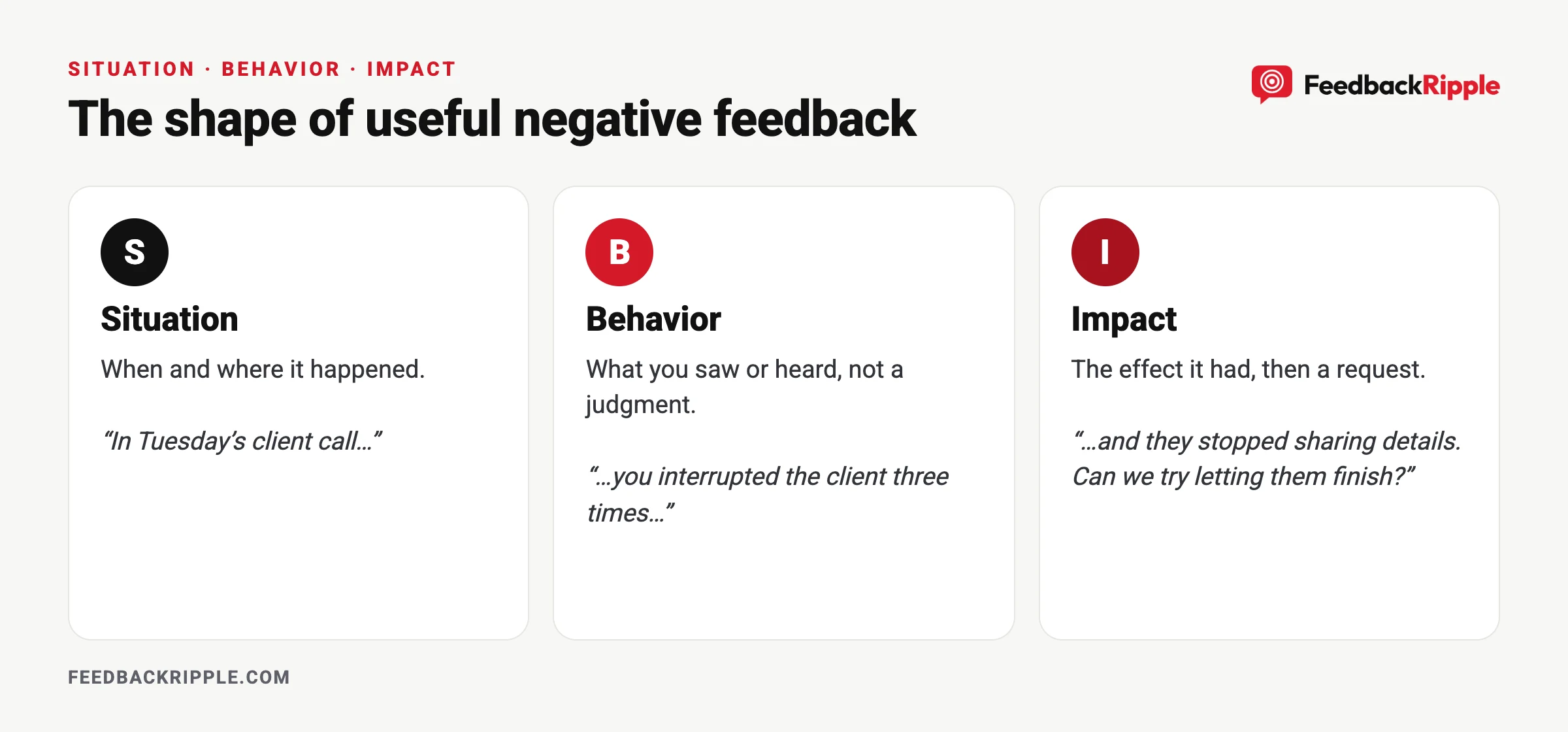
Most good examples follow the same three parts, usually called SBI:
- Situation: when and where it happened. “In Tuesday’s client call…”
- Behavior: what you saw or heard, without judgment. “…you interrupted the client three times…”
- Impact: the effect it had. “…and they stopped sharing details.”
Then add a request or a question: “Can we try letting them finish?” or “What was going on there?” That last part is what turns criticism into a conversation.
Negative feedback examples by situation
Missed deadlines
- “The report was due Monday and came in Thursday. Because of that, we sent the client our numbers late. What got in the way, and how can we avoid it next time?”
- “You’ve missed three of the last five sprint deadlines. I want to understand why before it affects the release.”
- “When you realize something will be late, please tell me that day. Finding out on the due date leaves us no options.”
- “The deadline itself moved twice without anyone being told. Can you flag changes in the project channel so that everyone can plan?”
Quality of work
- “The proposal had several numbers that didn’t match the appendix, and the client noticed. Can you add a second check before anything goes out?”
- “Your code works, but it had no tests, so the review took twice as long. Let’s agree tests are part of “done”.”
- “The design missed two of the requirements in the brief. Can we go through the brief together before you start the next one?”
- “The first draft was fine, but the final version still had the typos we flagged. I need the review comments addressed before it ships.”
Communication
- “In the update to the director, the key risk was in paragraph five. Can you lead with the main point next time?”
- “I didn’t hear about the supplier problem until the customer called me. I’d really prefer to hear bad news early, even if it’s incomplete.”
- “Your messages in the team channel have been quite short lately, and a couple of people read them as frustration. Is everything OK?”
- “You said yes to the extra work in the meeting, then told me afterwards you didn’t have time. I’d rather you push back in the room.”
Meetings and collaboration
- “In the last two retros you rejected ideas before people finished explaining them. Could you ask a question first?”
- “You joined the last three standups 10 minutes late, and we had to repeat updates. What would help you get there on time?”
- “You were on your phone for most of the planning session, and we missed your input on the estimates.”
- “You took over the client call without checking with Sam, who was leading it. Let’s agree roles before the next one.”
Attitude and behavior
- “When Lee raised the testing issue, you rolled your eyes. He noticed, and he didn’t speak again for the rest of the meeting.”
- “You’ve made a few jokes about the support team’s skills. Even if they’re meant lightly, they affect how people work with them.”
- “When things go wrong, I hear you blame other teams first. I’d like us to focus on what we can fix ourselves.”
- “You raised your voice at Priya in the corridor yesterday. That’s not OK here, whatever the pressure.”
Ownership and initiative
- “The bug was assigned to you for two weeks without an update. If you’re stuck, please say so, so that we can help.”
- “You flagged the problem, which I appreciate. But I also need you to suggest a fix, not just raise it.”
- “You waited for me to approve things that are within your role. You can decide on these yourself.”
Leadership and management
- “Two people on your team told me they don’t know what they’re working on next quarter. Can we look at how you share priorities?”
- “You tend to fix your team’s work yourself rather than explaining what’s wrong. They aren’t learning, and you’re working late.”
- “In your one-to-ones you mostly talk about status. Your team would benefit from time on their own growth too.”
- “You gave Mark’s feedback in front of the whole team. Please keep that kind of conversation private.”
Quieter problems in a team often only surface in anonymous feedback, given that people may not say them to a manager directly. If you’re collecting that kind of input, our 360 feedback examples show how peers and direct reports tend to phrase it.
Negative feedback examples by relationship
Manager to employee
- “I want to talk about the handover last Friday. Several tasks weren’t documented, and the weekend team spent hours working them out. Can we build a checklist?”
- “Your results are strong, but how you get there matters too. Three people have said they feel steamrolled in planning.”
- “I’ve noticed you’ve been less engaged in the last month: fewer ideas, cameras off, quick replies. I’m not judging, I just want to check in.”
Peer to peer
- “Can I share something? When you changed my slides without telling me, I presented numbers I didn’t recognize. Next time, can you message me first?”
- “I know we’re both busy, but I’ve been waiting on your review for a week. Could you give me a date?”
- “In the meeting, you said the delay was my team’s fault. I don’t think that’s accurate, and I’d like to sort it out between us.”
Employee to manager
Giving negative feedback upward takes more courage, so keep it specific and focused on the work (our page on upward feedback covers how to make it safe):
- “When priorities change on the same day, our team usually loses the work already done. Could we get a heads-up before changes are final?”
- “Our one-to-ones have been cancelled three times this month. They really matter to me. Could we protect them?”
- “In the team meeting, my idea was presented without my name. I’d appreciate credit when that happens.”
- “I’d find it easier to improve if feedback came during the project, not only at the review.”
For a remote or hybrid teammate
- “Your status in chat shows available, but messages often go unanswered for a day. Can we agree a response time?”
- “On calls, your camera is off when you present, so people lose focus. Could you turn it on for your part?”
- “Your written updates are long and the decision is hard to find. Could you put it in the first line?”
Negative feedback examples for performance reviews
In a review, negative feedback should describe a pattern and what needs to change, never a surprise. Typically, nothing here should be news to the person:
- “Ana’s work is accurate, but deadlines remain an area to improve: four of ten projects this year were late, usually without early warning. The goal for next year is to flag risks within a day.”
- “Tom’s technical skills are strong. He needs to develop how he gives feedback in code reviews, which several peers described as blunt and discouraging.”
- “Jess sometimes takes on too much and then misses commitments. We’ve agreed she’ll check capacity with me before accepting new projects.”
- “Raj needs to delegate more. His team’s growth has slowed because he still handles most client contact himself.”
Harsh vs useful: 8 negative feedback rewrites
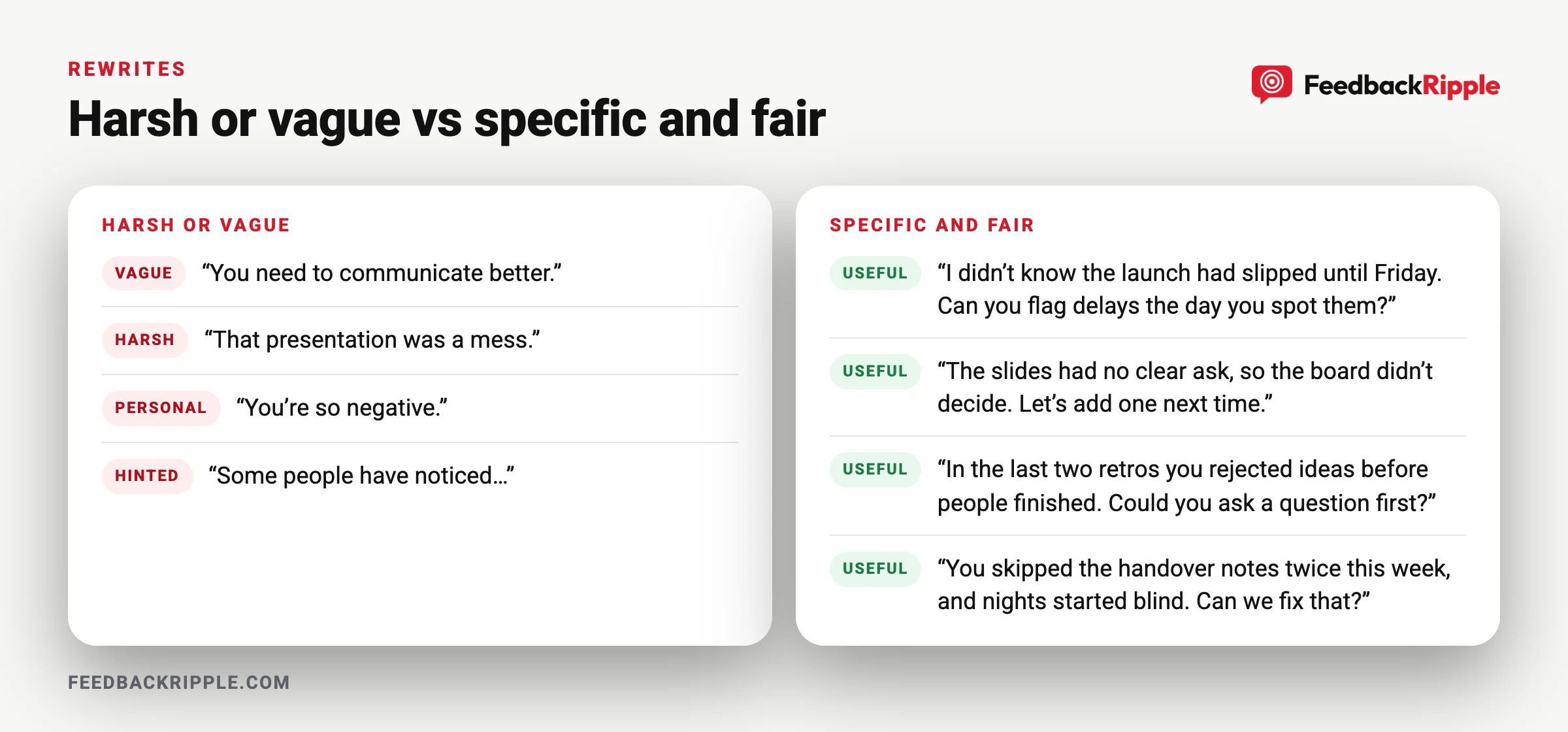
| Harsh or vague | Specific and useful |
|---|---|
| “Your work is sloppy.” | “The report had three wrong totals in section 2, so the client questioned the rest. Can you add a second check?” |
| “You’re never on time.” | “You joined the last three standups 10 minutes late, and we repeated updates. What would help?” |
| “You need to communicate better.” | “I didn’t know the launch had slipped until Friday. Can you flag delays the day you spot them?” |
| “That presentation was a mess.” | “The slides had no clear ask, so the board didn’t decide. Let’s add one next time.” |
| “You’re so negative.” | “In the last two retros you rejected ideas before people finished. Could you ask a question first?” |
| “Some people have noticed…” | “I noticed you skipped the handover notes twice this week, and nights started blind. Can we fix that?” |
| “You’re not a team player.” | “You declined to help with testing twice when we were behind. I need you to pitch in on release weeks.” |
| “You should be more confident.” | “You had the right answer in the meeting but didn’t share it. I’d really like you to speak up next time.” |
How to give negative feedback
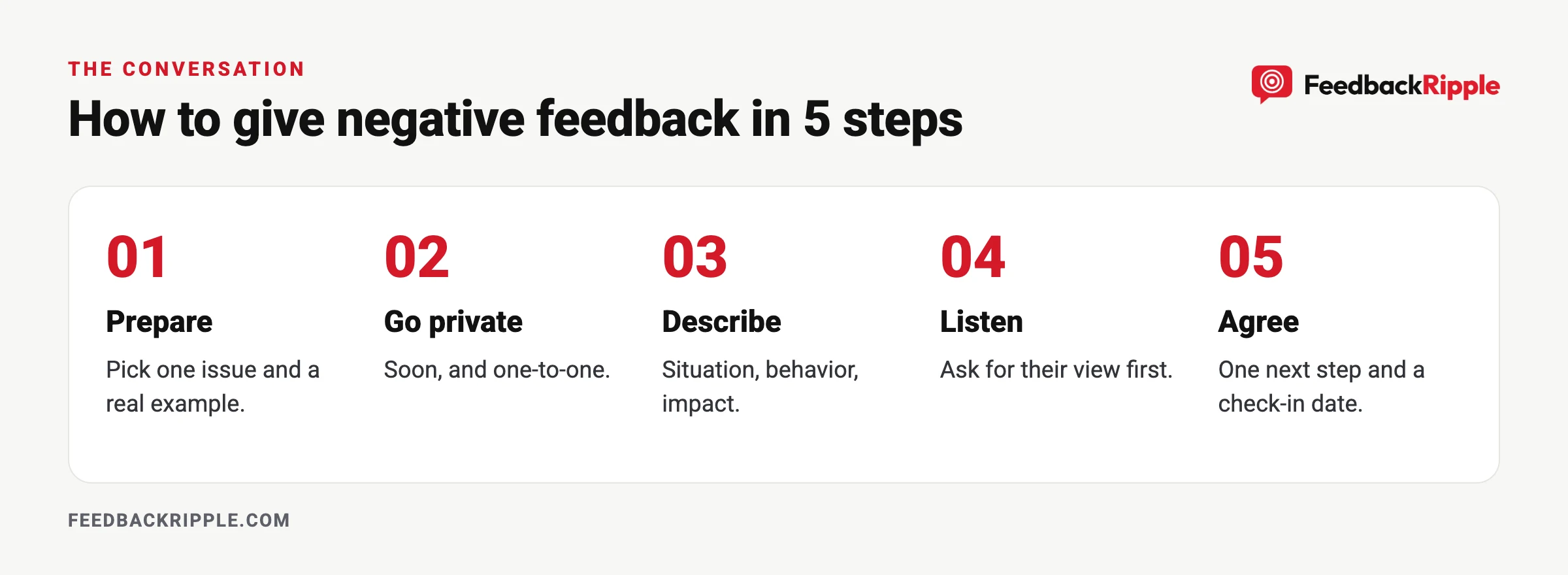
- Prepare. Pick one issue, not five, and have a real example ready.
- Go private, and go soon. Within a day or two, one-to-one. You have to give people the chance to respond without an audience.
- Describe it. Use situation, behavior and impact. Leave out labels like “lazy” or “difficult”.
- Listen. Ask for their view: “How did you see it?” There’s often context you don’t have.
- Agree a next step. One change, and a date to check in. Then actually check in.
Balance matters over time, not inside one conversation. If people hear plenty of specific praise (see our positive feedback examples), negative feedback tends to land as help rather than as a verdict.
To give you a concrete example, at FeedbackRipple, we don’t simply hand people a list of low scores. Their feedback report shows written comments from their manager, peers and direct reports, with peer and direct-report answers kept anonymous so that people can be honest about what needs to change.
Mistakes to avoid with negative feedback
- Waiting for the review. If the first time someone hears about a problem is in their annual review, the process has truly failed.
- The feedback sandwich. Hiding criticism between two compliments usually confuses the message and makes future praise feel suspicious.
- Speaking for others. “People are saying…” makes the person anxious and gives them nothing to act on. Share what you saw.
- Piling up issues. Ten points at once feels like an ambush. Pick the one or two that matter most.
- Doing it by email. Written criticism is easy to misread. Talk first, then follow up in writing.
And if you want a fuller method for both kinds of feedback, our guide on how to give 360 feedback walks through it step by step.
FeedbackRipple · First 3 people free
Get honest feedback people can act on
FeedbackRipple gathers anonymous feedback from the people around each person and turns it into a report with strengths, blind spots and what to try next. Your first 3 people are free.
The author

Venchito Tampon
Venchito Tampon is the Founder of FeedbackRipple, 360 feedback software that tells people what to do next. It helps executive coaches and HR and L&D teams run anonymous 360s, turn the results into clear guidance and follow through on development plans.
He is a Certified Executive Coach, certified by Symbiosis Coaching, an ICF-accredited coaching organization. He brings that coaching lens to FeedbackRipple: every report ends with clear next steps, not just charts.
He is also the CEO and Founder of eLearning Solutions Lab, a Philippines-based eLearning production company specializing in custom eLearning development and rapid eLearning solutions for global clients.
He founded Rainmakers Training & Consultancy, a corporate training and leadership development firm where he has trained and spoken at 250+ conventions, seminars, and workshops across the Philippines and internationally, including Singapore, Slovakia, and Australia. He has worked with top corporations including SM Hypermarket, Shell, and National Bookstore.
His other ventures include ExpirePilot, document expiration tracking software for small businesses, SharpRocket, a digital marketing and SEO company, and Hills & Valleys Cafe, a local café with available franchising.
He is a certified member of The Philippine Society for Talent Development (PSTD), the premier organization for Talent Development practitioners in the country, and an active Go Negosyo Mentor under the Mentor Me program.